
A spouse super contribution is an after-tax payment you make directly into your partner's complying super fund. It counts toward their non-concessional cap, and if your spouse earns under $40,000, you may claim a tax offset of up to $540 per year. That's the short version.
The immediate action: check three things before 30 June. First, your spouse's income (assessable income plus reportable fringe benefits plus reportable employer super contributions). Second, their total super balance against the general transfer balance cap, which is currently set for the income year in question. Third, whether the fund will actually receive the money before the financial year closes. Miss any one of these and the offset disappears.
Tools like Aerowealth let you model what a $3,000 contribution today compounds into at retirement, so the decision isn't just about the $540 you save this year.
Quick eligibility snapshot:
- Spouse's income below the applicable income threshold
- Both you and your spouse are Australian residents when the contribution is made
- You are living together (not permanently separated)
- Spouse's total super balance is below the general transfer balance cap at the start of the income year
- Contribution is non-deductible to you
- Spouse meets the age requirement applicable for the income year
Table of Contents
- Two ways to move money into your spouse's super
- Who qualifies for the spouse contribution tax offset
- How to make a spouse super contribution and claim the offset
- Caps, timing, and balance checks before you contribute
- Direct spouse contributions vs. contributions-splitting: which one fits your situation
- Who actually benefits from spouse super contributions
- How Aerowealth models a $3,000 spouse contribution
- Key Takeaways
- The Aerowealth team's view on spouse contributions
- See your retirement numbers before you decide
- Useful sources and further reading
- FAQ
Two ways to move money into your spouse's super
There are two legally distinct methods, and they work very differently. Confusing them is one of the most common mistakes people make.
Direct spouse contribution is straightforward: you transfer after-tax money directly into your spouse's super fund. The fund treats it as your spouse's non-concessional contribution. This is the method that qualifies for the spouse contribution tax offset. No forms to lodge with the ATO — you just pay the fund, notify them it's a spouse contribution, and claim the offset in your own tax return.
Contributions-splitting is a different animal. Here, you ask your own fund to transfer a portion of your concessional contributions (employer contributions, salary sacrifice, or deductible personal contributions) to your spouse's account. The ATO treats this as a rollover, not a new contribution. That means no spouse contribution tax offset. It also means the split doesn't touch your spouse's non-concessional cap, which is the key structural advantage.
The administrative difference matters too. For splitting, you apply using the Superannuation contributions splitting application (NAT 15237) or your fund's own equivalent form, typically after the end of the income year. Trustees have discretion to accept or reject the application, and they'll check that the amount falls within splittable component rules.
- Direct spouse contribution: uses spouse's non-concessional cap, qualifies for tax offset, pay anytime before 30 June
- Contributions-splitting: uses your concessional contributions, no tax offset, apply after year-end, trustee approval required
Pro Tip: If you plan to claim a tax deduction for a personal contribution and also split it with your spouse, lodge your Notice of Intent to Claim a Deduction before you submit the splitting application. Doing it in the wrong order can invalidate both the deduction and the split.
Who qualifies for the spouse contribution tax offset
The tax offset calculation is 18% of the eligible contribution, capped at $3,000, giving a maximum offset of $540. But getting to that $540 requires clearing a checklist first.
Eligibility checklist:
- Married or de facto relationship, living together (not permanently separated)
- Both you and your spouse are Australian residents at the time of contribution
- Contribution is non-deductible to you (you can't claim it as an employer contribution)
- Spouse is under 75 at the time of contribution
- Spouse's total super balance is below the general transfer balance cap at the start of the income year
- Spouse's non-concessional contributions for the year have not exceeded their cap
How the offset calculates:
The eligible contribution amount is $3,000, reduced by $1 for every $1 your spouse's income exceeds $37,000. Once spouse income hits $40,000, the eligible amount drops to zero and the offset disappears entirely.
| Spouse income | Eligible contribution | Tax offset (18%) |
|---|---|---|
| Below the lower threshold | Maximum eligible contribution | Maximum offset |
| Between thresholds | Reduced eligible contribution | Reduced offset |
| At or above upper threshold | No eligible contribution | No offset |
One thing that trips people up: you cannot claim the offset for contributions you made to your own fund and then split to your spouse. That's a rollover, not a spouse contribution, and the offset rules don't apply to it.
The offset is also non-refundable. If your tax liability for the year is less than $540, you only get the benefit up to what you owe. You won't receive a cash refund for the unused portion.
Key figure: Contribute $3,000 when your spouse earns $37,000 or less and you save exactly $540 in tax that year — the maximum the law allows.
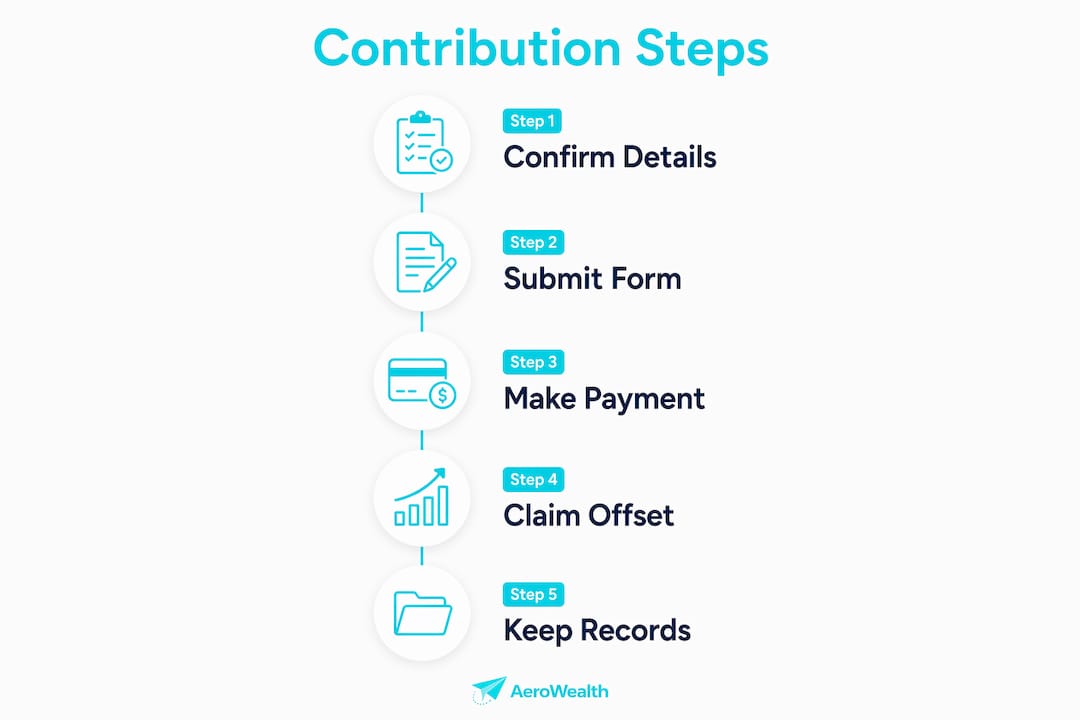
How to make a spouse super contribution and claim the offset
Step 1: Confirm fund payment details
Contact your spouse's fund or log into their member portal to get the correct BPAY biller code and reference number, or the EFT details for spouse contributions. AustralianSuper provides a dedicated spouse contribution form (PDF) that includes payment instructions and the correct reference to use so the fund codes it correctly.

Step 2: Submit any required fund form
Many funds require you to complete a spouse contribution form before or alongside payment. This tells the fund the money is a spouse contribution (not a personal contribution from your spouse). Without this, the fund may allocate it incorrectly, which creates a recordkeeping headache at tax time.
Step 3: Make the payment before 30 June
Transfer the funds via BPAY or EFT. Keep the transaction reference, date, and confirmation. The fund must receive the money by 30 June for it to count in that financial year. Initiating a BPAY on 30 June doesn't guarantee same-day receipt — many payments post the next business day.

Step 4: Claim the offset in your tax return
myTax includes a dedicated section for spouse super contributions. It asks for your spouse's assessable income, reportable employer super contributions, and the contribution amount, then calculates the offset automatically. You don't need to do the math yourself.
Step 5: Keep your records
Retain the following for at least five years (in line with ATO guidance on tax record retention):
- Payment receipt or bank confirmation
- Fund's written acknowledgment that the contribution was received as a spouse contribution
- Evidence of your spouse's income for that year (payment summary or income statement)
Pro Tip: Screenshot the fund's confirmation page immediately after payment. Funds occasionally reclassify contributions if the form wasn't submitted, and having a timestamped confirmation protects your offset claim.
For contributions-splitting, the process is different. You apply to your own fund using NAT 15237 (or the fund's equivalent) after the income year ends. The fund then transfers the approved amount to your spouse's account as a rollover.
Caps, timing, and balance checks before you contribute
Getting the contribution right means checking three numbers before you transfer anything.
Non-concessional cap: A direct spouse contribution uses your spouse's non-concessional cap, not yours. The non-concessional cap is subject to annual legislative limits applicable for each income year. If your spouse has already made or received non-concessional contributions close to that limit, an additional $3,000 could push them over, which triggers excess contribution tax. The bring-forward rule can allow up to three years' worth of contributions in one year, but it also locks in the cap for the following two years, so timing matters.
Transfer balance cap check: Your spouse's total super balance must be below the general transfer balance cap immediately before the start of the income year. For 2025–26, that cap is $2 million. If their balance equals or exceeds that figure, you cannot claim the offset at all, regardless of their income.
Timing: The fund must receive the contribution by 30 June. This is a hard rule, not a guideline.
| Common mistake | Consequence |
|---|---|
| Contributing more than $3,000 expecting a larger offset | Offset stays capped at $540; excess still goes into spouse's super but generates no extra tax benefit |
| BPAY initiated on 30 June, posts 1 July | Contribution counts in the next financial year; offset lost for current year |
| Spouse's non-concessional cap already used | Excess contribution tax applies to the spouse |
| Spouse's total super balance at or above $2 million | No offset available, regardless of income |
- Check your spouse's total super balance in their fund portal before contributing
- Confirm the fund's cut-off time for same-day BPAY processing
- If your spouse has already made personal contributions this year, add them up before adding yours
Deadline reminder: Last-minute BPAYs frequently post in the next financial year. The ATO is clear that the fund must receive the money by 30 June — not that you must send it.
Direct spouse contributions vs. contributions-splitting: which one fits your situation
Both methods move money toward your spouse's retirement. They serve different goals.
Direct spouse contributions — pros and cons:
- Qualifies for the spouse contribution tax offset (up to $540)
- Simple to execute: pay the fund, complete a form, claim in myTax
- Uses your spouse's non-concessional cap — watch the $120,000 annual limit
- Works best when your spouse has low income and hasn't used much of their non-concessional cap
Contributions-splitting — pros and cons:
- No tax offset, but doesn't touch your spouse's non-concessional cap
- Good for equalizing balances when your spouse has a large non-concessional cap already used
- Trustee approval required; not all funds accept splits for all contribution types
- You can split up to 85% of taxed concessional contributions (employer and deductible personal contributions) made in the previous financial year
| Feature | Direct spouse contribution | Contributions-splitting |
|---|---|---|
| Tax offset available | Yes (up to $540) | No |
| Cap affected | Spouse's non-concessional cap | Your concessional cap |
| When to apply | Before 30 June | After income year ends |
| Form required | Fund spouse contribution form | NAT 15237 or fund equivalent |
| Trustee discretion | No | Yes |
| Counts as new contribution | Yes (for spouse) | No (treated as rollover) |
Decision checklist:
- Spouse income under $40,000 and non-concessional cap not near limit? Use direct spouse contribution.
- Want to equalize balances without affecting spouse's non-concessional cap? Consider splitting.
- Planning to claim a deduction on a personal contribution you also want to split? Lodge the Notice of Intent first.
Pro Tip: Contributions-splitting is not automatic. Some funds require evidence that your spouse meets the age conditions (under preservation age, or between preservation age and 65 and not retired). Check your fund's requirements before applying.
Who actually benefits from spouse super contributions
The $540 offset sounds modest, but the real value often isn't the tax saving — it's what that $3,000 does inside super over 20 or 30 years.
Profiles that benefit most:
- Non-working spouses or carers with little or no super of their own
- Couples with a large super balance gap approaching retirement
- Households where one partner earns above the super guarantee threshold but the other doesn't
- Couples wanting to improve Age Pension eligibility by distributing super more evenly between partners
Worked example 1 — full offset: Partner A earns $90,000. Spouse earns $32,000. Partner A contributes $3,000 to the spouse's fund. Spouse income is below $37,000, so the full $540 offset applies. That $3,000 inside super, compounding at a conservative rate over 25 years, grows substantially more than the after-tax equivalent sitting in a savings account.
Worked example 2 — offset phases out: Same couple, but the spouse picks up extra work and earns $39,000 that year. The eligible contribution drops to $1,000, and the offset falls to $180. Still worth doing for the balance-building, but the immediate tax benefit is reduced.
Non-obvious considerations:
- The offset is non-refundable. If your tax bill is $200, you get $200 of offset, not $540.
- Spouse contributions still count toward the recipient's non-concessional cap. If your spouse is using the bring-forward rule, an extra $3,000 could complicate the three-year window.
- Spouse contributions can stack with the government co-contribution if your spouse also makes personal after-tax contributions and earns below the co-contribution threshold. Both incentives can apply in the same year.
- Super balances affect Age Pension means-testing. Equalizing balances between partners can sometimes improve combined pension entitlements, though this depends on each partner's age and the specific asset test rules.
Before deciding, confirm:
- Spouse's exact income for the year (including reportable fringe benefits)
- Spouse's current total super balance
- Whether you need the immediate $540 offset or are primarily focused on long-term balance equalization
- Whether your spouse has already used part of their non-concessional cap this year
How Aerowealth models a $3,000 spouse contribution
Numbers on a page are one thing. Seeing what $3,000 becomes at retirement is another.
Here's a simplified scenario to illustrate the compounding effect:
Scenario setup:
- Contributor age: 40
- Spouse age: 38
- Annual spouse contribution: $3,000 (after-tax, non-concessional)
- Assumed net return inside super: 7% per year
- Time horizon: 27 years to retirement at 65
- No additional spouse contributions modeled beyond this single year
| Outcome | Without $3,000 contribution | With $3,000 contribution |
|---|---|---|
| Contribution year tax saving | — | $540 (offset) |
| Projected value at retirement (27 yrs, 7%) | Baseline | Baseline + ~$17,600 |
| Annual retirement income impact | Baseline | Modestly higher |
The $540 offset is the immediate win for those exploring retirement income from life insurance, adding an important dimension to your retirement planning. The ~$17,600 compounded difference is the reason financial planners treat spouse contributions as a long-term strategy, not just a tax trick.
What Aerowealth adds: Rather than a static table, Aerowealth lets you input your actual ages, current balances, contribution amounts, and assumed returns, then shows projected retirement balances and income side by side across multiple scenarios. You can compare "contribute $3,000 now" vs. "contribute $3,000 every year for 10 years" vs. "do nothing" in the same view.
- Assumptions above are illustrative; actual returns vary and are not guaranteed
- The 7% figure is used for demonstration only; Aerowealth lets you stress-test different return assumptions
- Tax on earnings inside super (15%) is not reflected in this simplified snapshot
Compounding note: The long-term balance impact of a spouse contribution typically dwarfs the annual tax offset. The $540 is the incentive; the compounding is the payoff.
Key Takeaways
A spouse super contribution of $3,000 earns a tax offset of up to $540 when your spouse earns $37,000 or less, and the compounding effect inside super makes it a strong long-term strategy for couples with unequal balances.
| Point | Details |
|---|---|
| Maximum tax offset | 18% of up to $3,000 = $540; only available when spouse income is below $40,000. |
| Balance cap check | Spouse's total super balance must be below $2 million at the start of the income year. |
| Deadline is firm | The fund must receive the contribution by 30 June; late BPAYs post in the next financial year. |
| Splitting vs. direct | Direct contributions qualify for the offset; contributions-splitting does not, but avoids the non-concessional cap. |
| Model before you contribute | Aerowealth lets you compare scenarios side by side to see the long-term retirement impact of spouse contributions. |
The Aerowealth team's view on spouse contributions
Spouse super contributions are one of the most underused levers in Australian retirement planning. The $540 offset gets most of the attention, but the real argument for making these contributions consistently is balance equalization. Couples who retire with wildly different super balances often leave Age Pension entitlements on the table, pay more tax in drawdown than they need to, and have less flexibility in how they structure retirement income. A few thousand dollars a year directed into a lower-balance spouse's fund, compounding inside a concessional tax environment, can shift those outcomes meaningfully over a decade.
What we see in Aerowealth's scenario modeling is that people consistently underestimate the compounding effect and overestimate the complexity. The administration is genuinely straightforward for direct contributions. Where it gets complicated is when couples try to combine spouse contributions with bring-forward strategies, contributions-splitting, and personal deductible contributions in the same year without mapping the interactions first. That's exactly the kind of multi-variable problem a side-by-side scenario comparison handles well. Running the numbers before 30 June, rather than after, is the difference between a deliberate strategy and a reactive one. For couples thinking about retirement income strategies, spouse contributions deserve a place in the plan early, not as an afterthought.
See your retirement numbers before you decide
Spouse contributions are simple in principle and surprisingly powerful in practice. What's harder is knowing whether $3,000 now, or $3,000 every year, or a different amount entirely, is the right call for your specific situation.

Aerowealth's free plan lets you model exactly this. Enter your ages, current super balances, contribution amounts, and time horizon, and the platform shows projected retirement balances and income side by side. You can run a "spouse contribution every year" scenario against a "concessional top-up only" scenario and see which one produces better outcomes for your household, without a spreadsheet or a financial adviser appointment. The Pro plan adds bridge-year modeling for early retirement, stress-testing of return assumptions, and a higher AI assistant quota for questions about how Australian rules apply to your numbers.
If your spouse's balance is near the cap, or you're considering combining spouse contributions with a bring-forward strategy, start with a free scenario in Aerowealth before the 30 June deadline.
Useful sources and further reading
The following primary sources support the claims and calculations in this article:
- ATO: Spouse super contributions — eligibility rules, income thresholds, and offset calculation
- ATO: Superannuation-related tax offsets — confirms the rollover exclusion and non-refundable nature of the offset
- ATO: Contributions splitting for members — NAT 15237 process, trustee discretion, and rollover treatment
- ATO: myTax 2025 — spouse super contributions — how to claim the offset in your tax return
- AustralianSuper: Spouse contribution form (PDF) — fund-specific payment instructions and BPAY reference details
- AusTax.tools: Spouse super contribution tax offset explainer — worked examples, common pitfalls, and stacking strategies
- QSuper: Spouse contributions — fund-level eligibility summary and payment options
- Moneysmart: Super contributions — plain-English overview of contribution types
- Aerowealth: Super contributions cap guide — non-concessional and concessional cap details and bring-forward rules
| Source | Best for |
|---|---|
| ATO spouse contributions page | Eligibility checklist and offset calculation |
| ATO myTax instructions | Claiming the offset in your tax return |
| AustralianSuper spouse form | Fund payment process and BPAY details |
| AusTax.tools explainer | Worked examples and common mistakes |
| Aerowealth cap guide | Non-concessional cap and bring-forward planning |
This article is general information only and does not constitute financial or tax advice. Confirm current rules with the ATO or a qualified financial adviser for your own situation.
FAQ
How much can I contribute to my spouse's super?
There's no specific cap on the amount you can contribute to your spouse's super, but the contribution counts toward their non-concessional cap ($120,000 for 2025–26). The tax offset only applies to the first $3,000 contributed, giving a maximum offset of $540.
What is the spouse super contribution tax offset for 2025–26?
The offset is 18% of eligible contributions up to $3,000, capped at $540. The full $540 applies when your spouse earns $37,000 or less; it phases out completely at $40,000.
Is a spouse super contribution worth it?
For most couples with an income gap, yes. The $540 offset is modest, but the long-term compounding effect inside super and the potential improvement to Age Pension eligibility through balance equalization often make it worthwhile well beyond the immediate tax saving.
How do I make a spouse contribution to Australian super?
Get the fund's BPAY or EFT details for spouse contributions, complete any required fund form (such as the AustralianSuper spouse contribution form), transfer the funds before 30 June, then claim the offset in your tax return via the dedicated spouse super contribution section in myTax.
Can I split my super contributions with my spouse instead?
Yes, using the Superannuation contributions splitting application (NAT 15237). However, contributions-splitting is treated as a rollover and does not qualify for the spouse contribution tax offset. It's a separate strategy suited to equalizing balances without affecting your spouse's non-concessional cap.