
Australia's version of an individual retirement account is superannuation, a mandatory, employer-funded savings system that works very differently from the voluntary IRAs Americans know. Under the Superannuation Guarantee, employers must contribute 11.5% of wages to a super fund on your behalf. That money grows inside the fund, where investment earnings are taxed at a capped rate, and withdrawals are generally tax-free once you turn 60. When you retire, your accumulated super balance converts into a retirement income account, most commonly an account-based pension, that pays you a regular income. Australian superannuation and US-style IRAs are governed by entirely separate tax and regulatory frameworks, and rollovers between the two systems are generally prohibited.
- Super is compulsory; US IRAs are voluntary
- Employer contributions are legislated, not optional
- Withdrawals from age 60 are usually tax-free
- Post-retirement income flows through account-based pensions, not lump sums alone
- Retirement Savings Accounts (RSAs) also exist as capital-guaranteed products but are far less common
How to check, manage, and grow your superannuation balance
Knowing your super balance is the first step in any serious retirement plan. You can check it through your fund's online portal or directly via the ATO's myGov service, which also shows any lost or unclaimed super sitting in other accounts.
Consolidating multiple super accounts is one of the highest-return moves you can make before retirement. Every account charges fees, and carrying three funds from three jobs quietly erodes your balance over decades. Merging them into one fund takes about 10 minutes online and costs nothing.
Voluntary contributions are the other lever. You can top up super through salary sacrifice (concessional contributions, taxed at 15% inside the fund) or after-tax deposits (non-concessional contributions). For 2025–26, the concessional contributions cap sits at $30,000 AUD per year, covering both employer and personal pre-tax contributions. Non-concessional contributions have a separate, higher cap. Exceeding either cap triggers additional tax, so tracking your totals matters.
- Log in to myGov to find lost super across all funds
- Consolidate accounts before fees compound over years
- Use salary sacrifice to reduce taxable income while boosting super
- Check your fund's investment option: the default "balanced" option suits many people, but higher-growth options may suit those with 10-plus years until retirement
- Review fund fees annually; even a 0.5% difference in fees compounds significantly over 20 years
Pro Tip: Switch your super fund's investment option to a higher-growth allocation at least 10 years before your target retirement date, then shift gradually to a more conservative mix as you approach it. Most funds let you do this online in under five minutes.
What types of retirement income accounts exist in Australia?
Once you retire, your super balance does not just sit there. You convert it into a retirement income product, and the most common choice is an account-based pension, sometimes called an allocated pension.

An account-based pension pays you a regular income drawn from your super balance. You choose how much to receive each year, subject to a government-mandated minimum withdrawal percentage based on your age. There is no maximum, so you can draw more if needed. Investment earnings inside the account are tax-free, and payments from age 60 attract no income tax. The catch is longevity risk: the account lasts only as long as the money does, with no guaranteed income for life.
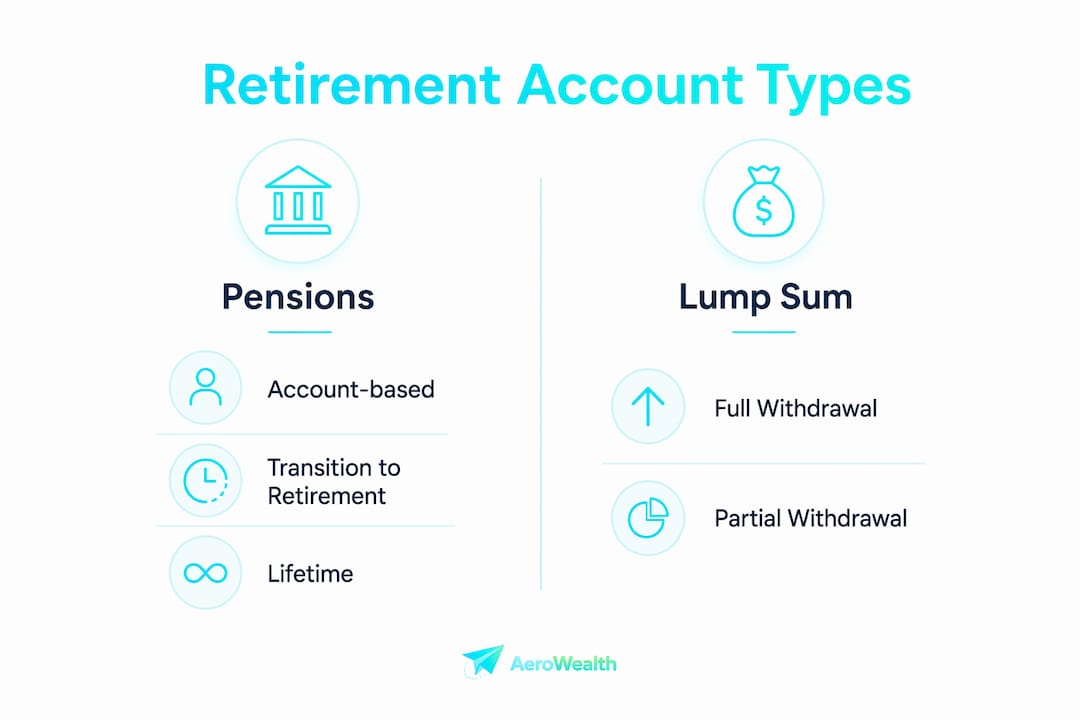
A Transition to Retirement Income Stream (TRIS) is a different option for people who have reached preservation age but are not yet fully retired. A TRIS lets you draw income from super while still working, capped at 10% of your account balance per year. It is useful for reducing work hours without a sharp income drop. Once you meet a full condition of release, such as reaching age 65 or formally retiring, the TRIS moves into the retirement phase and the 10% cap lifts.
| Account type | Who it suits | Tax on payments | Withdrawal flexibility |
|---|---|---|---|
| Account-based pension | Fully retired, age 60+ | Tax-free from age 60 | Flexible, above annual minimum |
| TRIS | Still working, preservation age reached | Tax-free from age 60 | Capped at 10% of balance per year |
| Lump sum withdrawal | One-off needs | Tax-free from age 60 | Full balance available |
| Retirement Savings Account (RSA) | Risk-averse savers | Standard super tax rules | Capital guaranteed, lower returns |
You can also take a lump sum from super at retirement, either in full or in part alongside a pension. Many retirees combine a partial lump sum to pay off a mortgage with an account-based pension for ongoing income.
How much super do you actually need, and what are the tax rules?
A common question is whether $700,000 in super is enough to retire. The honest answer depends on your lifestyle, your age at retirement, and whether you qualify for the Age Pension. To generate a certain level of annual income, you generally need a balance large enough that your investment returns and drawdowns sustain that level over your expected retirement duration. A financial planner or a retirement projection tool can model this precisely for your situation, factoring in fees, returns, and inflation.
Tax treatment is one of super's biggest advantages. Withdrawals after age 60 are tax-free regardless of the amount. Between ages 55 and 59, the taxable component of pension payments is taxed at your marginal rate less a 15% tax offset. Concessional contributions are taxed at 15% inside the fund, which is well below the marginal rate most working Australians pay. Understanding your super's tax components (taxable versus tax-free) before you start drawing down can save a meaningful amount.
- Concessional contributions: taxed at 15% inside the fund, capped at $30,000 AUD per year
- Non-concessional contributions: after-tax money, no tax inside the fund, separate annual cap
- Withdrawals from age 60: generally tax-free
- Withdrawals aged 55–59: taxable component taxed at marginal rate less 15% offset
- Super balance affects Age Pension eligibility through both the assets test and the income test
Getting your tax position right before you start drawing super can make a real difference to what you actually keep.
How does the Age Pension fit into your retirement plan?
The Age Pension is a means-tested government payment that supplements super income for eligible Australians. Eligibility depends on your age, your assets, and your income. Your account-based pension counts toward both the assets test and the income test, so a larger super balance can reduce or eliminate your Age Pension entitlement.
That interaction cuts both ways. Retirees with modest super balances often receive a partial or full Age Pension, which meaningfully extends how long their super lasts. Retirees with larger balances may receive nothing from the Age Pension but benefit from tax-free super income instead.
- Age Pension age is currently 67 for most Australians
- Both assets and income tests apply; failing either test reduces payments
- Account-based pensions opened before January 1, 2015 may be assessed differently under grandfathering rules
- Commonwealth Seniors Health Card provides concessions on health costs for self-funded retirees who do not qualify for the Age Pension
- Specialist retirement advice firms help Australians maximize entitlements and navigate the application process
Pro Tip: If you are close to the assets test threshold, timing when you draw lump sums from super can shift your assessed balance and affect Age Pension payments. Model this before you act.
How Aerowealth helps you model your Australian retirement plan

Spreadsheets break down fast when you are juggling super, an investment property, a mortgage offset account, and an uncertain retirement date. Aerowealth is built specifically for this problem. It lets you run side-by-side scenario comparisons across different retirement ages, contribution levels, and income strategies, all within Australian tax and superannuation rules.
The platform models bridge years for people planning to retire before their super preservation age, which is a gap most generic tools ignore entirely. Stress-testing assumptions, like a lower investment return or a higher drawdown rate, takes seconds rather than hours. Aerowealth's planning success rate reaches up to 94%, and its AI assistant explains projections in plain language rather than financial jargon.
For anyone serious about retirement savings planning, combining a tool like Aerowealth with periodic professional advice gives you both the clarity to make decisions and the confidence that the numbers behind them are right.

Start modeling your retirement income today at Aerowealth and see exactly where your super, investments, and income streams take you.
Key Takeaways
Superannuation is Australia's mandatory individual retirement savings system, and understanding how it interacts with account-based pensions, contribution caps, and the Age Pension is the foundation of any effective retirement plan.
| Point | Details |
|---|---|
| Employer contributions are mandatory | The Superannuation Guarantee requires employers to contribute 11.5% of wages to your super fund. |
| Withdrawals are tax-free from age 60 | Pension payments and lump sums from super are generally tax-free once you turn 60. |
| Account-based pensions carry longevity risk | Your pension lasts only as long as your balance does; there is no guaranteed income for life. |
| Contribution caps limit annual deposits | Concessional contributions are capped at $30,000 AUD per year; exceeding this triggers extra tax. |
| Age Pension eligibility depends on assets and income | Your account-based pension balance counts toward both tests and can reduce government payments. |