
Preparing to retire is the process of organizing your finances, income streams, and lifestyle to support a stable, fulfilling life after paid work ends. For Australians approaching this milestone, retirement planning means far more than checking your superannuation balance. It requires aligning your savings with the ASFA Retirement Standard, understanding Age Pension eligibility, managing tax exposure under 2026 legislation, and designing a drawdown strategy that lasts 20–30 years. The decisions you make in the five years before retirement carry more weight than almost any other financial choices in your life.
How much money do you need to retire comfortably in Australia?
The ASFA Retirement Standard sets the clearest benchmark for retirement readiness in Australia. According to the Q1 2026 figures, homeowner couples aged 65 and over need approximately $77,375 per year for a comfortable retirement lifestyle. That number reflects real spending on health, leisure, and household costs, not a padded estimate.
For singles, the super balance target for a comfortable retirement sits at $630,000, while couples need around $730,000. A modest retirement requires far less, with singles needing approximately $110,000 in super when combined with the Age Pension. The gap between comfortable and modest is significant, and it shapes every savings decision you make now.
Home ownership changes the math considerably. Retirees who own their home outright face lower essential costs and need less capital to sustain the same lifestyle. Renters, by contrast, must build a larger super balance to cover ongoing housing costs that homeowners do not carry.
Pro Tip: Use the ASFA figures as a floor, not a ceiling. Add a 10–15% buffer for healthcare inflation and unexpected costs, which tend to rise sharply after age 75.
| Retirement type | Annual budget | Super balance needed (single) |
|---|---|---|
| Comfortable (homeowner) | ~$77,375 | ~$630,000 |
| Modest (homeowner) | Lower threshold | ~$110,000 |
| Comfortable (couple) | Higher combined | ~$730,000 |
Most Australians overestimate how much they need, often fixating on $1 million as a magic number. Combining super with the Age Pension safety net means a modest but comfortable lifestyle is achievable on significantly less, provided you plan the income streams carefully.
What strategies make retirement savings last 20–30 years?
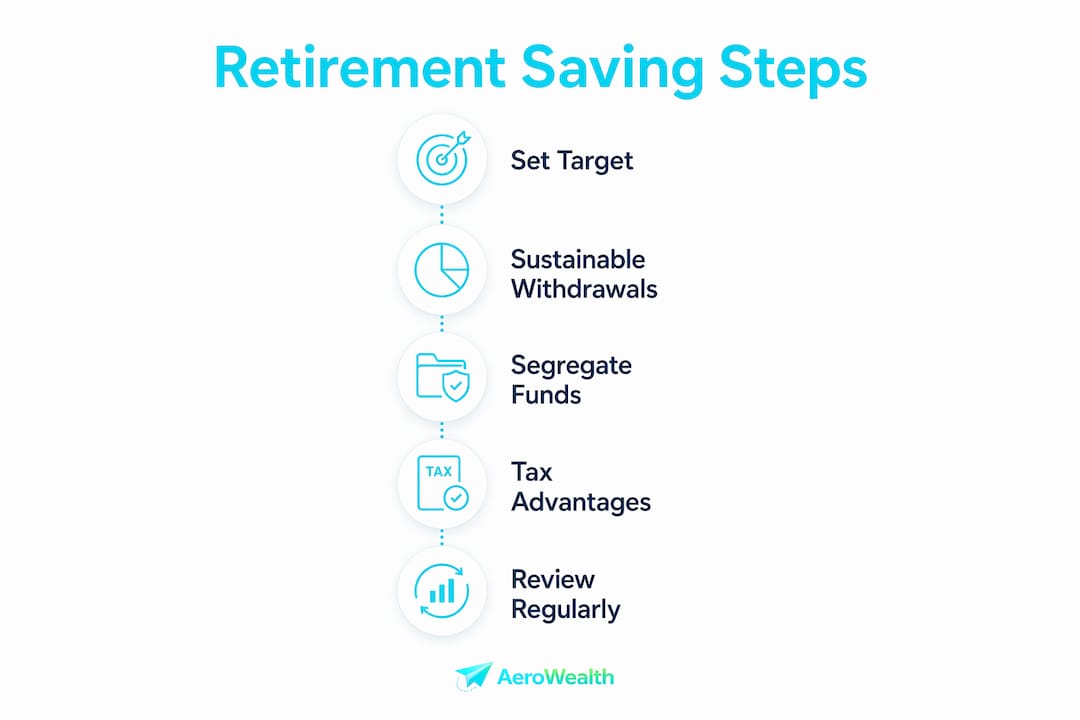
Sustainable withdrawal rates are the foundation of long-term retirement income planning. Financial experts recommend an initial withdrawal rate of between 3.8% and 4.2% of your opening retirement balance, adjusted each year for inflation. On a $630,000 balance, that translates to roughly $23,940–$26,460 per year from super alone, supplemented by the Age Pension.
Withdrawing too much in the early years creates sequencing risk. A market downturn in year two of retirement, combined with high withdrawals, permanently reduces the capital base you need for decades ahead. The damage is asymmetric: recovering from early losses is far harder than avoiding them.
The bucket strategy addresses this risk directly:
- Short-term bucket (0–2 years): Cash and term deposits covering living expenses. No market exposure.
- Medium-term bucket (3–7 years): Defensive assets like bonds and hybrid securities. Moderate growth.
- Long-term bucket (8+ years): Growth assets including Australian and international equities. Higher volatility, higher return potential.
Segregating funds this way reduces the pressure to sell growth assets during downturns. You draw from the short-term bucket while the long-term bucket recovers, protecting your overall capital.
Account-based pensions add a powerful tax advantage to this structure. Super earnings and withdrawals are tax-free after age 60, within a $1.9 million transfer balance cap. That tax efficiency materially extends how long your money lasts compared to drawing income from taxable accounts.
The 2026 interest rate environment has also shifted asset allocation preferences toward defensive assets. Term deposits and bonds now offer yields that were unavailable three years ago, making a more conservative portfolio both safer and more productive than it was in the low-rate era.
Pro Tip: Review your withdrawal rate every two years, not annually. Frequent adjustments based on short-term market moves often do more harm than a steady, inflation-adjusted drawdown plan.
How do government benefits and tax rules affect your retirement plan?
The Age Pension provides a baseline income safety net, but it averages $31,223 per year for singles. That figure has not kept pace with rising living costs, which means superannuation carries more of the income burden than it did a decade ago.
Eligibility for the Age Pension depends on both an assets test and an income test. The income test uses deeming rates to calculate assumed earnings on your financial assets. Higher deeming rates in 2026 increase your assessed income, which can reduce or eliminate your pension entitlement even if your actual investment returns are lower. This is a trap many retirees do not anticipate.
Key rules to factor into your retirement plan:
- Age Pension age: Currently 67 for most Australians. Eligibility requires meeting residency and means test criteria.
- Assets test thresholds: Exceeding these thresholds reduces your pension by $3 for every $1,000 over the limit.
- Division 296 tax: From july 2026, super balances over $3 million attract an additional 15% tax on earnings. Balances over $10 million face an additional 25% tax.
- Concessional contributions cap: Set at $30,000 per year, this limits how much you can add to super at the concessional tax rate before retirement.
Timing your super withdrawals relative to Age Pension eligibility creates real income advantages. Drawing down super before age 67 can reduce your assessable assets, improving your pension entitlement once you reach eligibility age. This coordination between super and the pension is one of the most underused strategies in Australian retirement planning.
Retirement planning must shift beyond accumulation to actively managing income streams, balancing government support, personal savings, and tax efficiencies. The accumulation mindset that served you well during your working years becomes a liability in retirement if it stops you from drawing down strategically.
What lifestyle adjustments should you make when preparing to retire?
Financial readiness is only half the picture. Retirees who plan their lifestyle with the same rigor they apply to their finances report far greater satisfaction in the years after work ends.
Start by categorizing your expected expenses into three groups:
- Essential expenses: Rent or rates, utilities, groceries, healthcare, and transport. These are non-negotiable and must be covered by reliable income streams.
- Lifestyle expenses: Travel, dining, hobbies, and social activities. These are important for wellbeing but can be scaled if income tightens.
- Aspirational expenses: Major trips, gifts to family, or property purchases. These require surplus capital and should be planned as one-off events, not ongoing costs.
Classifying spending this way prevents the common mistake of treating all expenses as equally fixed. When markets fall or health costs rise, retirees with a clear expense hierarchy adjust more easily than those who have not thought it through.
Downsizing the family home is one of the most effective ways to boost retirement cash flow. Selling a larger property and moving to a smaller one frees up capital, reduces maintenance costs, and can contribute to your super balance under the downsizer contribution rules. The timing matters: downsizing too early can affect Age Pension eligibility if the proceeds push your assessable assets above the threshold.
Healthcare costs deserve a dedicated budget line. Medical expenses tend to increase significantly after age 75, and private health insurance premiums rise with age. Building a healthcare reserve into your retirement plan, separate from your general living budget, prevents these costs from eroding your lifestyle spending.
Part-time work or consultancy income in the early retirement years can extend the life of your super balance considerably. Even modest earned income reduces the withdrawal rate you need from super, giving your investments more time to compound. Many Australians find that a gradual transition, rather than a hard stop, also supports better mental health and social connection in the early retirement phase. The transition to retirement calculator from Aerowealth helps you model exactly how different work-to-retirement timelines affect your long-term financial position.
Key Takeaways
Preparing to retire successfully requires combining a realistic income target, a sustainable withdrawal rate, and a clear lifestyle plan before you leave work.
| Point | Details |
|---|---|
| Know your income target | ASFA sets $77,375 per year for a comfortable couple retirement in 2026. |
| Use a safe withdrawal rate | Draw 3.8%–4.2% of your opening balance annually, adjusted for inflation. |
| Coordinate super and pension | Time super drawdowns before age 67 to improve Age Pension eligibility. |
| Classify your expenses | Separate essential, lifestyle, and aspirational costs to manage spending under pressure. |
| Plan for tax changes | Division 296 adds 15% tax on super earnings above $3 million from july 2026. |
Retirement planning in 2026 requires a different mindset
The retirees I see struggle most are not the ones with the smallest balances. They are the ones who kept thinking like accumulators after they stopped working. They avoided drawing down super because it "felt like losing money," and then found themselves underspending in their healthiest years while their estate grew unnecessarily.
The shift from saving to spending is genuinely hard. Decades of financial conditioning tell you that drawing down capital is dangerous. But a retirement plan that leaves you with a large estate and a diminished quality of life is not a success. It is a missed opportunity.
What the 2026 economic environment demands is flexibility, not rigidity. Interest rates have reshaped what a defensive portfolio can earn. Tax changes under Division 296 have made high super balances more expensive to hold. Age Pension deeming rates have made passive income more visible to Centrelink. Every one of these changes rewards people who review their plan regularly and adjust, rather than those who set a strategy in 2020 and never revisited it.
The most effective approach combines a clear income target, a bucket-based drawdown structure, and an annual review that accounts for tax, pension rules, and personal circumstances. No single income source, whether super, the Age Pension, or investment income, should carry the full load. Diversifying income streams is as important in retirement as diversifying assets was during accumulation.
— Aerowealth Team
How Aerowealth helps you plan for retirement with confidence
Retirement planning works best when you can see the numbers before you commit to a decision.
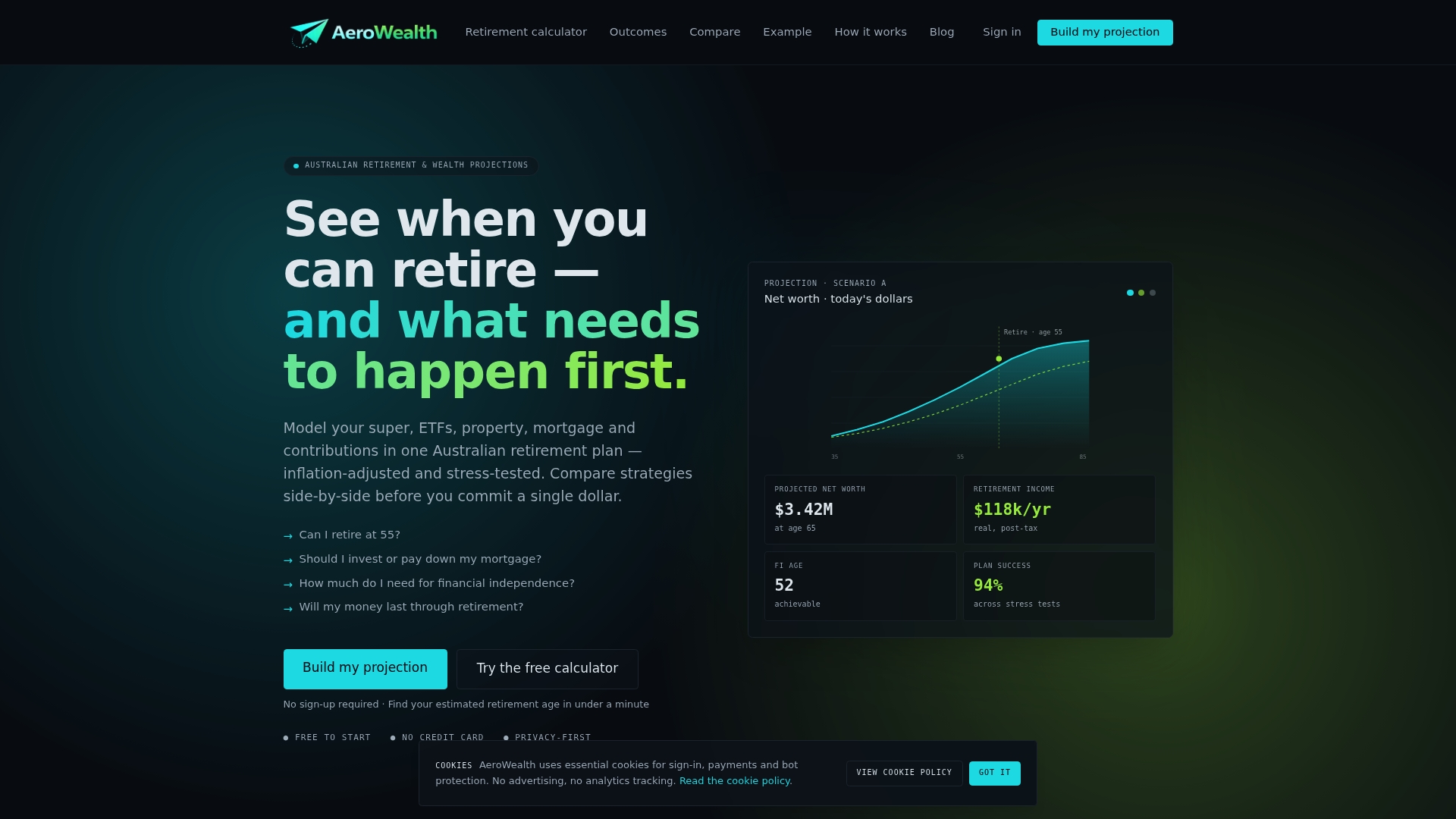
Aerowealth is built specifically for Australians who want to model their retirement outcomes with real variables: superannuation balances, property equity, mortgage obligations, and income streams. The platform runs side-by-side scenario comparisons so you can see how retiring at 62 versus 67 changes your lifetime income, or how downsizing affects your Age Pension eligibility. Aerowealth reports planning success rates of up to 94%, which reflects how much clearer decisions become when you can stress-test them before acting. If you are within ten years of retirement, the retirement calculator is the most direct way to find out where you stand and what needs to change. Explore Aerowealth's pricing plans to find the right level of support for your situation.
FAQ
How much super do I need to retire comfortably in Australia?
Singles need approximately $630,000 in superannuation for a comfortable retirement, while couples need around $730,000, based on the ASFA Retirement Standard Q1 2026 figures. These targets assume home ownership and are supplemented by the Age Pension.
What is a safe withdrawal rate in retirement?
Financial experts recommend withdrawing between 3.8% and 4.2% of your opening retirement balance each year, adjusted for inflation. This rate is designed to sustain a 20–30 year retirement without depleting your capital.
When should I start preparing for retirement?
The five years before your target retirement date are the most critical for financial planning. Starting earlier gives you more time to adjust super contributions, manage tax exposure, and model different income scenarios.
How does the Age Pension affect my retirement plan?
The Age Pension provides a baseline income of approximately $31,223 per year for singles, but means testing through assets and deeming rates can reduce your entitlement. Timing your super withdrawals strategically before age 67 can improve your pension eligibility.
What is Division 296 and does it affect me?
Division 296 is a tax measure that applies an additional 15% tax on superannuation earnings for balances above $3 million, effective from july 2026. If your super balance is approaching that threshold, restructuring your assets before the cutoff can reduce your tax exposure significantly.