
A retirement savings plan is a structured approach to building financial security for later life using Australia's superannuation system, voluntary contributions, and strategic investment choices. Superannuation sits at the center of every Australian's long-term savings strategy, backed by the Superannuation Guarantee (SG) rate of 12% of ordinary time earnings as of july 2025. Yet only 18% of Australians have a clear, written plan for retirement. That gap between intention and action is exactly where most people lose ground. Understanding the rules, contribution caps, and income options available in 2026 gives you a real advantage.
What does a good retirement savings plan look like?
A solid plan starts with knowing how much income you will need after you stop working. Financial planners widely use 70% of pre-retirement income as the baseline target for retirement spending. That figure covers essentials like housing, food, and utilities, but you need to adjust it upward if you plan to travel, support family, or carry a mortgage into retirement.

Inflation is the silent threat in every long-term projection. At an annual rate of 2–3%, the purchasing power of a fixed income falls meaningfully over a 20 to 30 year retirement. A dollar today buys noticeably less in 15 years. Building inflation into your projections from the start prevents a nasty surprise later.
Healthcare costs deserve a separate line in your budget. Australians over 65 spend significantly more on medical care than working-age adults, and that gap widens with age. Factor in private health insurance premiums, out-of-pocket specialist costs, and potential aged care expenses when modeling your retirement income needs.
The Age Pension provides a safety net, but it is not a retirement plan on its own. Eligibility starts at age 67 and requires passing both an assets test and an income test. Many Australians will receive a partial pension rather than the full rate, so treating the Age Pension as a supplement rather than a primary income source is the more realistic approach.
- Estimate annual expenses in today's dollars, then apply a 2–3% inflation factor
- Include healthcare, travel, and discretionary spending, not just bills
- Check your Age Pension eligibility using the MoneySmart calculator
- Identify the gap between projected super income and total spending needs
Pro Tip: Run your retirement budget estimate at two income levels: one for a basic lifestyle and one for your preferred lifestyle. The gap between those two numbers tells you exactly how hard your super needs to work.
How does Australian superannuation work?
Superannuation is a legally preserved savings system. Access conditions restrict early withdrawal, unlike a regular bank account. Funds accumulate through employer contributions, voluntary additions, and investment returns until you meet a condition of release, typically reaching your preservation age or turning 65.
Contribution types and caps
Contributions split into two categories: concessional and non-concessional. Concessional contributions are made from pre-tax income and taxed at 15% inside the fund. Non-concessional contributions come from after-tax money and are not taxed on entry.
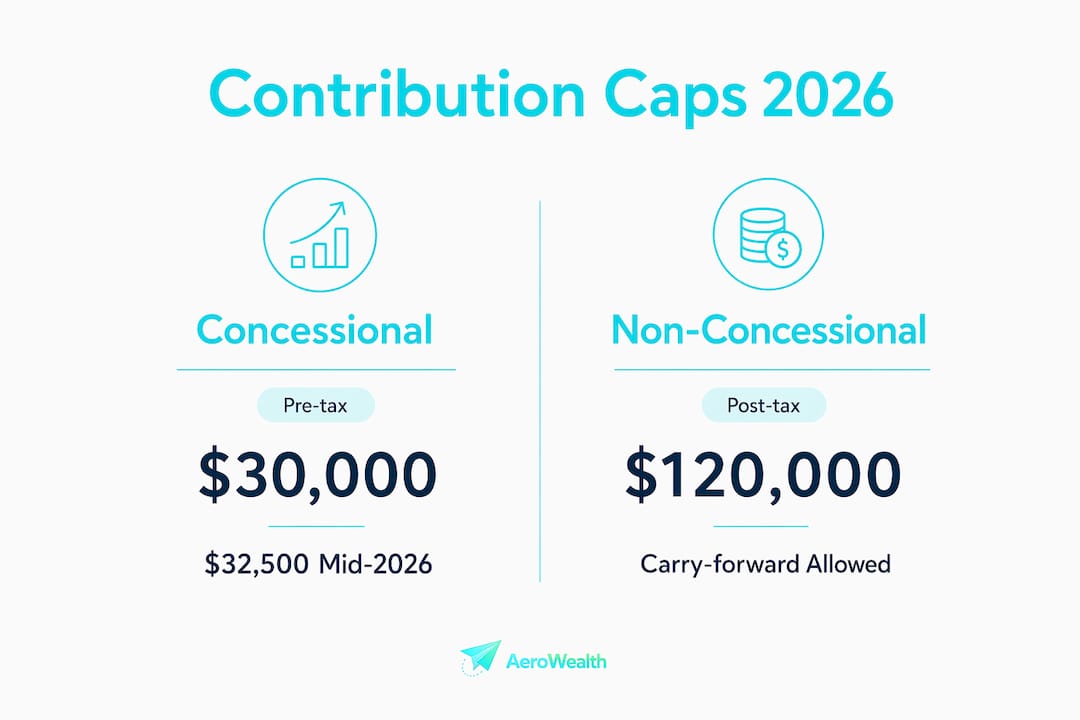
The 2025–26 concessional cap sits at $30,000 per year, rising to $32,500 from mid-2026. The non-concessional cap is $120,000 per year, with a bring-forward rule that lets eligible members contribute up to three years' worth in a single year. These caps reset annually, so unused room in concessional contributions can carry forward if your total super balance is under $500,000.
| Contribution type | Tax treatment | 2025–26 annual cap |
|---|---|---|
| Concessional (pre-tax) | Taxed at 15% in fund | $30,000 |
| Non-concessional (after-tax) | Not taxed on entry | $120,000 |
| Employer SG | Taxed at 15% in fund | Included in concessional cap |
Preservation age and access rules
Australians born after july 1, 1964 have a preservation age of 60. Reaching that age while retired triggers full access to super benefits. Members who are still working at 60 can access super through a transition to retirement (TTR) income stream, which allows limited drawdowns while continuing to contribute. Full unrestricted access applies at age 65 regardless of employment status.
The Transfer Balance Cap (TBC) limits the amount you can move into the tax-free pension phase. The TBC is $2.1 million effective july 2026. Balances above that threshold stay in the accumulation phase, where investment earnings are taxed at 15%. A proposed Division 296 tax would impose an additional 15% tax on earnings for balances above $3 million, though legislative timing remains subject to parliamentary process.
- Preservation age: 60 for those born after july 1, 1964
- Full access at 65 regardless of work status
- TTR streams allow limited drawdowns from preservation age while working
- TBC of $2.1 million caps tax-free pension phase assets
Pro Tip: If your super balance is under $500,000, check whether you have unused concessional contribution room from prior years. Carry-forward rules let you make larger pre-tax contributions in a single year, which can significantly reduce your taxable income.
How do you choose the right super fund?
The type of fund you choose shapes your long-term balance more than most people realize. Fees and insurance costs can erode decades of growth when left unchecked. Reviewing your fund annually is not optional; it is one of the highest-return activities you can do for your retirement.
Fund types compared
Australia's super system offers four main fund structures. Industry funds are member-owned and historically strong performers, particularly for workers in specific sectors. Retail funds are run by financial institutions and offer broad investment menus. Corporate funds are employer-sponsored and often carry negotiated fee structures. Self-managed super funds (SMSFs) give members direct control over investment decisions but require governance, accounting, and compliance work. SMSFs suit high balances and experienced members who can manage the administrative load.
Investment options and fees
Most funds offer a range of investment options from high-growth (typically 70–90% in shares and property) to conservative (mostly fixed income and cash). Younger members generally benefit from higher growth allocations because they have time to recover from market downturns. Members within 5–10 years of retirement often shift toward balanced or conservative options to protect accumulated wealth.
Default MySuper options provide a reasonable starting point but are not always the best fit for your age, balance, or goals. Reviewing your investment option at each life stage is worth the 20 minutes it takes. Consolidating multiple super accounts into one also eliminates duplicate fees and insurance premiums, which can add up to thousands of dollars over a career.
- Compare funds using annual fees as a percentage of balance, not just dollar amounts
- Check net returns after fees over 5 and 10 year periods
- Review insurance cover inside super: life, total and permanent disability, and income protection
- Consolidate old accounts through the ATO's online services or myGov
What strategies boost retirement savings the most?
Voluntary contributions are the single most effective lever most Australians can pull. Salary sacrifice arrangements redirect pre-tax income directly into super, reducing your taxable income while growing your balance. Even an extra $100 per week through salary sacrifice compounds significantly over 10 to 20 years.
- Set up salary sacrifice. Talk to your employer's payroll team about redirecting a portion of your gross salary into super. The contribution is taxed at 15% rather than your marginal rate, which creates an immediate tax saving.
- Make after-tax contributions. If you receive a bonus, inheritance, or asset sale proceeds, depositing after-tax money into super under the non-concessional cap keeps future earnings in a low-tax environment.
- Use catch-up contributions. Members with balances under $500,000 can carry forward unused concessional cap room from up to five prior years and make a larger pre-tax contribution in a single year.
- Plan your TTR strategy. Transition to retirement income streams let you draw limited income from super while still working, which can fund salary sacrifice contributions and reduce tax simultaneously.
- Model account-based pension drawdowns. Once retired, account-based pensions require minimum annual drawdowns based on your age. Planning those drawdowns alongside Age Pension income tests helps you maximize total after-tax income.
- Review your plan with a licensed adviser. Professional advice around ages 50–55 integrates your super, property, tax position, and Age Pension eligibility into a single strategy. The decade before retirement is when personalized advice delivers the greatest return.
Pro Tip: Use the retirement projection tools available through Aerowealth to model different salary sacrifice amounts side by side. Seeing the projected balance difference at age 67 makes the decision concrete rather than abstract.
Key Takeaways
A structured retirement savings plan built on superannuation, voluntary contributions, and regular review gives Australians the clearest path to a financially secure retirement.
| Point | Details |
|---|---|
| Superannuation is the foundation | Employer SG contributions at 12% form the baseline; voluntary additions accelerate growth. |
| Know your contribution caps | Concessional cap is $30,000 for 2025–26; non-concessional cap is $120,000 per year. |
| Fees erode long-term balances | Compare net returns after fees and consolidate old accounts to stop paying duplicate costs. |
| Plan income streams carefully | Account-based pensions and the Age Pension work together; model both to maximize after-tax income. |
| Seek advice before 55 | Licensed financial advisers help integrate super, tax, and pension eligibility into one plan. |
The planning gap no one talks about
The Aerowealth Team works with Australians across every life stage, and the pattern we see most often is not bad investment choices. It is the absence of any plan at all. People assume their employer contributions will be enough, or that they will "sort it out later." Later arrives faster than expected.
The uncomfortable truth about default super settings is that they are designed to be adequate, not optimal. A MySuper balanced option will not automatically adjust to your age, your debt position, or your retirement income target. That adjustment requires deliberate decisions, and most people never make them.
We have also seen the cost of ignoring fees. A difference of 0.5% in annual fees sounds trivial. Over 30 years on a $200,000 balance, it translates to a materially smaller retirement nest egg. The math is not complicated, but it requires someone to actually run it.
Digital calculators like MoneySmart's retirement planner give you a useful starting point. They do not replace tailored advice, especially as you approach retirement age and your financial picture becomes more complex. The right move is to use both: a calculator to understand the shape of your situation, and a licensed adviser to refine the details.
The ASIC retirement hub frames this well: the goal is moving from worry to clarity. That shift does not happen by accident. It happens when you build a plan, review it regularly, and adjust it as your life changes.
— Aerowealth Team
How Aerowealth helps you plan with confidence
Retirement planning gets complicated fast when you factor in superannuation, property, mortgages, and tax. Aerowealth is built specifically for Australians who want to see how those variables interact before making decisions.

The platform lets you run side-by-side retirement scenarios comparing different contribution levels, retirement ages, and investment strategies. You can stress-test your plan against market downturns or unexpected expenses without touching a spreadsheet. Aerowealth projects your retirement age, income, and net worth in clear visual terms, giving you the confidence to act rather than guess. Check the Aerowealth pricing page to find the plan that fits your stage of life.
FAQ
What is the Superannuation Guarantee rate in 2026?
The Superannuation Guarantee rate is 12% of ordinary time earnings, mandatory for most Australian employees as of july 2025. This forms the compulsory baseline of every employer-sponsored retirement contribution.
When can I access my superannuation?
Australians born after july 1, 1964 can access super at preservation age 60 if retired, or at age 65 regardless of work status. Transition to retirement income streams allow limited access from age 60 while still working.
How much super do I need to retire comfortably?
A common benchmark is replacing 70% of your pre-retirement income, adjusted for your lifestyle goals and inflation of 2–3% annually. The exact amount depends on your planned retirement age, spending habits, and whether you qualify for the Age Pension.
What is the concessional contribution cap for 2025–26?
The concessional contribution cap is $30,000 per year for 2025–26, rising to $32,500 from mid-2026. Members with balances under $500,000 can carry forward unused cap room from prior years to make larger contributions in a single year.
What is the Transfer Balance Cap and why does it matter?
The Transfer Balance Cap is $2.1 million effective july 2026, limiting the amount you can hold in the tax-free pension phase. Balances above that threshold remain in the accumulation phase, where investment earnings are taxed at 15%.