
What "super choices" actually means for your retirement
Most Australian employees have the right to choose which super fund receives their employer contributions. That decision, made once or revisited over time, shapes how much you retire with.
If you don't make a choice, your employer checks for a stapled fund linked to you from a previous job. No stapled fund? They pay into a default. Either way, someone else decides where your money goes.
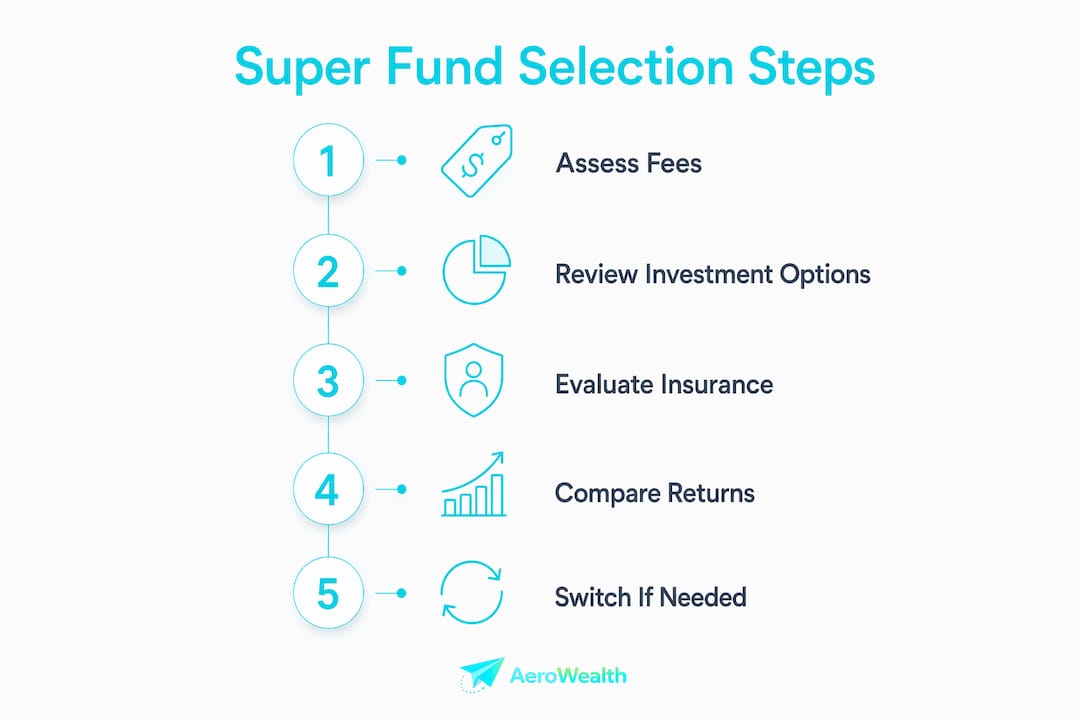
Key things to weigh when making your selection:
- Investment options: growth, balanced, conservative, or self-directed mixes
- Fees: fixed, percentage-based, or event-triggered charges that compound against your balance over decades
- Insurance: life cover, total and permanent disability (TPD), and income protection, with varying premiums and exclusions
- Performance: compare balanced options over a 5-year period using the ATO's YourSuper tool
- Member services: online access, financial advice, and flexibility to switch options
Table of Contents
- What really matters when picking a super fund
- How to compare and switch super funds
- Tax implications of super fund and investment choices
- Aerowealth makes retirement modelling concrete
- Key Takeaways
- FAQ
What really matters when picking a super fund
Investment options and risk
The right investment mix depends on where you are in life. Shifting from growth to conservative options as retirement nears reduces short-term volatility, though it can lower long-term returns. Reviewing your mix every 3–5 years is standard practice, not optional. A well-diversified approach, including retirement portfolio diversification, can protect against sequence-of-returns risk in the years just before you stop working.

Fees and their long-term drag
Fees reduce your balance growth over time, and the effect compounds. Lower fees on similar-performing funds consistently produce better outcomes. Charges appear as fixed administration fees, percentage-based investment fees, and event-based costs like switching fees.
Insurance inside super
Many funds provide automatic insurance on joining, but the default cover often doesn't fit individual needs. Review exclusions, definitions of disability, and whether income protection covers your occupation before assuming the default is adequate.
| Selection Criterion | What It Means | Why It Matters |
|---|---|---|
| Investment options | Range of asset classes available | Affects growth potential and risk exposure |
| Fees | All charges deducted from your balance | Directly reduces compounding returns |
| Insurance | Life, TPD, income protection cover | Protects income and dependents |
| Performance | Net returns over 5+ years | Benchmark against peers in same category |
| Member services | Advice access, digital tools, flexibility | Supports informed, ongoing decisions |
Integrating super with your broader plan
The ATO advises treating super as one component of a larger picture that includes personal savings, property, and the Age Pension. Retirement planning is continuous, not a one-time event. Running what-if scenarios on contributions, salary sacrifice, and part-time work helps stress-test assumptions before they become expensive mistakes.
How to compare and switch super funds
Start with the ATO's YourSuper comparison tool, which ranks MySuper products by fees and net returns. Focus on like-for-like comparisons: balanced options against balanced options, over at least five years.
Switching funds is straightforward. Most funds let you initiate a rollover online through myGov. Before switching, check for exit fees, insurance gaps during the transition, and whether your new fund accepts rollovers from your current one. Consolidating multiple accounts into one also eliminates duplicate fees and insurance premiums.
Pro Tip: Before switching, request a written statement of your current insurance cover. Some conditions aren't transferable to a new fund, and losing cover mid-switch can leave you exposed.
Tax implications of super fund and investment choices
Contributions to super are generally taxed at 15% inside the fund, well below most marginal income tax rates. Investment earnings within super are also taxed at 15% in accumulation phase, dropping to zero in retirement phase once you convert to an account-based pension. Capital gains on assets held longer than 12 months inside super attract a one-third discount, bringing the effective rate to 10%.
The transition to retirement (TTR) phase offers additional tax advantages if modeled correctly against your preservation age, contribution caps, and Age Pension eligibility. Choosing a higher-growth investment option inside super can amplify these tax benefits over time, since gains compound in a low-tax environment.
Aerowealth makes retirement modelling concrete
Choosing the right fund is step one. Knowing how that choice interacts with your mortgage, property, contributions, and target retirement age is where most Australians hit a wall.

Aerowealth is built specifically for this. The platform lets you model super alongside property, ETFs, and mortgages in one plan, then run side-by-side scenario comparisons to see exactly how each decision shifts your retirement age or income. Features like bridge years modelling (for retiring before your preservation age), CGT impact analysis, and mortgage offset strategies go well beyond what a spreadsheet can handle. Aerowealth reports a 94% planning success rate among users who engage with its full scenario toolkit. Start with the free plan or explore Pro subscription options to unlock advanced modelling.
Key Takeaways
Choosing the right super fund and modelling its interaction with your full financial picture is the most direct lever Australians have over their retirement outcome.
| Point | Details |
|---|---|
| Super choices are active decisions | Most employees can choose their fund; inaction defaults to a stapled or employer-default fund. |
| Fees compound against you | Lower fees on comparable-performing funds consistently produce better long-term balances. |
| Insurance needs active review | Default cover often doesn't match individual needs; check exclusions before assuming adequacy. |
| Tax advantages are real | Super earnings are taxed at 15% in accumulation, dropping to zero in retirement phase. |
| Aerowealth models the full picture | Side-by-side scenario comparisons, bridge years, and CGT modelling support a 94% planning success rate. |
FAQ
What does "super choices" mean in Australia?
It refers to the legal right most employees have to nominate which superannuation fund receives their employer contributions, rather than defaulting to a fund chosen by their employer.
How do I compare super funds fairly?
Use the ATO's YourSuper tool to compare MySuper products by net returns and fees over five years, focusing on funds in the same investment category (e.g., balanced vs. balanced).
What happens if I don't make a super fund choice?
Your employer checks for a stapled fund linked to your tax file number. If none exists, contributions go into the employer's default fund.
Aerowealth lets you model super contributions, investment scenarios, and retirement age projections alongside property and mortgage variables. It offers side-by-side comparisons and reports a 94% planning success rate.
Are super fund earnings taxed?
Yes. Earnings inside super are taxed at 15% during accumulation phase and at zero once you move into retirement phase with an account-based pension.