
Retirement income strategies are approaches that help Australians generate reliable, sustainable income throughout retirement by blending superannuation, government benefits, investments, and dedicated income products. The best plans draw from multiple sources because no single stream covers every risk. Australian Treasury's 2026 Best Practice Principles require super trustees to offer diversified retirement income products, including account-based pensions and lifetime income options. That regulatory shift signals a national move away from pure accumulation toward active decumulation planning. Whether you are five years from retirement or already there, the strategies below give you a clear framework for building income that lasts.
1. Retirement income strategies: start with account-based pensions
Account-based pensions (ABPs) are the most widely used retirement income vehicle in Australia. They draw directly from your superannuation balance, pay tax-free income once you turn 60, and let you control how much you withdraw above the annual minimum. Tax-free ABP income for retirees aged 60 and over makes this one of the most tax-efficient income sources available. That efficiency compounds over a long retirement, keeping more money working for you.
The minimum withdrawal rate rises with age, which means your drawdown accelerates over time. Plan for that increase early so it does not force you to sell assets at the wrong moment.

2. Lifetime annuities for guaranteed income security
Lifetime annuities provide guaranteed income by transferring longevity and market risk to the provider. You give up access to the capital, but you receive a fixed or indexed payment for life. That certainty has real value when you are budgeting for essential expenses like rent, utilities, and groceries.
Annuities work best as one layer in a blended plan, not as a standalone solution. Pair them with a more flexible account-based pension to cover discretionary spending and preserve some upside exposure.
3. Innovative Retirement Income Streams (IRIS)
Innovative Retirement Income Streams, known as IRIS, are a newer product class designed to blend the flexibility of account-based pensions with the longevity protection of annuities. They manage cohort-based longevity risk by pooling members, which lowers the cost of guaranteed income compared to traditional annuities. The Australian Treasury Best Practice Principles specifically highlight IRIS as part of a diversified retirement income approach.
IRIS products are still gaining traction in the Australian market. Ask your super fund whether they offer one, and compare the pooling terms before committing.
4. The Age Pension as a strategic income floor
The Age Pension is undervalued as a planning tool. It provides a stable, inflation-indexed base that lets you take more growth-oriented positions inside your super without risking your essential income. Many Australians treat it as a fallback. The better approach is to treat it as a foundation and build above it.
Eligibility depends on the income and assets tests, so your super drawdown strategy directly affects how much Age Pension you receive. A financial adviser can model the interaction between your super balance and your Age Pension entitlement to find the most efficient combination.
5. Transition to Retirement Income Streams for phased exit
Transition to Retirement Income Streams (TRIS) let you draw a pension from your super while still working. They suit people who want to reduce hours gradually rather than stop work entirely. The catch is that lump sum access is restricted until you meet a full release condition, typically at age 65.
TRIS work well for a phased retirement but require careful planning. Use a transition to retirement calculator to model how different work reduction scenarios affect your long-term income.
6. Investment income from shares, bonds, and property
Passive income in retirement from a diversified investment portfolio gives you growth exposure that pure income products cannot. Dividend-paying Australian shares, government bonds, term deposits, and investment property all generate cash flow outside the super system. This matters because it reduces your reliance on any single source.
Property income carries management costs and liquidity risk. Shares carry market volatility. Bonds and term deposits offer stability but limited growth. The right mix depends on your risk tolerance, your other income sources, and your time horizon.
Pro Tip: Dividend reinvestment plans (DRPs) are worth switching off at retirement. Take the cash dividend instead and use it as income rather than compounding into more shares you may not need.
7. Managing sequencing risk in early retirement
Sequencing risk critically affects retirement income streams. Poor market returns in the first few years of retirement, combined with ongoing withdrawals, can permanently reduce your balance and shorten how long your money lasts. This risk is highest in the first decade of retirement.
The standard mitigation is to hold two to three years of essential expenses in cash or short-term bonds. That buffer lets you avoid selling growth assets during a downturn. Blending in a lifetime annuity or IRIS product for essential expenses removes the sequencing risk from that portion of your income entirely.
Sequencing risk is not about average returns over a lifetime. It is about the order those returns arrive. A 20% loss in year one of retirement does far more damage than the same loss in year fifteen, because you are withdrawing while the balance is falling.
8. Longevity risk and inflation protection
Retirement income sustainability requires planning for longevity, market volatility, inflation, and unexpected expenses. Australians are living longer, which means a retirement that starts at 65 could last 25 to 30 years. Running out of money is a real risk, not a theoretical one.
Inflation erodes purchasing power over that timeframe. An income of $60,000 per year today buys significantly less in 20 years at even modest inflation rates. Growth assets inside your super or investment portfolio, and index-linked income products, are the two main defenses against this erosion.
Regular planning reviews are the most underused tool in retirement income management. Circumstances change, markets move, and government rules shift. A review every one to two years keeps your plan aligned with reality.
9. Tax and Age Pension means testing
Tax rules and government benefit assessments have a direct effect on how much income you actually keep. Post-age 60, account-based pension income is generally tax-free. That changes the math significantly compared to drawing income from a personal investment account, where earnings are taxed at your marginal rate.
The Age Pension means test applies both an income test and an assets test. Here is how each affects your entitlement:
- Income test: Super account-based pensions are assessed under deeming rules, which assume a set rate of return regardless of actual earnings. Lower balances attract lower deemed income, which can increase your Age Pension payment.
- Assets test: Your super balance counts as an asset. Reducing it through drawdowns or converting part of it to a lifetime annuity can improve your assets test position.
- Lifetime annuity concessions: Lifetime income streams have concessional means test treatment, meaning only a portion of the purchase price counts toward the assets test. This can meaningfully increase Age Pension eligibility.
- Deeming rate impact: The deeming rate applied to your financial assets affects your assessed income. When actual returns exceed the deeming rate, you keep the difference without it affecting your pension.
Planning around these rules is not tax avoidance. It is using the system as it was designed to be used.
10. The bucket strategy for balancing security and flexibility
Blending income streams by bucketing essential versus discretionary expenses balances security with flexibility. The approach works by assigning different income sources to different spending categories. Guaranteed income, such as an annuity or the Age Pension, covers non-negotiable costs. Your account-based pension covers lifestyle spending.
This structure reduces anxiety during market downturns because your essential expenses are already covered regardless of what markets do. It also prevents the behavioral mistake of selling growth assets in a panic to pay bills.
Pro Tip: Review your bucket allocations annually. As you age, your essential expenses typically rise as a share of total spending, so the guaranteed income bucket should grow proportionally.
11. Tools and professional advice for personalized planning
ASIC's Moneysmart Retirement Planner attracts more than 11 million annual visitors. That scale reflects how many Australians are actively trying to model their retirement income. The tool lets you test scenarios across superannuation, the Age Pension, and other income sources without needing a financial background.
Professional advice adds a layer that calculators cannot. Advisers enhance retirement income outcomes by providing personalized, cohort-sensitive guidance that goes beyond what any fund-level approach can offer. The combination of a good digital tool and a qualified adviser gives you both the data and the interpretation.
For a structured starting point, the 2026 retirement savings guide walks through how to build a savings base that supports the income strategies covered here.
Key Takeaways
The most effective retirement income plan for Australians combines account-based pensions, guaranteed income products, and the Age Pension into a layered structure that manages longevity, sequencing, and inflation risk simultaneously.
| Point | Details |
|---|---|
| Layer your income sources | Combine ABPs, annuities, the Age Pension, and investments to cover all risk types. |
| Protect against sequencing risk | Hold two to three years of essential expenses in cash to avoid selling assets in a downturn. |
| Use means test rules strategically | Lifetime annuities receive concessional treatment, which can increase your Age Pension entitlement. |
| Review your plan regularly | Annual reviews keep your withdrawal rates and asset allocation aligned with changing markets and life circumstances. |
| Use digital tools and advice together | ASIC's Moneysmart Planner and a qualified adviser together give you data and personalized interpretation. |
What the shift to decumulation really means for Australian retirees
The superannuation system spent 30 years teaching Australians to accumulate. The 2026 Best Practice Principles from Australian Treasury mark a genuine turning point. Funds are now expected to actively help members draw down their savings in a way that lasts. That is a fundamentally different problem, and most retirees are not yet thinking about it that way.
What I see consistently is that people arrive at retirement with a solid balance and no clear plan for turning it into income. They default to the minimum ABP withdrawal, leave the rest invested in a balanced fund, and hope for the best. That approach works in a rising market. It fails badly when markets fall in the first few years of retirement, which is exactly when sequencing risk does its damage.
The retirees who do this well share one habit. They treat their income plan as a living document, not a one-time decision. They review it every year, adjust their withdrawal rate when markets shift, and rebalance their income buckets as their spending patterns change. That discipline matters more than picking the perfect product at the start.
The other thing I would push back on is the idea that guaranteed income products are too expensive or too inflexible to be worth it. A lifetime annuity covering your essential expenses is not a bad deal. It is insurance against the worst outcome, which is outliving your money. The cost of that insurance looks very different when you are 85 and the alternative is running out of funds.
Australia has better tools and better products available now than at any point in the past decade. The gap is not in the products. It is in the planning.
— Aerowealth Team
How Aerowealth supports your retirement income planning
Retirement income planning works best when you can see the numbers before you commit to a strategy.
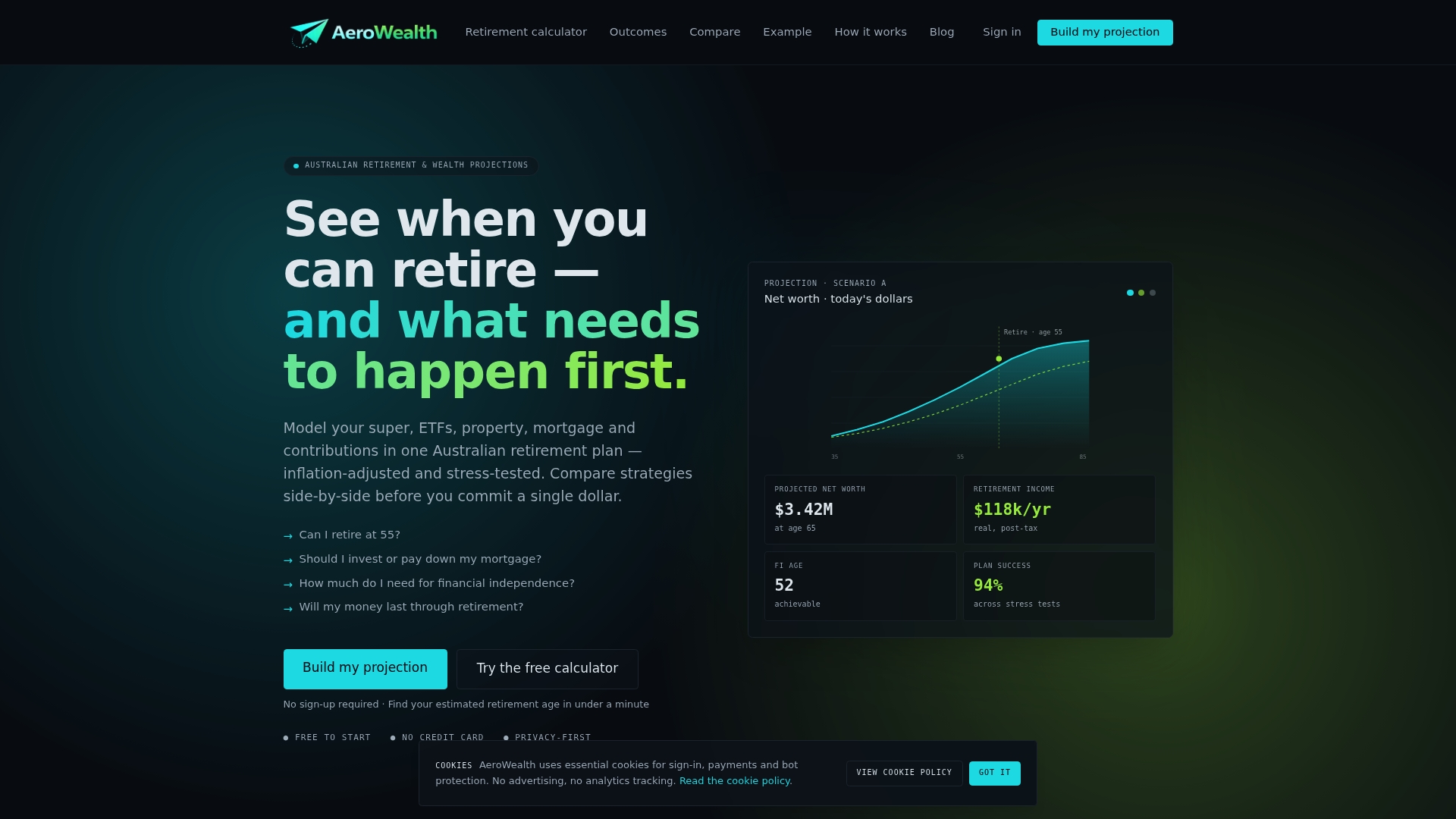
Aerowealth is built specifically for Australians who want to model their retirement income across superannuation, property, and investments in one place. The platform's side-by-side scenario comparisons let you test how different withdrawal rates, income product combinations, and retirement ages affect your long-term financial position. Aerowealth reports planning success rates of up to 94%, which reflects how much clarity comes from seeing your projections laid out clearly rather than guessing. If you are ready to move from uncertainty to a concrete plan, view Aerowealth's pricing and find the option that fits your situation.
FAQ
What are the best retirement income strategies for Australians?
The best approach combines account-based pensions, lifetime annuities or IRIS products, the Age Pension, and investment income from shares or property. Blending these sources manages longevity, sequencing, and inflation risk more effectively than any single stream.
How does sequencing risk affect my retirement income?
Sequencing risk occurs when poor market returns in the early years of retirement combine with ongoing withdrawals to permanently reduce your balance. Holding a cash buffer and using guaranteed income for essential expenses are the two most effective defenses.
Is account-based pension income tax-free in Australia?
Account-based pension income is generally tax-free for retirees aged 60 and over. This makes it one of the most tax-efficient income sources available in the Australian retirement system.
How does a lifetime annuity affect my Age Pension entitlement?
Lifetime income streams receive concessional means test treatment, meaning only a portion of the purchase price counts toward the assets test. This can increase your Age Pension payment compared to holding the same amount in an account-based pension.
When should I start planning my retirement income strategy?
The earlier you start, the more options you have. Transition to Retirement Income Streams are available before full retirement, and preparing to retire in Australia covers the key steps to take in the years leading up to your target date.