
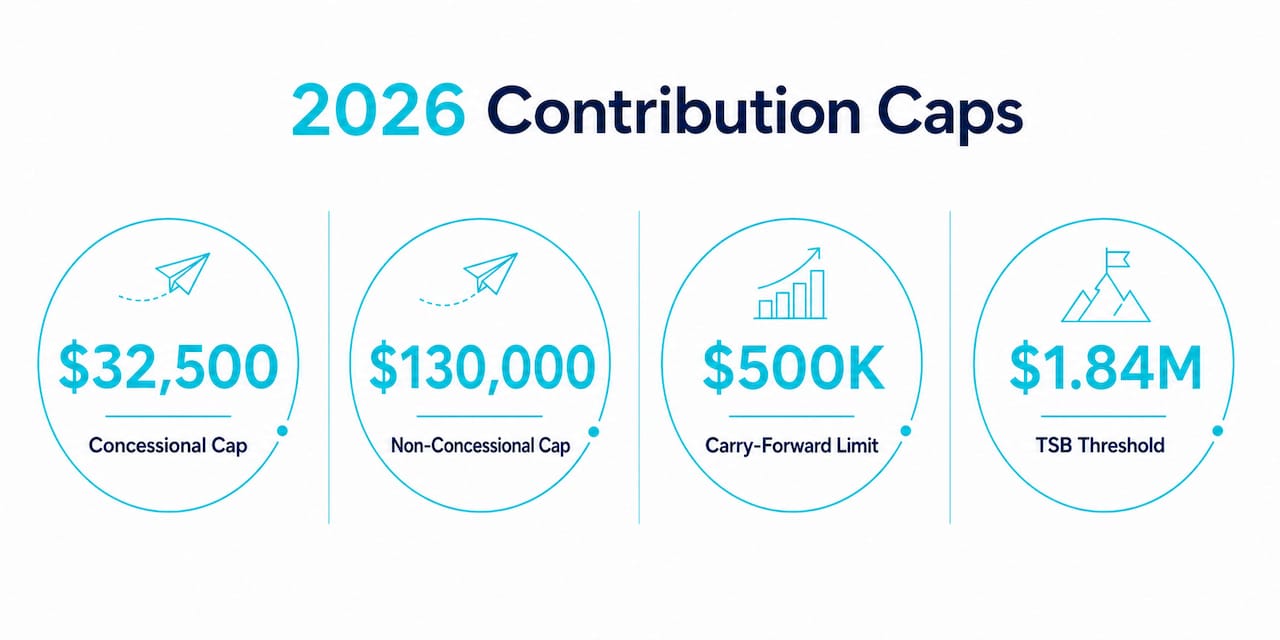
The super contributions cap sets the maximum amount you can add to your Australian superannuation fund each year without triggering extra tax. From 1 july 2026, the concessional cap rose to $32,500, up from $30,000, while the non-concessional cap sits at $130,000 annually. The Australian Taxation Office (ATO) indexes both caps to Average Weekly Ordinary Time Earnings (AWOTE), so they shift over time. Knowing where these limits sit, and how your Total Super Balance (TSB) affects your eligibility, is the difference between growing your super tax-efficiently and paying a penalty you did not see coming.
What is the super contributions cap and how does it work?
The super contributions cap divides into two distinct categories: concessional contributions and non-concessional contributions. Each has its own annual limit, tax treatment, and set of rules.
Concessional contributions are before-tax contributions. They include your employer's compulsory Super Guarantee (SG) payments, salary sacrifice amounts, and personal contributions you claim as a tax deduction. The concessional cap is $32,500 from 1 july 2026. Contributions within this cap are taxed at 15% inside your super fund, which is lower than most people's marginal income tax rate.
Non-concessional contributions are after-tax contributions. You make these from money you have already paid income tax on, and they are not taxed again when they enter your fund. The annual non-concessional cap is $130,000. Both caps apply across all your super funds combined, not per fund.
- Concessional contributions: employer SG, salary sacrifice, personal deductible contributions
- Non-concessional contributions: personal after-tax contributions, spouse contributions, and certain government co-contributions
- Both caps are assessed across all funds you hold
Carry-forward concessional contributions add a useful layer of flexibility. If your TSB is below $500,000, you can carry forward unused cap amounts from up to five previous financial years, starting from 2018–19. This means a person who contributed well below the cap in earlier years can make a larger concessional contribution in a single year without penalty.
Pro Tip: If you took time out of the workforce for caregiving or study, your TSB may be well under $500,000. Check your ATO MyGov account for your unused carry-forward amounts before june 30 each year.
How does Total Super Balance affect non-concessional contributions?
Your Total Super Balance, measured on june 30 of the prior financial year, determines whether you can make non-concessional contributions at all, and how much you can contribute. This is one of the most misunderstood rules in Australian superannuation.

The ATO uses three TSB bands to set your non-concessional contribution eligibility:
| TSB as of June 30, 2026 | Annual NCC cap | Bring-forward available |
|---|---|---|
| Below $1.84 million | $130,000 | Up to $390,000 over 3 years |
| $1.84 million to below $1.97 million | $130,000 | Up to $260,000 over 2 years |
| $1.97 million to below $2.1 million | $130,000 | Nil (one year only) |
| $2.1 million or more | $0 | Nil |
Individuals with a TSB of $2.1 million or more as of june 30, 2026 cannot make any non-concessional contributions. Those between $1.97 million and $2.1 million are limited to one year's cap with no bring-forward access.
The bring-forward rule lets eligible individuals contribute up to three years' worth of non-concessional contributions in a single year. From 1 july 2026, the full three-year bring-forward cap is $390,000, up from $360,000. Triggering the bring-forward rule in one year locks in the cap that applied at the time you triggered it, so timing matters.
TSB thresholds are indexed annually, which means your eligibility can shift from year to year even if your super balance stays flat. A person sitting just below a threshold in one year may cross it the next without making a single additional contribution.
Pro Tip: Check your TSB on MyGov or your fund's annual statement before making any large non-concessional contribution. A single dollar over a threshold can cost you thousands in excess contributions tax.
What happens if you exceed the super contributions caps?
Exceeding either cap triggers an ATO process that adds cost and complexity to your tax return. The consequences differ depending on which cap you breach.
For excess concessional contributions, the ATO adds the excess amount to your assessable income and taxes it at your marginal rate. You receive a 15% tax offset to account for the tax already paid inside your fund. The ATO issues an excess concessional contributions determination, and you can elect to release up to 85% of the excess from your super fund to pay the tax bill. If you do not release the funds, the excess is treated as a non-concessional contribution, which can then push you over that cap too.
For excess non-concessional contributions, the tax consequences are more severe. The ATO taxes the excess at the top marginal rate, currently 47% including the Medicare levy. You can choose to withdraw the excess plus an associated earnings amount, which avoids the top-rate tax but still generates a taxable amount.
Key steps the ATO takes after a cap breach:
- Issues a determination letter outlining the excess amount
- Gives you 60 days to respond and elect to release funds
- Applies the relevant tax treatment based on your election
- Adjusts your income tax assessment accordingly
Proactive monitoring throughout the financial year costs far less than dealing with an ATO excess contributions determination after the fact. Tracking your contributions monthly, not just at tax time, is the single most effective way to stay within your limits.
The introduction of Payday Super from 1 july 2026 requires employers to pay SG contributions each payday rather than quarterly. This change increases the frequency of concessional contributions hitting your fund, which raises the risk of accidental cap breaches for workers who also salary sacrifice or make personal deductible contributions.
How can you use contribution caps to build a stronger retirement plan?
The caps are not just limits. Used well, they are a framework for building super efficiently over time. Several strategies work consistently well for Australian savers.
-
Review caps every july. The concessional cap increases in $2,500 increments indexed to AWOTE. Each increase is an opportunity to lift your salary sacrifice or personal deductible contribution without changing your tax position.
-
Use carry-forward concessional caps if your TSB is under $500,000. This rule is especially valuable for people who re-enter the workforce after a career break. A single large concessional contribution can clear years of unused cap space and generate a meaningful tax deduction.
-
Time bring-forward contributions carefully. Contributing just after july 1 of a new financial year locks in the new, higher cap. Triggering the bring-forward rule in june locks in the prior year's lower cap. This timing difference can mean $30,000 more in allowable contributions over the three-year period.
-
Balance super between spouses. Couples benefit from keeping both balances below key TSB thresholds. A spouse with a lower balance can receive contributions that the higher-balance spouse cannot make directly, effectively doubling the household's non-concessional contribution capacity.
-
Account for Payday Super in your salary sacrifice calculations. From july 2026, SG contributions arrive more frequently. Adjust your salary sacrifice amount to reflect the new SG timing so you do not accidentally exceed the concessional cap mid-year.
-
Use a retirement projection tool to model scenarios. Seeing the long-term impact of different contribution levels, including the compounding effect of maximizing caps over a decade, makes the abstract rules concrete and motivating.
Pro Tip: Annual cap reviews are most effective when you check your super thresholds in july, not june. By july, you know the new caps, your june 30 TSB is set, and you have a full year to act.
Key Takeaways
The super contributions cap is the single most important number to track each year for tax-efficient superannuation growth, with the 2026 concessional cap at $32,500 and the non-concessional cap at $130,000.
| Point | Details |
|---|---|
| 2026 concessional cap | $32,500 per year, covering employer SG, salary sacrifice, and personal deductible contributions. |
| 2026 non-concessional cap | $130,000 per year, or up to $390,000 over three years with the bring-forward rule. |
| TSB determines eligibility | A TSB of $2.1 million or more as of june 30 blocks all non-concessional contributions. |
| Carry-forward rule | Unused concessional cap amounts from up to five prior years can be used if TSB is below $500,000. |
| Exceeding caps costs money | Excess concessional contributions are taxed at your marginal rate less a 15% offset; excess non-concessional contributions face the top marginal rate. |
The part most people get wrong about super caps
The Aerowealth Team works with Australians who are genuinely engaged with their finances, and the pattern we see most often is not recklessness. It is a quiet assumption that last year's strategy still applies this year. It rarely does.
The indexed nature of both the concessional and non-concessional caps means the rules shift every time AWOTE moves. Your TSB threshold eligibility can change without you doing anything. Payday Super now means your employer's SG contributions land in your fund more frequently, which compresses the margin for error on salary sacrifice. These are not edge cases. They affect ordinary workers with ordinary super balances.
The bring-forward rule is the area where I see the most costly mistakes. People trigger it in june, lock in the prior year's lower cap, and then realize in august that they could have waited six weeks and contributed $30,000 more. The fix is simple: model the timing before you act, not after.
Spouse contribution strategies are also underused. Couples often treat super as two separate problems. Balancing balances between partners, especially when one is approaching a TSB threshold, can preserve non-concessional contribution access for the household as a whole. That is a planning decision worth revisiting every year, not just at retirement.
The transition to retirement phase adds another layer of complexity. Contribution strategies that work during accumulation may need adjustment once you start drawing a pension. Getting that sequencing right requires modeling, not guesswork.
— Aerowealth Team
How Aerowealth helps you plan around contribution caps
Knowing the caps is one thing. Seeing how they interact with your salary, property, mortgage, and retirement timeline is another.
Aerowealth is built specifically for Australians who want to model their retirement strategies with real numbers. The platform lets you run side-by-side scenario comparisons, so you can see what maximizing your concessional cap for the next ten years actually does to your projected retirement income. You can stress-test different TSB outcomes, model the bring-forward rule, and adjust for Payday Super timing, all without a spreadsheet. Aerowealth's retirement planning tool gives you clear projections of retirement age, income, and net worth so you can make decisions with confidence. Explore the Aerowealth pricing page to find the plan that fits your planning needs.
FAQ
What is the concessional contributions cap for 2026?
The concessional contributions cap from 1 july 2026 is $32,500 per year. This covers all before-tax contributions, including employer SG payments, salary sacrifice, and personal contributions you claim as a tax deduction.
What is the non-concessional contributions cap for 2026?
The non-concessional contributions cap is $130,000 per year from 1 july 2026. Eligible individuals with a TSB below $1.84 million can use the bring-forward rule to contribute up to $390,000 over three years.
What happens if I go over my super contributions cap?
Excess concessional contributions are added to your taxable income and taxed at your marginal rate, less a 15% tax offset. Excess non-concessional contributions are taxed at the top marginal rate of 47% unless you withdraw the excess from your fund.
Can I contribute more to super if I have unused cap space from prior years?
Yes, if your TSB is below $500,000, you can carry forward unused concessional cap amounts from up to five prior financial years, starting from 2018–19. This allows a larger concessional contribution in a single year without breaching the cap.
Does my Total Super Balance affect how much I can contribute?
Your TSB as of june 30 of the prior year directly determines your non-concessional contribution eligibility. A TSB of $2.1 million or more means you cannot make any non-concessional contributions, while a TSB below $1.84 million gives you full access to the three-year bring-forward rule.