
A self-managed super fund (SMSF) is worth it if you have at least $200,000 in combined member balances, can commit more than 8 hours a month to fund management, and have a specific investment goal — direct property, concentrated shares, or CGT timing control — that a large fund simply cannot deliver. Below that threshold, or without that goal, the fixed cost structure works against you.
Three conditions that change the verdict:
- Balance: Industry research and ATO guidance point to $200,000 as the minimum for cost-competitiveness. Below that, fixed running costs consume a disproportionate share of returns.
- Time and skill: Trustees spend more than 8 hours per month on average. That is not a suggestion — it is the baseline for a fund that stays compliant.
- Control objective: If your reason is vague ("I want more control"), an SMSF may be unnecessary. If it is specific — buying business premises, timing a CGT event, or running a pension alongside a spouse — the case gets much stronger.
This article is general information, not financial or legal advice. Confirm your situation with a licensed adviser and the ATO before making structural changes to your super.
Table of Contents
- Is an SMSF the right structure for you?
- Costs and break-even: what the numbers actually look like
- Regulatory obligations and risks you cannot outsource
- Alternatives and hybrid approaches worth considering
- How to test the SMSF decision with scenario modelling
- Model your SMSF decision with Aerowealth
- Key Takeaways
- The SMSF decision is more about behavior than balance
- Useful sources and further reading
- FAQ
Is an SMSF the right structure for you?
Before running any numbers, a quick suitability screen saves a lot of modelling time.
You are a strong candidate if:
- Combined super balances are at or above $200,000 (more if you plan to hold direct property or run an LRBA)
- You want to invest in assets unavailable in large funds: direct property, direct shares, or alternative assets
- You have genuine interest in investment management and are comfortable learning trustee compliance
- You run a business and want your SMSF to purchase your business premises
- You have a partner or family member to co-trustee, spreading the governance load
- You want direct control over pension-phase drawdowns and contribution cap timing
Pause and reconsider if:
- Your balance is below $150,000 with no near-term contributions to close the gap
- You prefer a hands-off approach to investing
- You rely on group insurance inside your current fund. MoneySmart warns that existing cover may be lost or repriced after rolling into an SMSF, and replacement cover for older or higher-risk members can be costly
- You have limited access to a licensed SMSF adviser or accountant
Pro Tip: Before modelling anything, divide your current fund's annual fee by your balance to get your effective fee rate. If an SMSF's fixed costs would produce a higher rate at your current balance, the numbers are already telling you something.

Costs and break-even: what the numbers actually look like
SMSF costs are largely fixed, which is the single most important structural fact in this decision. A fixed annual admin bill represents a higher effective fee percentage for smaller funds and a $600,000 fund at 0.5%.
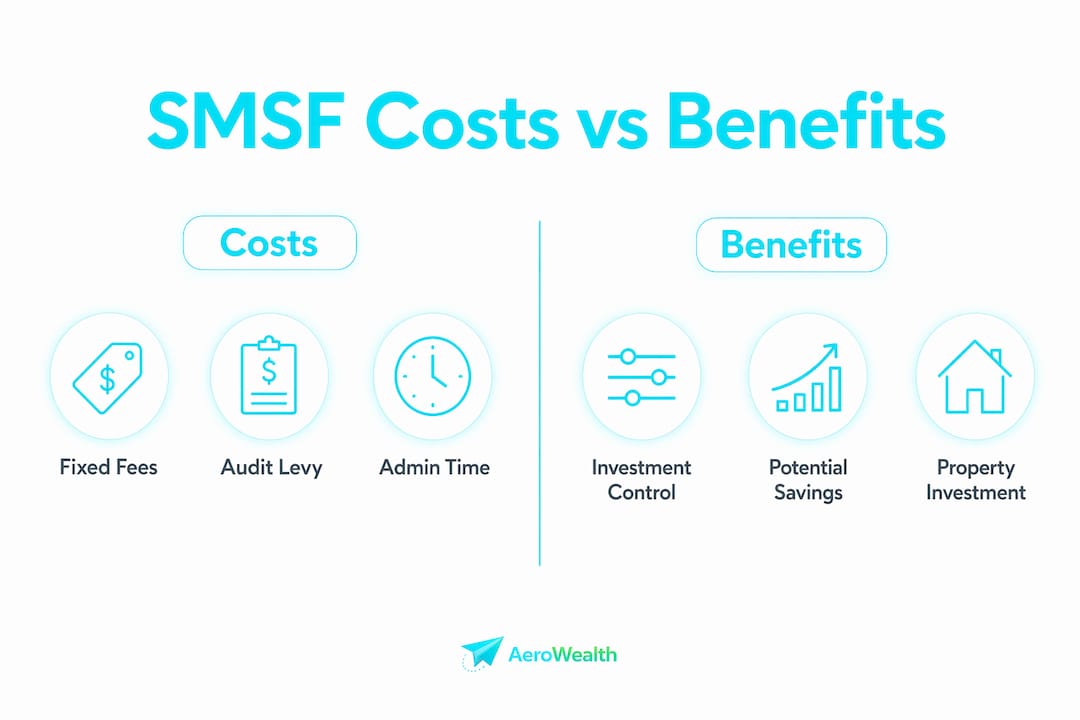
| Cost item | Indicative range | Frequency |
|---|---|---|
| ATO supervisory levy | ~$259 | Annual |
| Independent audit | $450–$800 | Annual |
| Accounting and administration | $1,200–$3,500+ | Annual |
| ASIC fee (corporate trustee) | Varies | Annual |
| Actuarial certificate (pension phase) | $200–$500 | When required |
| Property valuation | Varies | Annual (if property held) |
Sources: Cockatoo SMSF cost breakdown; Pinpoint Finance
Sources: Cockatoo SMSF cost breakdown; Pinpoint Finance
A simple break-even calculation: if your SMSF costs are around $4,000 per year, at a $100,000 balance that is a 4.0% effective fee, falling to 1.0% at a $400,000 balance and to 0.33% at $1,200,000. Well-run industry funds generally charge 0.5%–1.0% on mid-range balances, making the crossover point for cost-competitiveness usually between $400,000 and $600,000, depending on your exact cost structure and the alternative fund.
Property and limited recourse borrowing arrangements (LRBAs) change the picture materially. Lender pricing premiums, special documentation, annual valuations, and higher adviser fees all stack on top of the base costs above. Model LRBAs as a separate scenario, not a variation of the base case.
Pro Tip: Run two cost scenarios side by side: one where you outsource all administration (higher fixed cost, lower time) and one where you handle it yourself (lower cost, 8+ hours per month). The net benefit of DIY is often smaller than people expect once you price your own time.
Regulatory obligations and risks you cannot outsource
The ATO is unambiguous: trustees are personally responsible for fund compliance, even when they use professional administrators. Hiring an accountant does not transfer liability. That is not a technicality — it is the core risk of the structure.
Core trustee obligations include:
- Maintaining and regularly reviewing a written investment strategy
- Lodging annual returns and financial statements with the ATO
- Reporting transfer balance cap events (pension commencement, commutations)
- Meeting minimum pension payment rules each financial year
- Keeping records for at least five years (ten years for some documents)
- Arranging an independent annual audit
Non-compliance consequences range from administrative penalties to fund disqualification and punitive tax rates. SMSF members also lack access to AFCA and government compensation schemes for losses from fraud or theft — disputes are resolved at trustees' personal expense.
Trustee time reality: The average SMSF trustee spends more than 8 hours per month managing their fund. That is over 100 hours per year before any major transactions or compliance events.
Pension-phase complexity deserves special attention. Once a member starts a retirement income stream, actuarial certificates, minimum drawdown rules, and income stream reporting obligations all activate. Many trustees underestimate this shift.
Alternatives and hybrid approaches worth considering
An SMSF is not the only way to get more control over your super. Several structures deliver partial control with less governance burden.
- Platform-based accounts inside large funds: Some retail and industry platforms now allow direct share selection, ETF access, and term deposits within a managed account structure. You get investment choice without trustee liability.
- Managed accounts: A step up from a standard fund menu, these let you hold a personalized portfolio while a licensed manager handles compliance. Useful for investors who want direct shares but not the administration overhead.
- Family pooled funds: Adding a spouse or adult child to an existing SMSF spreads fixed costs across a larger combined balance and shares the trustee workload. Worth modelling before setting up a separate fund.
- Delaying setup: If your balance is $150,000–$200,000 and growing, staying in a low-cost industry fund for two to three more years while contributions accumulate can make the eventual SMSF economics significantly stronger.
When an alternative is clearly preferable: low balances, limited time, a need for insurance continuity, or no access to a specialist SMSF adviser. For a broader look at alternative retirement structures available to Australians, the options have expanded considerably in recent years.
Pro Tip: Test whether a platform account meets your core objective before committing to an SMSF. If direct ETF access is the main goal, a platform may deliver 80% of the benefit at 20% of the complexity. ETF investing in Australia is now accessible through multiple non-SMSF structures.
How to test the SMSF decision with scenario modelling
The decision is conditional and must be modelled against your specific circumstances and the alternative fund's actual competitiveness. Here is the framework.
Step-by-step modelling checklist:
- Set baseline assumptions: starting balance, annual contributions, expected net return, current fund fee rate, inflation, and target retirement age
- Calculate your SMSF effective fee rate at current balance, at $500,000, and at $1,000,000
- Model net retirement income and net asset value at three horizons: age 60, 67, and 75
- Run a downside stress test: what happens if returns average 2% below your central case for five consecutive years?
- Add the property/LRBA scenario as a separate model, not a variation of the base case
- If early retirement is the goal, model bridge years between your target retirement date and the super preservation age
Three scenarios that deliver the most decision value:
- Central case: Your most realistic assumptions, SMSF versus staying in your current fund, same return assumptions, different fee structures
- Downside stress: Sequence-of-returns risk combined with a compliance cost shock (e.g., a $5,000 unexpected adviser bill in year three)
- Property acquisition: Full LRBA cost stack, rental yield, capital growth assumption, and the impact on fund liquidity and diversification
Pro Tip: Sensitivity analysis on the fee rate is more decision-relevant than sensitivity on returns. A 0.5% difference in annual fees compounds dramatically over 20 years. Run the fee sensitivity first — it often resolves the decision before you need to stress-test returns.
Model your SMSF decision with Aerowealth
Most people try to answer the SMSF question with a spreadsheet and end up with a model that breaks when they change one assumption. Aerowealth is built specifically for this kind of retirement scenario modelling for Australians.

The platform lets you run side-by-side comparisons of an SMSF versus your current fund, model LRBA and property cash flows, stress-test sequence-of-returns risk, and project bridge years if you plan to retire before your super preservation age. CGT and tax impact modelling are built in, so you can see the after-tax outcome, not just the gross return. Aerowealth reports a planning success rate of up to 94% among users who complete a full scenario comparison.
The free plan covers core scenario modelling. The Pro plan adds expanded scenario comparisons, advanced mortgage and offset features, and a higher AI assistant quota for questions about how Australian rules apply to your projections. Start with the break-even template and run your central case first — it takes about 20 minutes and usually tells you more than hours of spreadsheet work.
Key Takeaways
An SMSF is worth it when your balance, time, and investment goals align — and modelling that alignment before you commit is the only way to know for certain.
| Point | Details |
|---|---|
| Balance threshold | $200,000 is the widely cited minimum for cost-competitiveness with large funds. |
| Fixed cost structure | Running costs of roughly $4,000 per year favor larger balances; the effective fee rate drops sharply as the fund grows. |
| Trustee liability | Personal legal responsibility cannot be outsourced, even when you use professional administrators. |
| Time commitment | Expect more than 8 hours per month; pension-phase obligations add further complexity. |
| Aerowealth next step | Run a side-by-side break-even scenario in Aerowealth to compare your SMSF effective fee against your current fund before deciding. |
The SMSF decision is more about behavior than balance
The balance threshold gets most of the attention, and it matters. But in practice, the trustees who regret setting up an SMSF almost never cite the cost as the primary problem. They cite the time, the complexity creep, and the moment they realized they had been running a regulated trust without fully understanding what that meant.
Three mistakes come up repeatedly. First, underestimating the time: eight hours a month sounds manageable until you add a property transaction, a pension commencement, or a compliance notice from the ATO. Second, ignoring pension-phase rules: the compliance load shifts significantly once drawdowns begin, and many trustees are not prepared for actuarial certificates and minimum pension obligations. Third, failing to stress-test an LRBA before committing: the numbers look attractive on a rising property market and look very different when rental income drops or interest rates move.
The confidence check is simple. If you can answer yes to three questions — Do I have a specific investment goal this structure uniquely enables? Do I have the time or the budget to outsource administration properly? Have I modelled the break-even against my actual alternative fund? — proceed to set up. If any answer is uncertain, keep modelling or speak to a licensed adviser first.
Useful sources and further reading
The sources below are the primary references for compliance facts, cost benchmarks, and modelling guidance in this article.
For compliance and trustee obligations:
- ATO: About SMSFs — start here for trustee duties, penalties, and the legal framework
- ATO: Compare SMSFs with other super funds — side-by-side regulatory comparison
- MoneySmart: SMSF guide — plain-language overview of trustee responsibilities and insurance risks
For cost benchmarking:
- Cockatoo: SMSF costs and fees — itemized cost ranges for audit, levy, and administration
- Pinpoint Finance: How much does it cost to run an SMSF? — fixed-cost structure and effective fee methodology
For modelling and planning:
- Aerowealth retirement planning tools — scenario modelling, break-even templates, and SMSF versus industry fund comparisons
- Aerowealth: retirement planning guide — broader planning context and when to involve advisers
"An SMSF is genuinely the right choice for some Australians and genuinely the wrong choice for others. The decision is conditional and must be modelled against current industry fund offerings and individual circumstances." — Hudson Financial Planning / Kalkine Education, 2026
If you are new to self-directed investing, the Investing for Beginners eBook is a useful primer on the investment fundamentals that underpin SMSF decision-making.
FAQ
How much do you need for an SMSF to be worth it?
Most industry research and ATO guidance points to $200,000 as the minimum combined balance for an SMSF to be cost-competitive with large funds. Below that level, fixed annual running costs consume a disproportionate share of returns.
How many hours does managing an SMSF actually take?
Trustees spend more than 8 hours per month on average, or over 100 hours per year, according to industry data referenced by MoneySmart. That figure rises during property transactions, pension commencements, or compliance events.
Can you lose your insurance when switching to an SMSF?
Yes. Existing group insurance cover inside your current fund may be lost or repriced when you roll over to an SMSF, and replacement cover for older or higher-risk members can be significantly more expensive.
What happens if your SMSF breaches compliance rules?
The ATO can impose administrative penalties, disqualify trustees, and apply punitive tax rates to the fund. Trustees remain personally liable even when they use professional administrators or advisers.
How does Aerowealth help with the SMSF decision?
Aerowealth lets you run side-by-side scenario comparisons of an SMSF versus your current fund, including break-even modelling, LRBA cash flows, CGT impact, and bridge-year projections for early retirement — all within a single plan.