
Exchange-Traded Funds (ETFs) are ASX-listed investment funds that give you instant exposure to a diversified basket of assets, from Australian shares to global bonds, all in a single trade. The Australian ETF market has grown to exceed $230 billion in funds under management, making it one of the fastest-growing retail investment categories in the country. ETFs in Australia trade on the ASX just like ordinary shares, yet they carry the diversification of a managed fund at a fraction of the cost. This guide covers how they work, what types exist, how to buy them, and which strategies actually build wealth over time.
How do ETFs work on the ASX?
An ETF is a fund that holds a collection of assets, such as shares, bonds, or commodities, and trades on the ASX throughout the day at a live market price. Unlike a managed fund, which prices once daily after market close, an ETF gives you real-time pricing and the ability to buy or sell at any point during trading hours.
The price of an ETF stays close to its net asset value (NAV) through a process called creation and redemption. Market makers arbitrage any price gap by creating new ETF units or redeeming existing ones, which keeps the trading price tightly aligned with the value of the underlying assets. This mechanism protects you from paying a large premium or receiving a steep discount when you trade.

Main ETF types available on the ASX
Australian investors can choose from several broad categories:
- Australian shares ETFs track indexes like the S&P/ASX 200 or ASX 300, giving you exposure to the largest domestic companies. Management expense ratios (MERs) for broad index ETFs typically sit at the lower end of the fee range.
- International shares ETFs track global indexes such as the MSCI World or S&P 500, giving you access to US, European, and Asian markets without a foreign brokerage account.
- Bond and fixed income ETFs hold government or corporate bonds and provide income with lower volatility than shares.
- Diversified multi-asset ETFs bundle Australian shares, international shares, and bonds into a single fund at a set risk profile, such as conservative, balanced, or growth.
- Sector and thematic ETFs focus on specific industries like technology, healthcare, or clean energy.
Physical ETFs hold the actual underlying assets. Synthetic ETFs use derivatives to replicate index returns. The vast majority of ETFs listed on the ASX are physical, which means you have a direct claim on real assets. Compared to traditional managed funds, ETFs offer cost advantages and transparency that benefit long-term investors, particularly because you can see exactly what you own at any time.
How to buy ETFs in Australia: a step-by-step guide
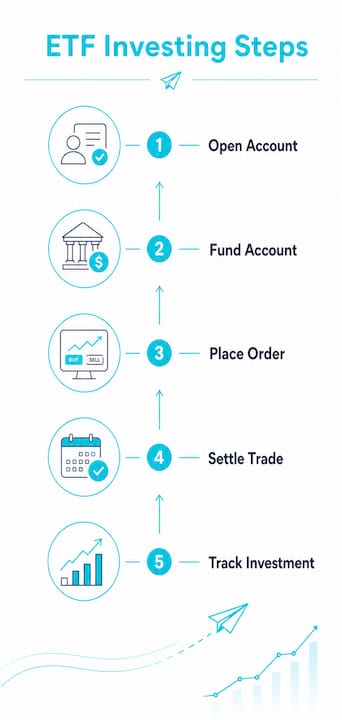
Buying an ETF on the ASX takes four practical steps: open a brokerage account, fund it, place an order, and wait for settlement.
Step 1: Open a brokerage account
You need an ASX-linked brokerage account before you can trade. The key choice is between a CHESS-sponsored account and a custodian account. A CHESS-sponsored account registers your ETF holdings directly in your name with the ASX Clearing House Electronic Subregister System. A custodian account holds assets in the broker's name on your behalf. CHESS sponsorship gives you clearer direct ownership and is generally preferred for long-term investors.
Step 2: Fund your account and understand fees
Brokerage fees range from $0 to $19.95 per trade depending on the platform you choose. That range matters a lot when you invest small amounts. A $9.95 brokerage fee on a $200 trade costs you nearly 5% before your ETF even moves. Keeping brokerage below 0.5% of your trade size is a practical rule of thumb.
Step 3: Place your order
You have two main order types. A market order executes immediately at the best available price. A limit order lets you set the maximum price you will pay. Experienced investors prefer limit orders to avoid buying at unfavorable prices during volatility or in low-liquidity conditions. For most broad-market ETFs with high trading volumes, the difference is small. For niche or thematic ETFs with fewer buyers and sellers, a limit order can save you real money.
Pro Tip: ETF prices stabilize and better reflect NAV about 30 minutes after the ASX opens at 10:00 AM. Placing your order mid-morning rather than at the open typically reduces the bid-ask spread you pay.
Step 4: Settle and track
ETF trades settle on a T+2 cycle, meaning the cash and units exchange hands two business days after your trade. Plan your cash timing accordingly. Many brokers, including platforms like Pearler, offer automated recurring purchases that support dollar cost averaging without requiring you to log in each time.
What are the costs, risks, and tax rules for Australian ETFs?
Understanding the full cost of owning an ETF goes beyond the headline management fee.
Fee layers to know
Management fees range from 0.04% to around 0.48% per year, depending on the ETF type. Broad index ETFs sit at the lower end. Thematic or actively managed ETFs sit at the higher end. On top of the MER, you pay brokerage on every buy and sell, plus an indirect cost called the bid-ask spread, which is the gap between the buy price and the sell price at any moment.
Tax considerations
Australian ETFs pay distributions that include dividends, interest, and sometimes capital gains. Most ETFs offer a Distribution Reinvestment Plan (DRP), letting you take new units instead of cash. Franking credits attached to Australian share ETF distributions represent corporate tax already paid by the underlying companies. For investors with a marginal tax rate below 30%, including many retirees, franking credits can generate a direct tax refund. That makes dividend-paying Australian ETFs particularly attractive for retirement portfolios.
Capital gains tax applies when you sell ETF units at a profit. Holding units for more than 12 months qualifies you for the 50% CGT discount. The Australian FIRE Calculator from Aerowealth models CGT events alongside your broader retirement plan, which helps you time sales more efficiently.
Pro Tip: If your ETF pays foreign income, you may be eligible for a Foreign Income Tax Offset (FITO) to avoid double taxation. Check your annual tax statement from the ETF provider.
Key risks to weigh
- Market risk: All share ETFs fall when markets fall. Diversification reduces but does not eliminate this risk.
- Sector concentration: The ASX is heavily weighted toward financials at 28% and materials at 20%. An ASX-only portfolio carries significant sector concentration risk.
- Tracking error: Some ETFs do not perfectly replicate their index, especially synthetic or less liquid funds.
- Liquidity risk: Niche ETFs with low trading volumes can have wide bid-ask spreads, raising your effective cost.
Which ETF strategies work best for Australian investors?
The most effective ETF strategy for most Australian investors combines domestic and international exposure, keeps costs low, and invests consistently over time.
Balancing domestic and international shares
The ASX concentration in financials and materials means a portfolio of only Australian ETFs carries real sector risk. A split of roughly 40–60% international shares and 40–60% Australian shares counterbalances this. International ETFs give you access to technology, healthcare, and consumer sectors that are underrepresented on the ASX.
Three core ETF investing strategies
Strategy 1: The single diversified ETF approach. One multi-asset ETF handles the allocation for you. This suits investors who want simplicity and are comfortable with the fund manager's chosen split. The trade-off is slightly higher fees than building your own portfolio from separate funds.
Strategy 2: The two-fund or three-fund portfolio. You combine one Australian shares ETF with one international shares ETF, and optionally one bond ETF. This gives you control over your allocation and typically lower total fees. It requires occasional rebalancing, perhaps once a year, to maintain your target split.
Strategy 3: Dollar cost averaging with automated contributions. You invest a fixed dollar amount each month regardless of market conditions. This removes the temptation to time the market and smooths your average purchase price over time. Deciding how much to invest in an ETF per month depends on your income, expenses, and retirement timeline. Aerowealth's scenario modeling tools let you test different monthly contribution amounts against your retirement goals.
The right strategy depends on your risk tolerance, time horizon, and tax situation. Investors close to retirement often shift toward bond ETFs and income-focused Australian ETFs to capture franking credits. Younger investors with a 20-plus-year horizon typically hold a higher share of international growth ETFs.
Key Takeaways
Australian ETFs deliver diversified, low-cost market exposure through the ASX, and combining domestic and international funds with consistent monthly contributions is the most reliable path to long-term wealth.
| Point | Details |
|---|---|
| ETF pricing mechanism | Market makers keep ETF prices near NAV through continuous creation and redemption of units. |
| Fee awareness | MERs range from 0.04% to 0.48%; brokerage and bid-ask spreads add to the real cost of each trade. |
| Tax advantage | Franking credits on Australian share ETFs can generate tax refunds for investors with marginal rates below 30%. |
| Portfolio balance | Splitting 40–60% between Australian and international ETFs reduces ASX sector concentration risk. |
| Consistent investing | Dollar cost averaging through automated monthly purchases removes market timing risk and builds discipline. |
The case for keeping it boring
The most common mistake I see Australian investors make with ETFs is overcomplicating things. They research 15 different funds, agonize over which thematic ETF will outperform, and end up either paralyzed or constantly tinkering with their portfolio. The data does not support that approach.
The investors who build real wealth with ETFs tend to pick two or three broad-market funds, set up an automatic monthly contribution, and leave it alone. Franking credits make Australian share ETFs genuinely attractive for income-focused investors, but chasing the highest yield often means concentrating in the same financials and materials sectors the ASX already overweights. Balance matters more than optimization.
One thing that rarely gets discussed is the psychological cost of complexity. Every additional ETF in your portfolio is another decision point, another tax event, and another thing to monitor. Simplicity is not just convenient. It is a genuine performance advantage because it keeps you invested through downturns instead of reacting to them.
If you are starting out, a single diversified multi-asset ETF is a perfectly legitimate long-term strategy. As your portfolio grows and your understanding deepens, you can add a separate international fund to reduce fees. The goal is not the perfect portfolio. The goal is a good portfolio you actually stick with.
— Aerowealth Team
Plan your ETF portfolio with Aerowealth
Knowing which ETFs to buy is only half the picture. Understanding how your monthly contributions, asset allocation, and tax position combine to shape your retirement is where most investors lack clarity.
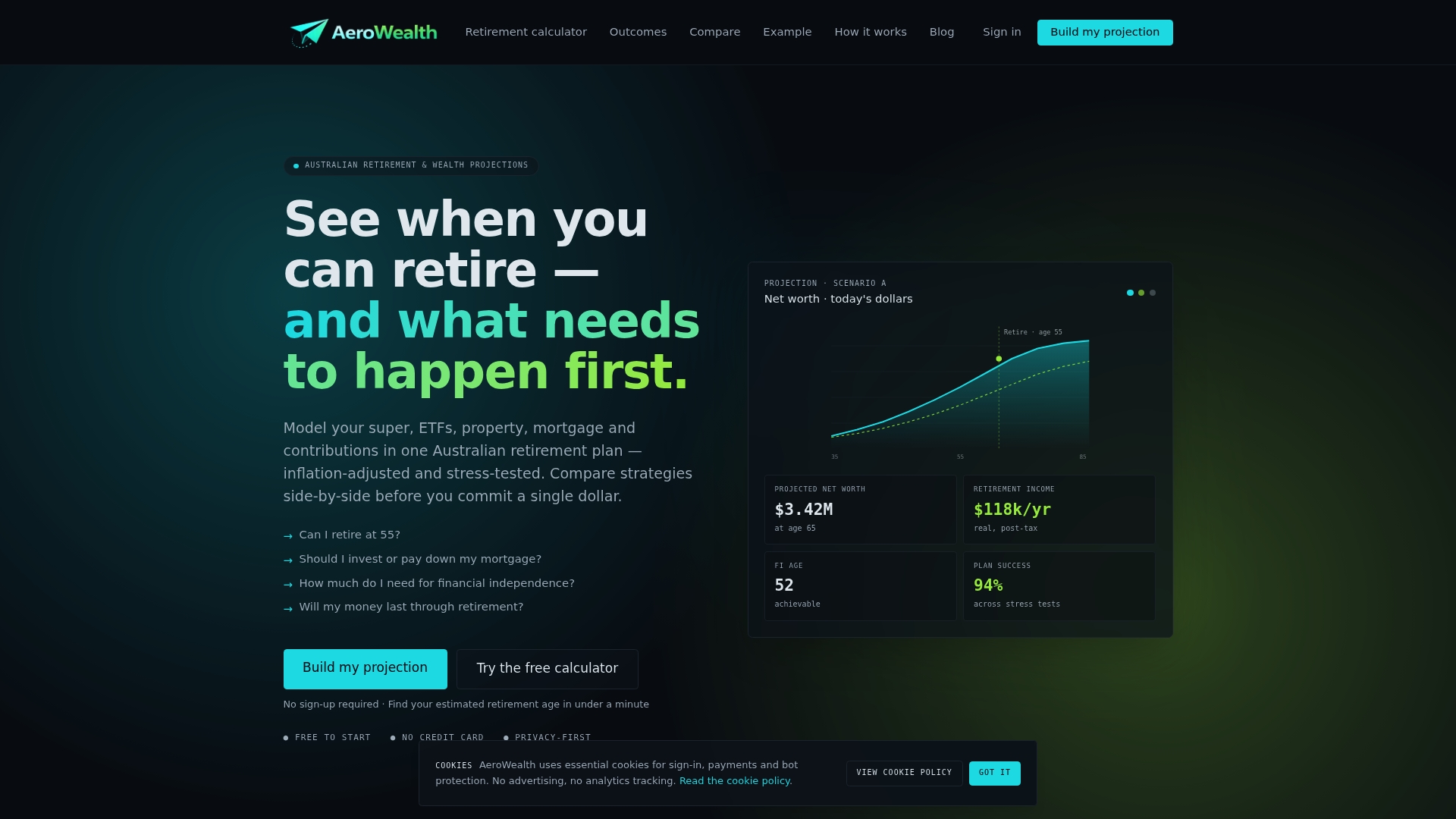
Aerowealth is built specifically for Australian investors who want to see exactly how their financial decisions play out over time. The platform models superannuation, property, ETF contributions, and capital gains tax side by side, so you can compare scenarios without building a spreadsheet from scratch. Aerowealth reports planning success rates of up to 94%, giving you a clear picture of your retirement readiness before you commit to a strategy. Check the Aerowealth pricing page to find the plan that fits your situation.
FAQ
What are ETFs in Australia?
ETFs are ASX-listed investment funds that hold a basket of assets and trade like ordinary shares throughout the day. They give investors diversified exposure to shares, bonds, or other assets at low cost.
How much should I invest in an ETF per month?
The right monthly amount depends on your income, expenses, and retirement timeline. A consistent contribution, even a small one, builds wealth through dollar cost averaging over time.
Are ETFs better than managed funds in Australia?
ETFs generally offer lower fees, greater transparency, and better tax efficiency than traditional managed funds, making them the preferred choice for most long-term retail investors.
What are the risks of investing in Australian ETFs?
The main risks include market risk, ASX sector concentration in financials and materials, tracking error, and liquidity risk in niche or low-volume funds.
Do Australian ETFs pay franking credits?
Australian share ETFs often distribute franking credits alongside dividends. Investors with marginal tax rates below 30% can receive a tax refund for the corporate tax already paid by the underlying companies.