
An alternative retirement plan is defined as a deliberate mix of superannuation-based income, non-traditional investment accounts, and outside-super assets structured to fund retirement across multiple life stages. Only 18% of Australians aged 45–75 have a clear retirement plan, with nearly half worried about running out of money. That gap between anxiety and action is exactly where diversified retirement income strategies prove their worth. Relying on a single super fund payout is no longer enough. The most effective approach combines account-based pensions, Innovative Retirement Income Streams (IRIS), and liquid outside-super investments to manage both longevity risk and cash flow needs.
What retirement income options make up an alternative retirement plan?
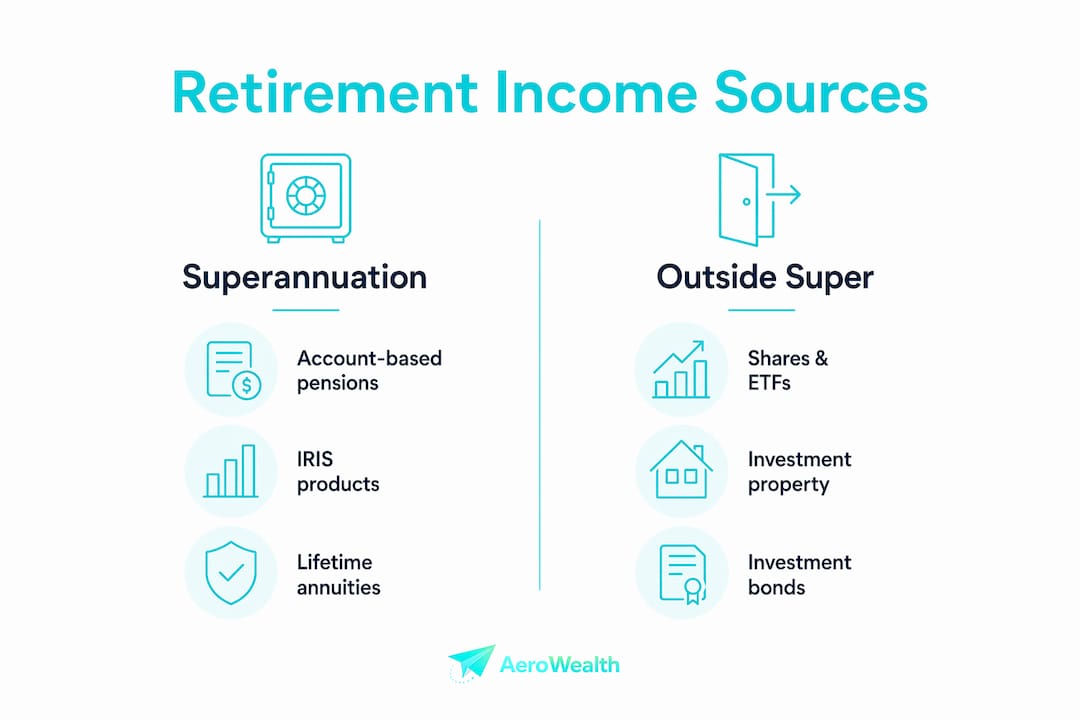
A well-structured retirement income plan draws from at least three distinct sources: superannuation-based products, government support, and outside-super investments. Each source serves a different function, and the combination you choose determines both your flexibility and your financial security.
Account-based pensions
An account-based pension (ABP) converts your super balance into a regular income stream after you reach preservation age. ABPs offer flexibility because you control how much you draw down and when. The trade-off is longevity risk: if markets fall or you live longer than expected, the balance can run out. ABPs work best as the flexible layer of a retirement portfolio, not the only layer.
Lifetime annuities and IRIS products
Retirement strategies often blend account-based pensions with Innovative Retirement Income Streams, which pay income for life with higher starting income but less liquidity. That guaranteed income floor removes the fear of outliving your savings. Lifetime annuities operate similarly, providing fixed or inflation-linked payments regardless of market conditions. Both products suit retirees who want certainty over control.
Outside-super investments
Shares, exchange-traded funds (ETFs), investment property, and investment bonds all qualify as outside-super retirement assets. Early retirement before preservation age requires accessible outside-super investments like shares, ETFs, or property to fund living expenses. This is the layer most Australians overlook entirely. Investment bonds offer a tax-free withdrawal benefit after 10 years and bypass estate probate, making them an often-overlooked outside-super alternative.

Government Age Pension
The Age Pension acts as a partial income floor for most Australians. Means testing applies to both assets and income, so the structure of your retirement portfolio directly affects your eligibility. IRIS products and certain annuities receive favorable treatment under means testing, which makes them more valuable than their face value suggests.
Pro Tip: Map your expected annual expenses before choosing any product. Separate non-negotiable costs (rent, food, health) from discretionary spending (travel, hobbies). That split determines how much guaranteed income you actually need.
How do Innovative Retirement Income Streams (IRIS) enhance retirement security?
IRIS is a regulatory category introduced in Australia in 2017 to expand retirement income options beyond traditional account-based pensions and lifetime annuities. IRIS products are regulated, pooling longevity risk and offering retirement income with preferred Age Pension means-test treatment but limited liquidity. That regulatory structure is what makes IRIS genuinely different from a standard managed fund.
How IRIS pools longevity risk
IRIS products work by pooling contributions from many members. Participants who die earlier effectively subsidize income payments to those who live longer. This pooling mechanism allows IRIS providers to offer higher starting income than an account-based pension of the same size. The result is more income in early retirement when spending tends to be highest.
Means-test advantages
IRIS products receive discounts on both the assets test and the income test for the Age Pension. That preferential treatment can increase your Age Pension entitlement compared to holding the same money in an ABP. For retirees near the means-test thresholds, this difference can be worth thousands of dollars per year.
| Feature | Account-based pension | IRIS product |
|---|---|---|
| Income guarantee | No | Yes (for life) |
| Liquidity | High | Limited |
| Longevity risk | Borne by individual | Pooled across members |
| Age Pension means-test treatment | Standard | Discounted (favorable) |
| Market exposure | Full | Partial (varies by product) |
Trade-offs to understand
IRIS products require limited commutation, meaning you cannot easily withdraw a lump sum once you commit. IRIS products are regulatory categories requiring limited commutation and offer deferred income options to hedge longevity risk effectively. Deferred IRIS products, which start paying income at age 80 or 85, cost less upfront and act as insurance against extreme longevity. Most financial advisers recommend allocating 20%–40% of super to IRIS, with the remainder in an ABP for flexibility.
Pro Tip: Ask any IRIS provider for the "income projection at age 90" figure before signing. That number tells you whether the product actually solves your longevity risk or just delays it.
Why is a diversified retirement income strategy critical before and after preservation age?
Preservation age in Australia is currently 60 years. Super is locked until you reach that age and meet a condition of release. That rule creates a funding gap for anyone who wants to retire at 55 or even 58.
Funding the pre-60 gap
The outside-super bridge is the term financial advisers use for liquid, tax-effective assets that cover living costs until preservation age. Shares and ETFs held in a personal name or family trust provide accessible income without triggering super rules. Investment property can also serve this role, though rental income is less predictable than dividends. The key is building this bridge well before you plan to stop working.
The floor-and-flex framework
Most retirees benefit from combining lifetime income products with flexible account-based pensions to separate essential from discretionary spending. This approach is called the floor-and-flex framework. The floor covers non-negotiable expenses through guaranteed income (IRIS, annuities, Age Pension). The flex layer covers discretionary spending through an ABP or outside-super portfolio. Structuring retirement this way removes the anxiety of watching a single account balance decline.
Steps to build a diversified retirement income strategy
- Calculate your income floor. Add up your essential monthly expenses. That total is the minimum your guaranteed income sources must cover.
- Identify your preservation age gap. If you plan to retire before 60, calculate how many years of outside-super income you need and what assets will fund them.
- Allocate super between ABP and IRIS. Decide what percentage of your super balance will go into a guaranteed product versus a flexible account-based pension.
- Assess Age Pension eligibility. Model your assets and income against current means-test thresholds to see whether IRIS or annuities improve your entitlement.
- Review tax implications. Super income streams are generally tax-free after age 60, but outside-super income (dividends, rent, bond withdrawals) may attract income tax. Integrated planning across both pools reduces your overall tax burden.
Legislative considerations
Shifting legislation and tax rules make professional integrated retirement plans critical for optimal outcomes. Self-managed super fund (SMSF) property rules, transfer balance cap limits, and contribution caps all interact with outside-super strategies in ways that change regularly. A plan built in 2022 may no longer be optimal in 2026.
How to evaluate and implement alternative retirement plans tailored to your situation
Assessing your retirement readiness starts with three numbers: your current super balance, your expected annual expenses in retirement, and your target retirement age. Those three inputs determine whether your existing plan has a gap and how large that gap is.
Key factors to evaluate
- Longevity risk. Australians are living longer. A 65-year-old woman today has a median life expectancy past 88. Plan for at least 25 years of retirement income.
- Sequence-of-returns risk. A market downturn in the first five years of retirement does far more damage than one in year 20. Guaranteed income products reduce this exposure.
- Liquidity needs. Health costs, home repairs, and family support needs are unpredictable. Keep at least 12 months of expenses in accessible cash or near-cash assets.
- Tax efficiency. Blending super and outside-super income sources lets you manage your taxable income each year, potentially keeping you in a lower tax bracket.
- Estate planning. Outside-super assets like investment bonds pass outside the estate and avoid probate delays. Super death benefits have their own tax rules depending on who receives them.
Tools that help
The ASIC Moneysmart Retirement Hub provides calculators and tools to help Australians better plan and understand their retirement income streams. The hub is free and covers account-based pension projections, Age Pension estimates, and basic income stream comparisons. For more detailed scenario modeling, including side-by-side comparisons of different asset mixes and stress tests against market downturns, purpose-built planning tools go further than any government calculator. Aerowealth's retirement scenario modeling lets you input superannuation, property, and mortgage variables together to see how different decisions affect your projected retirement age and income.
Common pitfalls to avoid
- Treating super and outside-super assets as separate, unrelated pools. Most Australians unknowingly treat super and non-super assets as exclusive, but the best strategies blend them to achieve early retirement goals and long-term security.
- Defaulting to an account-based pension without considering IRIS or annuities, then facing longevity risk in their 80s.
- Ignoring the Age Pension entirely because they expect to be "too wealthy." Means-test thresholds change, and many retirees qualify for at least a part pension.
- Delaying planning until age 60. The outside-super bridge takes years to build. Starting at 45 gives you 15 years of compounding growth before you need the funds.
Pro Tip: Run at least two retirement scenarios: one where you retire at your target age and one where you retire five years later. The difference in projected income often reveals whether your current savings rate is on track.
Key Takeaways
An alternative retirement plan works best when it combines guaranteed lifetime income, a flexible super account, and liquid outside-super assets to cover every stage of retirement.
| Point | Details |
|---|---|
| Diversify income sources | Blend account-based pensions, IRIS products, and outside-super assets to reduce longevity and liquidity risk. |
| Build an outside-super bridge | Accumulate shares, ETFs, or investment bonds to fund living costs before preservation age at 60. |
| Use the floor-and-flex framework | Assign guaranteed income to essential expenses and flexible assets to discretionary spending. |
| Leverage IRIS means-test benefits | IRIS products receive favorable Age Pension means-test treatment, potentially increasing your entitlement. |
| Start modeling early | Planning before age 50 gives you time to adjust contributions, asset allocation, and retirement age targets. |
The misconception that costs Australians the most
The most damaging belief I see is that superannuation is the retirement plan. It is not. Super is one component of a retirement plan, and treating it as the whole picture leaves most Australians exposed to at least two serious risks: running out of money in their 80s, and having no accessible income if they want to retire before 60.
The floor-and-flex framework changed how I think about retirement income. The question is not "how much super do I have?" It is "how much guaranteed income do I need, and what fills the gap?" Those are completely different questions, and they lead to completely different portfolios.
The other misconception worth addressing: IRIS products sound complex, so people avoid them. The complexity is mostly regulatory, not practical. Once you understand that IRIS pools your longevity risk with other members and rewards you with higher income and better Age Pension treatment, the logic is straightforward. The trade-off is liquidity, and for most retirees with an ABP running alongside, that trade-off is entirely manageable.
Regulatory change is the wild card. Super tax rules, transfer balance caps, and means-test thresholds shift regularly. A plan that was optimal three years ago may now be leaving money on the table. Adaptive planning is not optional. It is the only kind that works.
— Aerowealth Team
Aerowealth tools for modeling your retirement income mix
Retirement planning gets clearer when you can see the numbers side by side rather than guessing at outcomes.
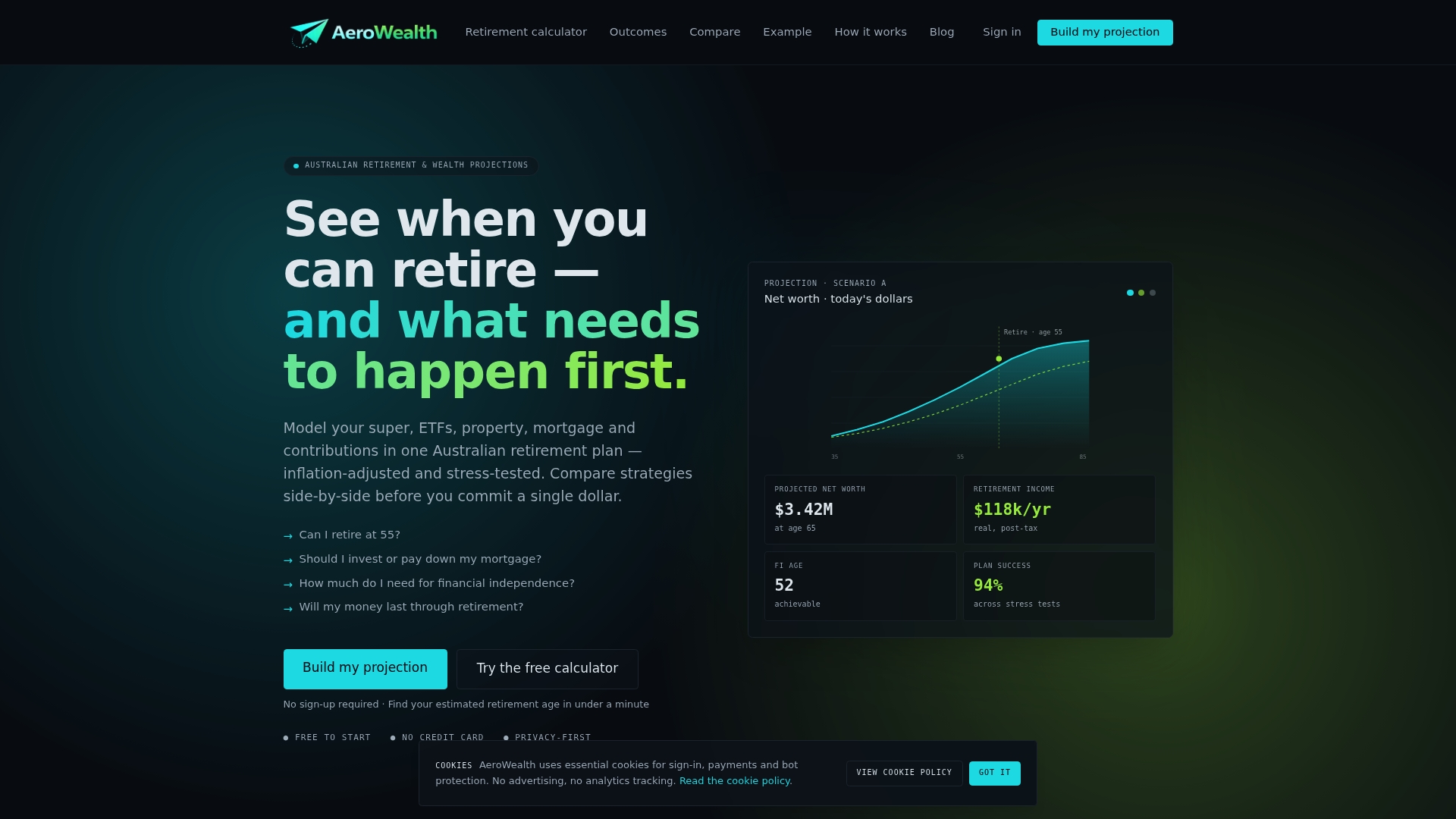
Aerowealth is built specifically for Australians who want to model superannuation, property, and outside-super investments together in one place. The platform runs side-by-side scenario comparisons and stress tests so you can see exactly how different income mixes affect your projected retirement age and net worth. Aerowealth reports planning success rates of up to 94%. For Australians weighing account-based pensions, IRIS products, and outside-super strategies, that kind of clarity is the difference between guessing and deciding. Check the Aerowealth pricing page to find the plan that fits your planning needs.
FAQ
What is an alternative retirement plan?
An alternative retirement plan combines superannuation-based income streams with non-traditional income sources such as IRIS products, investment bonds, shares, and property to fund retirement across multiple life stages.
What are Innovative Retirement Income Streams (IRIS)?
IRIS are a regulated category of superannuation income products introduced in Australia in 2017 that pool longevity risk among members and provide lifetime income with favorable Age Pension means-test treatment.
How do I fund retirement before preservation age?
Australians who retire before age 60 must rely on outside-super assets such as shares, ETFs, or investment bonds to cover living expenses until they can access their superannuation.
Is the Age Pension part of an alternative retirement strategy?
The Age Pension functions as a partial income floor and interacts directly with your asset and income structure. Choosing IRIS or annuities over account-based pensions can improve your Age Pension entitlement through means-test discounts.
What is the floor-and-flex retirement framework?
The floor-and-flex framework assigns guaranteed income products to cover essential expenses and flexible assets like account-based pensions to cover discretionary spending, reducing the risk of outliving your savings.