
For most Australians, an industry super fund is the smarter default until your balance clearly justifies the cost and complexity of a self-managed super fund (SMSF). The practical break-even point where an SMSF becomes cost-competitive sits at a high balance once you count administration, audit, advice, and replacement insurance. Below that threshold, industry funds like AustralianSuper typically deliver better net outcomes through lower percentage-based fees, professional governance, and built-in group insurance.
The core trade-off is control versus convenience. An SMSF hands you direct ownership of assets, timing over tax events, and access to investments like business real property. An industry fund handles everything professionally, costs less at lower balances, and protects you from personal trustee liability.
Three quick signals to orient your decision:
- Stay in an industry fund if your balance is relatively low, you have no interest in active management, or you cannot afford to replace your group insurance affordably.
- Consider an SMSF if your balance is significantly higher, you want to hold direct property or business real property, or you have specific estate planning needs that a standard fund cannot accommodate.
- Model your position first if you are in the borderline range or unsure how costs stack up against your expected return differential.
Pro Tip: Never compare just the headline fund fees. Add the full SMSF cost stack: administration, annual audit, ATO supervisory levy, licensed advice if you use it, and the premium difference for replacing your group insurance individually. That total number is what you actually compare against an industry fund's percentage fee.
Table of Contents
- How does an SMSF work, and what are your obligations as a trustee?
- What is an industry super fund and what does it do for members?
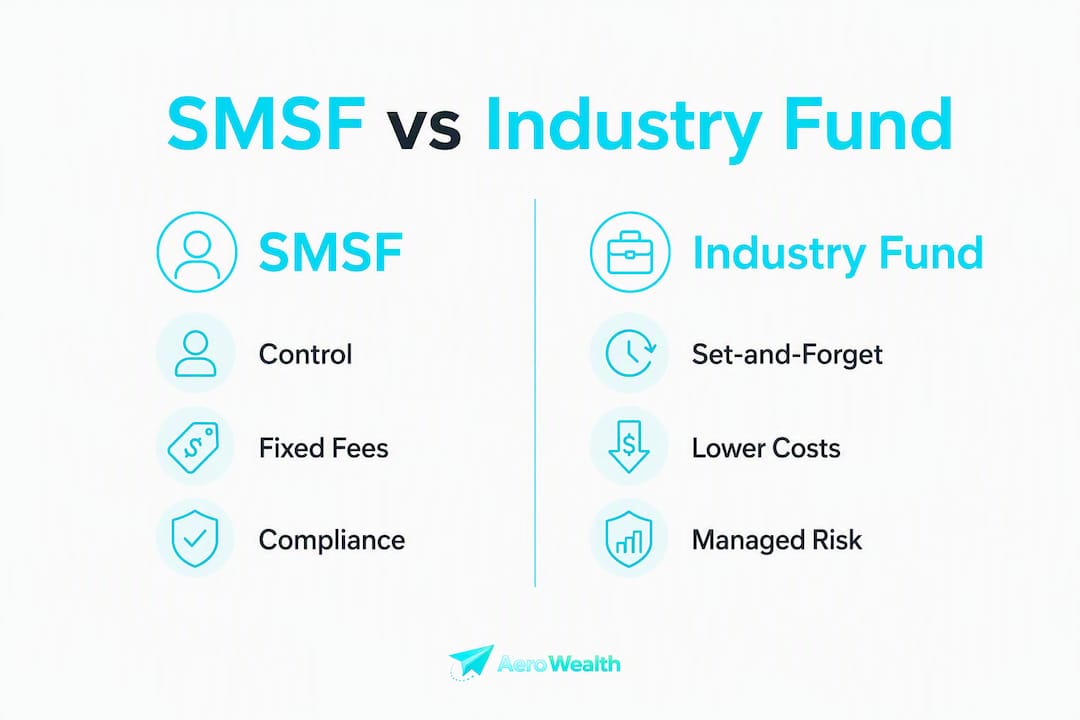
- SMSF vs industry fund: a side-by-side comparison
- What are the real advantages of running an SMSF?
- What makes industry super funds the right choice for most investors?
- How much does an SMSF actually cost, and when does it break even?
- Is an SMSF right for you? A decision checklist
- What are the compliance risks trustees face, and what does the ATO expect?
- Tax differences that matter: accumulation phase vs pension phase
- Can you hold an SMSF and an industry fund at the same time?
- How to model whether an SMSF or industry fund suits your situation
- Key Takeaways
- The case for modelling before you commit
- See your SMSF vs industry fund numbers before you decide
- Useful sources
- FAQ
How does an SMSF work, and what are your obligations as a trustee?
A self-managed super fund is a private superannuation trust where the members and the trustees are the same people. You run it for your own retirement benefit, and the Australian Taxation Office is your regulator. An SMSF can have up to six members, and every member must be a trustee (or a director of a corporate trustee).

That trustee role is where most people underestimate the commitment. The ATO requires trustees to exercise honesty, care, skill, and diligence; meet the sole purpose test; develop and regularly review a documented investment strategy; value assets annually; arrange an independent annual audit; and lodge a Self-Managed Superannuation Fund Annual Return (SAR). These are not optional tasks you can skip in a busy year.
Arranging insurance is entirely your responsibility. Unlike an industry fund, there is no default cover. Life, total and permanent disability, and income protection insurance must be sourced individually, often at higher premiums than group rates. Time commitment is real too: trustees typically spend several hours per month on administration, investment decisions, and compliance monitoring.
What is an industry super fund and what does it do for members?
Industry super funds operate on a profit-to-member model. Surpluses go back to members rather than to shareholders, and the fund is governed by a professional trustee board regulated by the Australian Prudential Regulation Authority (APRA). Members do not carry personal trustee liability.
AustralianSuper is the largest example in Australia, managing hundreds of billions in pooled assets across a range of investment options. That scale matters: pooled funds can access infrastructure, private equity, and large-scale property that individual SMSFs cannot reach at comparable cost. Most industry funds offer:
- Pre-built investment options (balanced, growth, high growth, index, conservative) that suit different risk profiles without requiring active management.
- Default MySuper products that automatically apply when a member does not make an active choice.
- Group insurance (life, TPD, income protection) bundled at wholesale rates, often significantly cheaper than individual cover.
- Professional governance with APRA oversight, internal compliance teams, and access to the Australian Financial Complaints Authority (AFCA) for dispute resolution.
The "set-and-forget" description fits most members well. You contribute, the fund invests, and you collect at retirement. There is no annual audit to arrange, no SAR to lodge, and no personal liability if markets move against you.
SMSF vs industry fund: a side-by-side comparison

The decision hinges on eight concrete dimensions. Here is how the two structures compare:
| Dimension | SMSF | Industry Fund |
|---|---|---|
| Fees and ongoing costs | Fixed dollar costs (admin, audit, levy) regardless of balance; typically $3,000–$6,000+ per year | Percentage-based fees; lower cost for smaller balances |
| Level of control | Full control: you choose every asset, timing, and strategy | Professional manager decides; member chooses investment option |
| Investment options | Direct shares, ETFs, direct property, business real property, LRBAs, alternatives | Pre-built options; some funds offer direct shares or ETFs via member-directed options |
| Insurance | Must be arranged separately; individual underwriting applies | Default group cover included; often cheaper and automatic |
| Regulation and compliance | ATO-regulated; trustee personally liable; annual audit and SAR required | APRA-regulated; professional trustee carries liability; no member compliance burden |
| Break-even balance | Competitive from approximately $500,000–$800,000+ | Cost-effective at all balances below break-even |
| Tax treatment | 15% in accumulation; 0% on earnings supporting pension accounts; trustee controls timing | Same statutory rates; fund manages timing across pooled members |
| Time and skill required | Several hours per month; investment knowledge needed | Minimal; no active management required |
The cost crossover is the most misunderstood point. SMSF administration and audit costs are largely fixed, so they shrink as a percentage of a large balance. At lower balances, fixed costs represent a higher percentage of assets, and at higher balances, they decrease proportionally. An industry fund charging a percentage fee costs more as balance increases. The lines cross somewhere at a substantial balance depending on your specific cost structure.
Pro Tip: Consult the ATO's trustee obligations page before setting up an SMSF. The legal duties are non-trivial, and understanding them upfront prevents costly compliance failures later.
What are the real advantages of running an SMSF?
The benefits of an SMSF are genuine, but they depend heavily on the trustee having the skills, time, and balance to extract them. Financial planning experts note that SMSF control does not automatically translate into better returns; it translates into potential better outcomes when used with sophisticated planning.
The concrete advantages:
- Direct asset ownership. You hold shares, ETFs, and property in the fund's name, not through a pooled vehicle. This matters for estate planning and for assets like business real property, which can be leased back to a related business under strict conditions.
- Tax timing control. You decide when to sell assets and realize capital gains. In pension phase, earnings supporting pension accounts are tax-free, so timing a disposal into pension phase can eliminate capital gains tax entirely on that asset.
- Limited-recourse borrowing arrangements (LRBAs). SMSFs can borrow to acquire a single asset under strict ATO rules, which is how many trustees hold direct investment property inside super.
- Custom estate planning. Reversionary pensions, binding death benefit nominations, and specific beneficiary structures are far more flexible in an SMSF than in a standard industry fund.
- Consolidated family wealth. Up to six members can pool assets in one fund, which is useful for couples and some family structures.
Pro Tip: Concentration risk is the silent killer in SMSFs. Trustees who hold a single property or a large parcel of one stock have no diversification buffer if that asset falls. Build a documented investment strategy that explicitly addresses concentration limits before you commit.
What makes industry super funds the right choice for most investors?
Industry funds' percentage-fee structure genuinely favors members with smaller balances, and the scale of pooled assets gives access to institutional-grade investments that most individual investors cannot replicate. Those two facts alone explain why industry funds are the default recommendation for most Australians.
The practical advantages go beyond cost:
- No personal liability. APRA-regulated funds carry compliance risk at the trustee-board level, not the member level. You cannot be personally penalized for a fund governance failure.
- Built-in insurance at group rates. Group life, TPD, and income protection cover is typically cheaper through an industry fund than equivalent individual policies. This gap widens with age and health history.
- Simpler member experience. No annual audit, no SAR lodgement, no investment strategy documentation. You choose an investment option and contribute.
- AFCA access. If you have a dispute with your fund, the Australian Financial Complaints Authority provides a free external resolution pathway. SMSF members have no equivalent external body.
- Scale-driven investment access. Large industry funds invest in infrastructure, unlisted property, and private equity at institutional pricing. These asset classes are either inaccessible or prohibitively expensive for most SMSFs.
The "set-and-forget" framing is not a criticism. For someone focused on their career, family, or business, not spending mental energy on super administration is a legitimate advantage.
How much does an SMSF actually cost, and when does it break even?
SMSF running costs are largely fixed regardless of your balance. A realistic annual cost stack includes:
| Cost Item | Approximate Annual Range |
|---|---|
| Administration (software or accountant) | $1,500 to $3,500 |
| Independent annual audit | $300–$600 |
| ATO supervisory levy | $259 |
| Licensed financial advice (if used) | $2,000 to several thousand dollars |
| Replacement insurance premiums | Varies significantly by age and health |
| Total (excluding insurance and advice) | Approximately $2,000 to $4,500 |
Now compare that against an industry fund charging 0.6% per year:
- At lower balances, industry funds generally cost less annually than SMSFs by a substantial margin. At moderate balances, SMSFs can become competitive on fees alone, excluding advice and insurance replacement costs. At very high balances, SMSFs tend to be clearly cheaper even when fully serviced.
Recent analysis places the practical break-even at a relatively high balance once full costs are counted. Older rules of thumb that assumed lower break-even balances did not account for realistic administration and insurance replacement costs.
Pro Tip: Insurance replacement is the most commonly overlooked cost. If you are 45 with $600,000 in super and currently hold $1,000,000 in group life cover through your industry fund, get an individual policy quote before you roll over. The premium difference can shift your break-even by $200,000 or more.
Is an SMSF right for you? A decision checklist
Work through these questions before committing to either structure. For a deeper cost-benefit walkthrough, the Aerowealth SMSF decision guide covers the full analysis.
- Is your super balance above $500,000? Below this, the fixed cost burden of an SMSF almost always outweighs the benefits for most people.
- Are you willing to commit several hours per month to administration and investment decisions? If the honest answer is no, an industry fund will serve you better.
- Do you have a specific investment goal that requires an SMSF? Direct property, business real property, LRBAs, or highly concentrated share strategies are the main reasons to consider the switch.
- Are you comfortable with personal trustee liability and compliance risk? Breaches can result in penalties, fund disqualification, and personal fines.
- Can you replace your current group insurance at an affordable premium? Get a quote before you decide, not after.
- Do you have complex estate planning needs? Reversionary pensions and specific death benefit nominations are easier to customize in an SMSF.
Red flags that suggest staying in an industry fund: balance under $300,000; no interest in active investment management; reliance on group insurance you cannot replace cheaply; no time or inclination to handle annual compliance.
If you answered yes to questions 1, 2, and 3, run a full scenario model before speaking with a licensed adviser. Aerowealth's super choices guide is a good starting point for structuring those inputs.
What are the compliance risks trustees face, and what does the ATO expect?
Trustees are legally responsible for all fund decisions and remain personally liable for compliance breaches even when they delegate tasks to accountants or advisers. Delegation reduces your workload; it does not reduce your legal exposure.
The ATO's core compliance requirements for SMSF trustees:
- Sole purpose test. The fund must be maintained solely to provide retirement benefits. Using fund assets for personal benefit (living in a fund-owned property, for example) is a serious contravention.
- Annual independent audit. Every SMSF must be audited by an approved SMSF auditor before the SAR is lodged. Failing to audit is one of the most common contraventions.
- SAR lodgement. The annual return must be lodged with the ATO on time. Late lodgement attracts penalties.
- Documented investment strategy. The strategy must be reviewed regularly and must consider diversification, liquidity, insurance, and the risk profile of members.
- Asset valuation. All assets must be valued at market value annually.
- Separation of assets. Fund assets must be kept strictly separate from personal and business assets.
Consequences of non-compliance range from administrative penalties to the fund being declared non-complying, which triggers a tax rate of 45% on the fund's assets. The ATO can also disqualify trustees permanently, which applies across all future SMSFs, not just the one where the breach occurred.
Tax differences that matter: accumulation phase vs pension phase
Both SMSFs and industry funds operate under the same statutory tax framework: 15% on earnings and contributions in accumulation phase, and 0% on earnings supporting pension accounts in retirement phase. The difference is in who controls the timing.
In an industry fund, the fund manager handles tax across a pooled book of members. You benefit from the fund's overall tax position, but you cannot time your own asset disposals. In an SMSF, you decide when to sell, which asset to sell, and whether to sell before or after converting to pension phase.
That timing control creates real value in specific situations. If you hold a property or share parcel with a large embedded capital gain, and you are approaching retirement, you can convert your accumulation account to a pension account before selling. The capital gain then falls into pension phase, where the earnings tax rate is 0%. An industry fund member cannot replicate this because the fund, not the member, controls the timing of asset sales.
Tax-loss harvesting works similarly: an SMSF trustee can sell underperforming assets to realize losses that offset gains elsewhere in the fund. Industry fund members have no direct access to this lever.
For income-phase strategies, the retirement income streams guide covers how pension-phase tax treatment interacts with drawdown strategies in both structures.
Can you hold an SMSF and an industry fund at the same time?
Yes. There is no rule preventing you from holding both simultaneously, and there are practical reasons to do so. The most common scenario: you open an SMSF to hold a specific asset (direct property, for example) while keeping your industry fund active to preserve group insurance cover you cannot replace cheaply. You contribute to both, subject to the standard concessional and non-concessional contribution caps that apply across all your super funds combined.
To roll over or split balances between funds:
- Check your insurance first. Confirm whether your industry fund insurance will lapse on rollover and get an individual policy quote before you transfer.
- Review binding death benefit nominations. Nominations in your industry fund do not carry over to an SMSF. Set up new nominations in the receiving fund before transferring.
- Confirm contribution cap headroom. Rollovers do not count as contributions, but any in-specie transfers of assets may trigger contribution cap issues depending on structure.
- Lodge a rollover request through ATO Online Services or MyGov. Most rollovers between regulated funds are processed electronically.
- For complex assets (business real property, LRBA-funded property). Get licensed advice before transferring. In-specie transfers of property into an SMSF have specific valuation and stamp duty implications that vary by state.
- Notify your employer. If you want future employer contributions directed to your SMSF, update your fund choice form.
Splitting balances is also a legitimate strategy during a phased transition to retirement, where you test SMSF management with a portion of your super before committing fully.
How to model whether an SMSF or industry fund suits your situation
The model does not need to be complex. You need six inputs and two scenarios.
Core inputs:
| Input | Description |
|---|---|
| Starting balance | Your current super balance |
| Annual SMSF fixed costs | Admin + audit + levy + advice (if used) |
| Industry fund percentage fee | Your current fund's total fee as a % of assets |
| Insurance premium difference | Individual policy cost minus current group premium |
| Expected return differential | Realistic estimate of whether you can outperform (0%–2% pa) |
| Time horizon | Years to retirement |
Scenario A (conservative, $400,000 balance): SMSF fixed costs of $4,000/year equal 1.0% of assets. Industry fund at 0.6% costs $2,400. The SMSF costs $1,600 more per year before any insurance difference. Unless the trustee generates a consistent return advantage of more than 0.4% per year, the industry fund wins.
Scenario B (growth, $900,000 balance): SMSF fixed costs of $5,000/year equal 0.56% of assets. Industry fund at 0.6% costs $5,400. The SMSF is now slightly cheaper on fees alone, and tax-timing strategies in pension phase can add further value. At this balance, the SMSF becomes genuinely competitive.
Run sensitivity tests for return gaps of 0.5%–2% per year and for insurance premium variance of $1,000–$3,000 annually. Those two variables move the break-even more than any other input. The Aerowealth retirement calculator lets you run these side-by-side comparisons with your own numbers, including super fees, tax timing, and insurance costs in one projection.
Key Takeaways
Industry funds are the right default for most Australians until their balance, investment goals, and governance capacity clearly justify the fixed cost and compliance burden of an SMSF.
| Point | Details |
|---|---|
| Default recommendation | Industry funds suit most Australians; SMSFs become competitive from approximately $500,000–$800,000 in balance. |
| Break-even rule of thumb | Fixed SMSF costs of $3,000–$6,000+ per year only beat percentage-based industry fees at higher balances. |
| ATO trustee duties | Trustees are personally liable for compliance; annual audit, SAR lodgement, and sole purpose test are non-negotiable. |
| Insurance warning | Group cover in an industry fund is often cheaper than individual replacement; check premiums before rolling over. |
| Aerowealth modelling | Use Aerowealth's scenario builder to test your specific balance, fees, and return assumptions before deciding. |
The case for modelling before you commit
The most common mistake in this decision is treating it as a binary choice between two fund types rather than a quantitative question about your specific numbers. Most people who set up an SMSF do so because a financial adviser, accountant, or peer suggested it, not because they ran a model showing it would cost less and deliver more. That is a problem.
The break-even analysis is not complicated, but it requires honest inputs: your actual balance, realistic administration costs (not the cheapest possible quote), the real cost of replacing your insurance, and a sober estimate of whether you will genuinely outperform a diversified industry fund option. Most people who run that model honestly find the break-even sits higher than they expected.
There is also a behavioral dimension that rarely gets discussed. SMSF trustees who concentrate their fund in a single property or a handful of stocks are not diversifying; they are taking on idiosyncratic risk that a pooled fund eliminates. The control that makes SMSFs attractive is the same control that allows behavioral mistakes to compound unchecked. An industry fund's professional governance is not just administrative convenience; it is a structural check on the kind of overconfident decision-making that costs trustees real money.
The right answer for borderline cases is not to guess. Model it, stress-test the assumptions, and then talk to a licensed adviser about the specific assets and strategies you have in mind.
See your SMSF vs industry fund numbers before you decide
Choosing between an SMSF and an industry fund on gut feel or a friend's recommendation is how people end up in the wrong structure for a decade. Aerowealth gives you a concrete alternative: model your actual balance, plug in realistic SMSF running costs, set your industry fund's percentage fee, and see the break-even projected forward to your retirement date.
The platform handles super fees, tax timing in accumulation and pension phase, insurance cost differentials, and LRBA impacts in one side-by-side view. No spreadsheet required. The free plan covers the core scenario comparison; Pro unlocks advanced features including bridge-year modelling for early retirement, higher AI assistant quota, and expanded scenario sets.

If you are sitting on a balance between $400,000 and $1,000,000 and genuinely unsure which structure wins for your situation, that is exactly the problem Aerowealth is built to solve. Start modelling your retirement scenarios or view Pro pricing to see which plan fits your planning depth.
This article is general information only, not personal financial advice. Confirm your specific situation with a licensed financial adviser or the ATO before making structural changes to your superannuation.
Useful sources
- Your obligations as an SMSF trustee (ATO) — Official ATO checklist of all SMSF trustee duties under the Superannuation Industry (Supervision) Act 1993.
- Starting an SMSF (ATO PDF) — ATO's starter guide covering setup, trustee responsibilities, and compliance obligations.
- Compare SMSFs with other super funds (ATO) — ATO's own side-by-side comparison of SMSFs and APRA-regulated funds.
- Types of super funds (MoneySmart) — ASIC's plain-language explainer covering industry, retail, corporate, and self-managed funds.
- Choosing a financial adviser (MoneySmart) — Guidance on finding a licensed adviser for complex super decisions.
- Is Self Managed Super Worth It? A 2026 Decision Guide (Aerowealth) — Aerowealth's full cost-benefit analysis with modelling examples.
- Aerowealth scenario modeller — Side-by-side retirement scenario comparisons including super fees, tax timing, and insurance costs.
For complex situations involving business real property, LRBAs, or significant insurance restructuring, consult a licensed financial adviser before making any changes to your superannuation structure.
FAQ
Can you have an SMSF and an industry fund at the same time?
Yes. You can hold both simultaneously, which is common when someone wants to preserve group insurance in an industry fund while testing SMSF management with a portion of their balance. Contribution caps apply across all your super funds combined.
Is an industry super fund better than an SMSF?
For most Australians with balances below $500,000, yes. Industry funds cost less at lower balances, carry no personal trustee liability, and include built-in group insurance. An SMSF becomes competitive once your balance, investment goals, and governance capacity justify the fixed running costs.
Is AustralianSuper the same as an industry super fund?
AustralianSuper is an industry super fund, not a separate category. It operates on the profit-to-member model, is regulated by APRA, and offers the same structural features as other industry funds. It is simply the largest example in Australia.
What is the 5% SMSF rule?
The 5% rule limits in-house assets: an SMSF cannot hold more than 5% of its total assets in investments related to a fund member or their associates. This prevents trustees from using the fund primarily to benefit related parties rather than for genuine retirement purposes, as required by the sole purpose test.
When should I get financial advice before switching super funds?
Get licensed advice before switching if you hold group insurance you need to replace, if you plan to transfer business real property or LRBA-funded assets, or if your balance is in the $400,000–$800,000 range where the cost difference between structures is genuinely close. ASIC warns against high-pressure tactics urging quick superannuation switches; take the time to model your own numbers first.