
Sequence of returns risk is the danger that poor market returns in the years immediately surrounding retirement can permanently shorten your savings, even if long-run average returns look fine. This isn't a theoretical concern. It's the single most underappreciated threat to retirement income for Australians drawing down an account-based pension (ABP).
Check these three things today:
- Run a stress-test scenario that applies two to three consecutive negative years at the start of your drawdown, not the middle.
- Confirm you have a one-to-three-year cash buffer so you're not forced to sell growth assets at depressed prices.
- Ask your adviser or check your Centrelink record when your Age Pension eligibility begins, because falling assessable assets can increase your entitlement and act as a partial offset.
Table of Contents
- What sequence of returns risk actually does to your money
- Two scenarios that show why the order of returns matters
- Why this hits Australian retirees harder than most people expect
- Practical strategies to reduce the damage
- How to model and stress-test your own sequence risk
- What the 4% rule gets wrong for Australian retirees
- Key Takeaways
- Why averages will mislead you in retirement
- See your sequence risk before it becomes a problem
- Useful sources for further reading
- FAQ
What sequence of returns risk actually does to your money
The core problem is timing. Two retirees can hold the same portfolio, earn the same average annual return over 20 years, and end up with vastly different balances, purely because of when the bad years hit.
When you're still accumulating super, a market crash hurts but you recover. You're buying more units at lower prices, and you're not selling. In retirement, the equation flips. Every withdrawal forces you to sell units. When prices are down, you sell more units to raise the same dollar amount. Those units are gone permanently, so even a strong recovery compounds from a smaller base. That's the mechanical driver of sequence damage.
This is also why the return figure your super fund reports each year doesn't tell the full story. Fund managers report time-weighted returns, which strip out the effect of cash flows. What you actually experience is a money-weighted return, which reflects when you withdrew and how many units you sold. Morningstar Australia analysis has observed noticeable gaps between these two figures during volatile periods. That gap is the cost of bad sequencing.
The retirement risk zone: Sequencing risk is greatest in the years immediately surrounding retirement, when withdrawals begin and balances are at their largest. A loss of 20% on a $1 million balance hurts far more than the same loss on a $200,000 balance you accumulated at 35.
Two scenarios that show why the order of returns matters
Both retirees below start with $800,000, withdraw $50,000 per year, and earn an identical average annual return of 5% over ten years. The only difference is the sequence.
| Year | Sequence A returns | Sequence A balance | Sequence B returns | Sequence B balance |
|---|---|---|---|---|
| 1 | –15% | — | +20% | — |
| 2 | –10% | — | +15% | — |
| 3 | –5% | — | +10% | — |
| 4 | +5% | — | — | — |
| 5 | +10% | — | +5% | — |
| 6 | +15% | — | –5% | — |
| 7 | +20% | — | –10% | — |
| — | +15% | — | –15% | — |
| — | +10% | — | –10% | — |
| 10 | +5% | $435,000 | –5% | $463,000 |
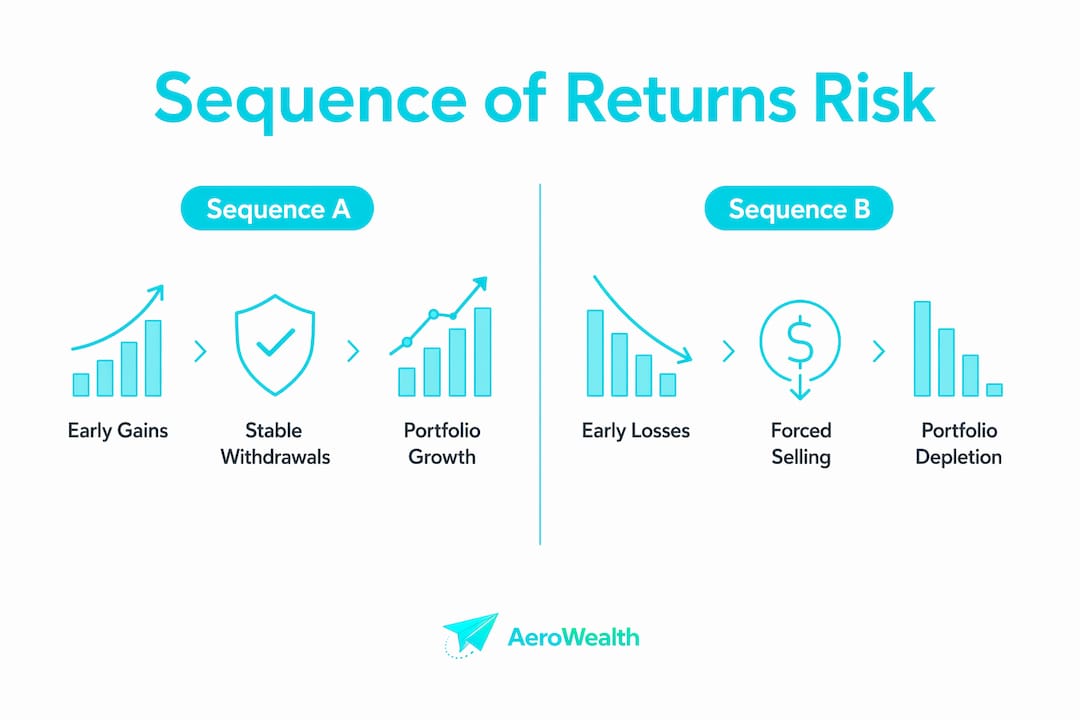
Note: These are illustrative scenarios. Figures are rounded.
The average annual return across both sequences is identical. Yet Sequence A ends with roughly $435,000 while Sequence B ends with roughly $463,000. Reverse the order and the gap widens further if withdrawals continue past year ten, because Sequence A's early losses permanently reduced the compounding base.
Key observations from these numbers:
- In years 1–3, Sequence A forces the retiree to sell more units per withdrawal because prices are depressed. Those units never return.
- The first five years of retirement are the highest-risk window. An early downturn can cause permanent portfolio harm even if long-run averages remain strong.
- In an ABP, this dynamic plays out through unit prices. When your fund's unit price falls, your minimum drawdown still requires selling units, compounding the damage.
Why this hits Australian retirees harder than most people expect
Sequence risk applies directly to account-based pensions, which are the primary drawdown vehicle for most Australians. It does not apply to fixed, guaranteed income sources like the Age Pension, which is why the Age Pension plays a more important role in sequencing protection than many retirees realize.

Here's how the interaction works. When a market downturn reduces your ABP balance, your assessable assets under Centrelink's means test fall too. That can increase your Age Pension entitlement, either triggering eligibility for the first time or lifting a partial payment. The Age Pension effectively acts as a partial floor, cushioning the income shortfall that sequencing damage creates. The current Age Pension age is 67, so if you retire at 62 or 63, you face a five-year window with no access to that buffer.
The Actuaries Institute research on sequencing risk across asset classes shows that different allocations produce materially different sequencing profiles. Australian shares, international shares, and fixed interest each carry distinct patterns of cumulative decline and return auto-correlation. A portfolio that looks diversified on paper may still concentrate sequencing exposure in correlated assets.
Behaviorally, the early drawdown years are also the hardest. Retirees who watch their balance fall often freeze, refusing to rebalance back toward growth assets even when that's exactly what the plan calls for. Others try to time the market, which typically makes the outcome worse. Spending cuts feel forced rather than chosen, which compounds the psychological toll on top of the financial one.
Practical strategies to reduce the damage
These are ranked by how quickly and reliably they reduce sequencing exposure:
-
Build a one-to-three-year cash buffer. Keep enough in cash or short-term term deposits to cover living expenses for one to three years. When markets fall, you draw from the buffer instead of selling growth assets at depressed prices. This is the bucket strategy in its simplest form.
-
Use flexible drawdown. If you can reduce discretionary spending during a bad market year, you sell fewer units and preserve more of the base. Flexibility in spending during bad market years increases a plan's success rate and is one of the most under-used levers available.
-
Diversify to reduce volatility, not just to chase returns. A lower-volatility allocation in the early retirement years reduces the magnitude of the worst-case drawdowns. The Actuaries Institute notes that sequencing risk is a function of both asset allocation and return auto-correlations, so the mix matters as much as the average return.
-
Add a partial guaranteed income stream. A lifetime annuity from an Australian provider converts a portion of your super into a fixed income stream that is immune to market sequencing. It reduces the amount you need to draw from your ABP during downturns. This is partial annuitization, not an all-or-nothing decision.
-
Delay retirement or use bridge income where feasible. Every additional year of accumulation reduces the balance at risk and shortens the drawdown period. If full retirement isn't possible, part-time or consulting work during a market downturn can substitute for ABP withdrawals and let the portfolio recover.
Pro Tip: The psychological value of a cash buffer is real and shouldn't be dismissed as irrational. Knowing you have two years of expenses in cash makes it far easier to leave growth assets untouched during a downturn. The trade-off is that cash held long-term loses purchasing power to inflation, so build in a rebalancing trigger: once markets recover and your buffer is depleted, replenish it from growth assets before the next cycle.
Questions to bring to your adviser:
- "How does a 20% drawdown in years one to three affect my plan's longevity?"
- "What happens to my Age Pension entitlement if my assessable assets fall by $200,000?"
- "What's my minimum ABP drawdown obligation, and how does that interact with a cash buffer?"
- "At what portfolio level should I consider adding a guaranteed income component?"
- "Does my current asset allocation reduce or concentrate sequencing exposure?"
How to model and stress-test your own sequence risk
Running a stress test doesn't require a financial degree. It requires the right inputs and a tool that can run scenarios side by side.
Step-by-step checklist:
- Set your base case: Starting ABP balance, annual withdrawal amount (or minimum drawdown percentage), expected inflation rate (typically 2.5–3%), and current asset allocation including fees.
- Build an adverse sequence: Apply two to three consecutive negative years of returns at the start of retirement (for example, –15%, –10%, –5%), then revert to your long-run average. This is a deterministic reversed-order test.
- Run a Monte Carlo simulation: Generate hundreds or thousands of random return sequences drawn from historical volatility assumptions. Look at the distribution of outcomes: what percentage of simulations deplete the portfolio before age 90? What percentage maintain income above a minimum floor?
- Vary the key inputs: Withdrawal rate (try 4%, 5%, and 6%), equity allocation (try 70/30 vs 50/50), length of cash buffer (one year vs three years), retirement age (62 vs 67 to capture the Age Pension timing effect), and inflation (2% vs 4%).
- Check Age Pension interaction: Model what happens to total income (ABP plus Age Pension) when the ABP balance falls. A good scenario tool integrates Centrelink means-testing so you can see the combined picture.
Pro Tip: When reading Monte Carlo results, don't just look at the median outcome. Look at the 10th percentile: the scenario where things go badly but not catastrophically. If that scenario still produces acceptable income, your plan is genuinely resilient. If the 10th percentile depletes your portfolio at 78, that's the number to fix.
Tools like Aerowealth are built specifically for this kind of side-by-side scenario modelling, integrating Age Pension timing and ABP drawdown minimums so you can see how sequencing interacts with Australian policy rules. That's a different exercise from running a generic calculator that assumes a flat return every year.
What the 4% rule gets wrong for Australian retirees
The 4% rule, which suggests withdrawing 4% of your starting balance each year, was developed from US market data and a 30-year retirement horizon. It's a useful starting point, not a guarantee.
For Australian retirees, several factors complicate the picture:
- ABP minimum drawdown rules require you to withdraw a set percentage of your balance each year regardless of market conditions. At age 65–74, the minimum is 5% per year (temporarily reduced rates have applied in some years, but the standard rate applies by default). This removes the flexibility to reduce withdrawals during a downturn, which is one of the most effective sequencing mitigants.
- The Age Pension bridge risk is real for anyone retiring before 67. A retiree who stops work at 62 faces five years of pure ABP drawdown with no Age Pension buffer. A market crash in that window is maximally damaging.
- Longer retirements mean the 30-year assumption may be too short. A 62-year-old Australian woman has a life expectancy well past 90. A 4% withdrawal rate calibrated for 30 years may not hold for 35.
Practical rules of thumb for Australian retirees:
- Start with a withdrawal rate below 5% if you retire before 67.
- Maintain a one-to-three-year cash buffer at all times.
- Re-run your scenario after any market move of 15% or more.
- Treat the ABP minimum drawdown as a floor, not a target, and draw only what you need above it.
For a broader look at retirement income strategies that account for these Australian-specific rules, the interaction between super, the Age Pension, and investment timing is worth modelling in detail before you commit to a drawdown rate.
Key Takeaways
Sequence of returns risk is the most consequential and least visible threat to retirement income for Australians drawing down an account-based pension, and the first five years of retirement are the window where it does the most permanent damage.
| Point | Details |
|---|---|
| Early losses are permanent | Selling units at depressed prices in years 1–5 reduces the compounding base for the rest of retirement. |
| ABPs carry the risk; Age Pension doesn't | Sequence risk applies to market-linked ABPs; the Age Pension provides a non-market-linked income floor for eligible retirees. |
| Cash buffer is the first line of defense | A one-to-three-year cash buffer lets you avoid selling growth assets during downturns. |
| Flexible spending multiplies resilience | Reducing discretionary withdrawals by 10–15% in bad market years materially improves long-term plan success. |
| Aerowealth models the scenarios you need | Aerowealth's side-by-side scenario tools integrate Age Pension timing and ABP minimums so you can see sequencing risk on your actual plan. |
Why averages will mislead you in retirement
The conventional wisdom says "stay invested, trust the long-run average, and don't panic." That advice is sound for accumulators. For retirees drawing down an ABP, it is dangerously incomplete.
Long-run averages hide the path. A fund that returns an average of 7% per year over 20 years could do that by returning –20% in years one and two and then recovering strongly, or by returning steadily positive throughout. The average is identical. The retiree's experience is not. The one who retired into the bad sequence may have depleted their portfolio by year 15. The one who retired into the good sequence is still fully funded at year 20.
What the Aerowealth team finds most striking is how rarely retirees are shown this distinction before they retire. Most pre-retirement conversations focus on accumulation milestones: "Do you have enough?" The sequencing question, "What happens if the first three years go badly?", is asked far less often, and it's the one that actually determines whether a retirement plan survives.
Scenario modelling doesn't eliminate uncertainty. It makes the uncertainty visible, so you can make deliberate choices about buffers, allocation, and timing rather than discovering the problem after it's already done damage. That's the practical value of stress-testing, and it's why the Aerowealth team built the tools around Australian-specific rules rather than generic assumptions.
This article is general information only and does not constitute personal financial advice. Confirm your own situation with a licensed financial adviser or the relevant primary source.
See your sequence risk before it becomes a problem
Knowing sequence of returns risk exists is one thing. Seeing exactly how it plays out on your specific balance, withdrawal rate, and retirement timeline is another.

Aerowealth is built for exactly this: Australian retirees who want to run the stress tests described in this article on their own numbers, not on generic assumptions. The platform lets you model side-by-side scenarios, including adverse early sequences versus favorable ones, with Age Pension timing and ABP minimum drawdowns already integrated. You can test what a 20% drawdown in years one to three does to your plan, compare a 70/30 allocation against a 50/50 one, and see how a two-year cash buffer changes the outcome, all in one view.
There's a free plan to get started, and a Pro subscription for full scenario access including bridge-year modelling for those retiring before the Age Pension age of 67. View pricing or start modelling your plan today.
This is not personal financial advice.
Useful sources for further reading
These are the most authoritative Australian resources for going deeper on sequence risk and retirement income planning:
- Actuaries Institute: Sequencing risk and asset allocation — the most rigorous Australian analysis of how asset class choice affects sequencing outcomes.
- Challenger: Sequencing risk explained — clear practitioner overview of the retirement risk zone and guaranteed income products available in Australia.
- SuperGuide: 5 ways sequencing risk affects retirement — practical mitigation strategies written for Australian retirees.
- ASIC MoneySmart — official Australian government guidance on retirement income, ABPs, and the Age Pension.
- Aerowealth blog — Australian-specific modelling walkthroughs, super guides, and retirement planning articles.
- Aerowealth: Retirement planning in Australia — broader retirement planning context for readers who want to situate sequence risk within a full plan.
FAQ
What is a simple example of sequence of returns risk?
Two retirees start with the same balance and earn the same average return over ten years, but one experiences losses in years one to three while the other experiences gains. The retiree who faces early losses sells more units at depressed prices and ends with a materially lower balance, even though the long-run average return is identical.
How do you reduce sequence of returns risk in Australia?
The most practical steps are maintaining a one-to-three-year cash buffer to avoid forced selling during downturns, using flexible drawdown to reduce withdrawals in bad market years, and considering a partial lifetime annuity to create a guaranteed income floor alongside your ABP.
Why is the 4% rule unreliable for Australian retirees?
The 4% rule was derived from US market data and a 30-year horizon. Australian ABP minimum drawdown rules require withdrawals regardless of market conditions, longer life expectancies extend the risk window, and retirees who retire before the Age Pension age of 67 face a period with no guaranteed income buffer.
What are the three phases of retirement?
The three phases are typically the active or go-go years (early retirement with higher spending), the slower or go-slow years (mid-retirement with reduced activity spending), and the late or no-go years (later retirement with lower discretionary but potentially higher care costs). Sequence risk is most damaging in the first phase, when balances are largest and withdrawals are highest.
Can the Age Pension offset sequence of returns risk?
Partly. The Age Pension is not market-linked, so it provides a stable income floor that sequence risk cannot erode. When a market downturn reduces your ABP balance and assessable assets, your Centrelink entitlement can increase, partially replacing the lost ABP income. This buffer only applies once you reach the Age Pension age of 67.