
Yes, eligible Australians can use carry forward concessional contributions right now — and from 1 July 2026, the general concessional cap rises to $32,500, which means more base room before you even touch unused amounts from prior years. The two facts that determine whether you can use carry-forward space: your total superannuation balance (TSB) must have been under $500,000 at 30 June of the previous financial year, and you must have unused concessional cap from at least one of the past five financial years. Unused amounts expire after five years on a rolling basis, so timing matters.
Three checks you can do in the next ten minutes:
- Log in to myGov, open ATO online services, go to Super > Information > Carry forward concessional contributions to see your available unused cap.
- Confirm your TSB at the prior 30 June using your fund's annual statement or the ATO's super balance figure.
- Check when your employer's next Super Guarantee (SG) payment lands — it counts toward your concessional cap and affects how much carry-forward room you can actually use.
If you want to see whether using that carry-forward room genuinely improves your tax position and retirement balance, Aerowealth lets you run side-by-side retirement scenarios before you commit to a contribution strategy.
Table of Contents
- What are carry-forward concessional contributions?
- What is the current concessional cap and how does the five-year window work?
- Who is eligible to use carry-forward super contributions?
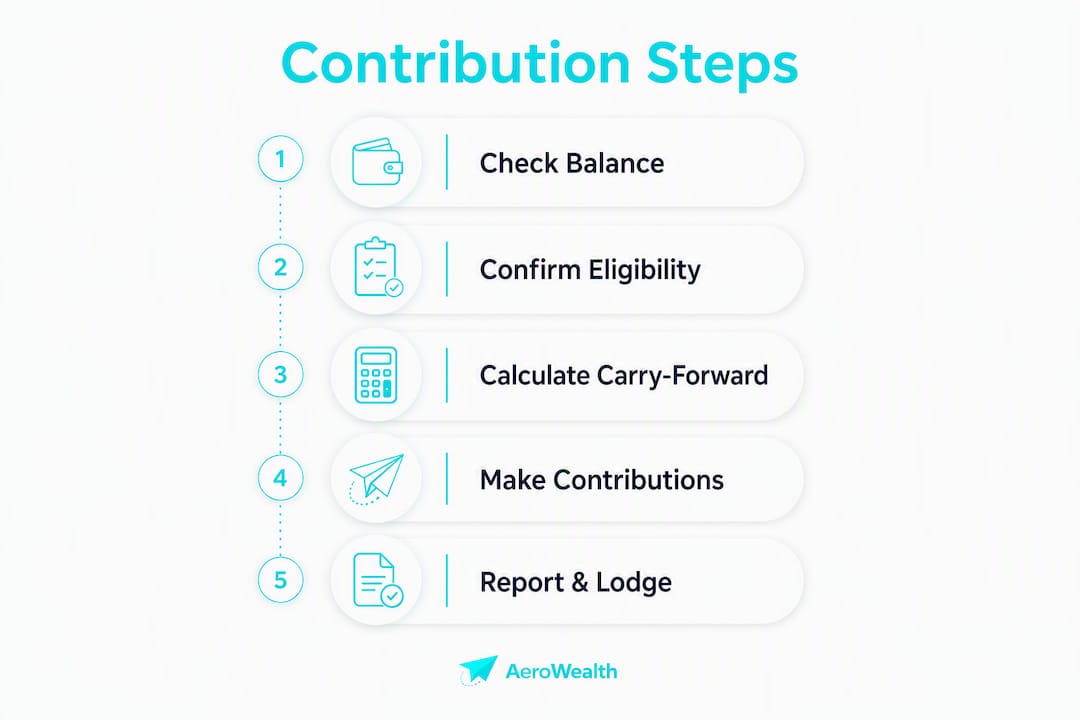
- How does the carry-forward calculation actually work?
- How do you check your available carry-forward amounts?
- How do you make contributions that use carry-forward room?
- What happens if you exceed the concessional cap?
- Why use carry-forward concessional contributions?
- Common mistakes to avoid with carry-forward room
- Model your carry-forward strategy with Aerowealth
- Key Takeaways
- The carry-forward opportunity most people underuse
- See your carry-forward scenarios in Aerowealth
- Useful sources
- FAQ
What are carry-forward concessional contributions?
Carry-forward concessional contributions — also called catch-up super contributions — are not a separate product or contribution type. They are additional concessional cap space created by rolling unused annual cap amounts from prior years into the current year. The contributions themselves remain concessional: employer SG, salary sacrifice, and personal tax-deductible contributions all count.
The rule has been available since 1 July 2018. If you contributed less than the annual cap in a given year, that shortfall carries forward for up to five financial years and then expires. You can accumulate unused amounts from multiple years and deploy them in a single high-income year to significantly reduce taxable income.
Carry-forward vs. bring-forward: the key distinction. Carry-forward applies to concessional (before-tax) contributions and increases your annual cap using unused prior-year amounts. Bring-forward applies to non-concessional (after-tax) contributions and lets you pull future years' non-concessional caps into the current year. They operate under entirely separate rules, separate eligibility tests, and separate caps. Confusing the two is one of the most common planning errors.
A person who took two years off work to care for a family member, then returned to full-time employment and received a bonus, is a textbook beneficiary. Their super contributions during the break were minimal, so unused cap accumulated. In the bonus year, they can direct a large concessional contribution into super, use the carry-forward room to stay within the rules, and cut their taxable income at the same time.
What is the current concessional cap and how does the five-year window work?
The general concessional cap for recent years:
- 2023–24: $27,500
- 2024–25: $30,000
- 2025–26: $30,000
- 2026–27 (from 1 July 2026): $32,500
Each year's unused cap amount is available for exactly five financial years before it expires. The 2020–21 unused cap, for example, expires at the end of 2025–26. From 1 July 2026, any 2021–22 unused cap becomes the oldest available year in the window.
$32,500 is the general concessional cap from 1 July 2026, up from $30,000 in the two prior years. Combined with carry-forward room, eligible Australians could have a substantially larger concessional cap available in 2026–27 depending on their contribution history.
The five-year window runs on a first-in, first-out basis. The ATO exhausts the oldest unused cap year before touching newer ones. You cannot choose to preserve an older year's unused amount while drawing on a newer year's room — the system applies FIFO automatically.
Who is eligible to use carry-forward super contributions?

The TSB cliff test
Eligibility hinges on one hard number: your TSB must be under $500,000 at 30 June of the previous financial year. Not the current year. Not the day you make the contribution. That single date determines whether you can access carry-forward room for the entire following financial year.
This is a cliff, not a taper. A TSB of $499,999 qualifies; $500,001 does not. Market movements in the weeks before 30 June can push a balance over the threshold, so monitoring your TSB in May and June is worth doing if you are close to the limit.
Age and administrative requirements

You must be under 75 to make voluntary concessional contributions. For members approaching that birthday, contributions must be received by the fund no later than 28 days after the end of the month you turn 75. Miss that window and the contribution cannot be accepted.
For personal deductible contributions, you must also lodge a valid notice of intent to claim a deduction with your fund before you lodge your tax return (or before certain other trigger events). The notice deadline is easy to miss, especially if you change funds mid-year.
ATO reporting lags
ATO online services may not display your carry-forward room until your fund has reported contribution data to the ATO. New migrants and members whose funds report slowly can see a blank or understated figure in myGov. Always cross-check with your fund's records before acting on the myGov number alone.
Eligibility checklist:
- TSB under $500,000 at 30 June of the prior financial year
- At least one year of unused concessional cap from the past five financial years
- Under age 75 (or within the 28-day post-birthday window if near 75)
- Notice of intent lodged with fund before tax return if claiming a personal deduction
Pro Tip: If your TSB is sitting close to $500,000 in late May or June, a voluntary non-concessional contribution or a market dip could push it below the threshold — but get advice before acting, because non-concessional contributions have their own caps and eligibility rules.
How does the carry-forward calculation actually work?
The ATO's logic is straightforward once you see it laid out year by year.
- Remember FIFO: — the ATO uses the oldest unused year first as your contributions accumulate during the year.
Worked example
Assume a person with a TSB under $500,000 at each relevant 30 June:
| Financial year | General cap | Contributions made | Unused cap |
|---|---|---|---|
| 2021–22 | $27,500 | — | $17,500 |
| 2022–23 | $27,500 | $27,500 | — |
| 2023–24 | $27,500 | — | — |
| 2024–25 | $30,000 | — | — |
| 2025–26 | $30,000 | — | — |
Total carry-forward room entering 2026–27 can add significantly to the general concessional cap, depending on unused amounts from prior years and provided the TSB was under the eligibility threshold at the prior 30 June.
When this person makes contributions in 2026–27, the ATO applies the 2021–22 unused amount ($17,500) first. If they do not use it by 30 June 2027, that 2021–22 amount expires permanently.
Pro Tip: Watch the expiry of your oldest unused year. If you have a large unused amount from 2021–22 that you have not touched, 2026–27 is the last year you can use it. After that, it is gone.
How do you check your available carry-forward amounts?
The ATO is the authoritative source. Here is how to find the figure:
- Log in to myGov and link to the ATO if you have not already.
- Select Super from the top menu, then Information, then Carry forward concessional contributions.
- The screen shows your unused cap amounts by financial year and the total available.
- Cross-check this against your fund's annual statement or member portal, which shows contribution dates and types received.
- If the figures differ, contact your fund to confirm what has been reported to the ATO and when.
One important caveat: the ATO figure reflects what has been reported to it. If your fund is slow to report, or if you recently joined the Australian super system, the myGov figure may be lower than your actual available room. Always allow extra time before EOFY if you are relying on the ATO figure to plan a large contribution.
Use the ATO figure for final verification before lodging a notice of intent or instructing salary sacrifice changes. Your fund's records are useful for cross-checking, but the ATO's system is what determines your actual cap position at tax time.
How do you make contributions that use carry-forward room?
Three contribution types count as concessional and draw on carry-forward space:
- Employer SG contributions — mandatory contributions your employer makes; these count automatically.
- Salary sacrifice — pre-tax salary directed to super under an agreement with your employer; takes effect from the date the fund receives the money.
- Personal deductible contributions — after-tax money you contribute and then claim as a tax deduction; requires a valid notice of intent lodged with your fund.
Timing rules to know:
- Contributions must be received by the fund within the financial year you intend to use the cap. A payment initiated on 29 June that clears on 2 July counts in the new financial year.
- For members near age 75, the fund must receive contributions within 28 days after the end of the month you turn 75.
- Notice of intent for personal deductible contributions must be lodged before you file your tax return, before you roll over the fund, or before certain other trigger events.
SMSF-specific notes
SMSF trustees must record and report contributions to the ATO via SuperStream or the SMSF annual return. Confirm the fund's bank account has received the contribution before EOFY and that the trustee minutes or records correctly classify it as concessional. In-specie contributions (transferring assets rather than cash) can qualify as concessional in limited circumstances, but the rules are strict — get specific advice before attempting one. For a broader look at whether an SMSF suits your situation, the SMSF decision guide on Aerowealth's blog covers the key trade-offs.
Pre-EOFY checklist:
- Confirm your employer's next SG payment date and amount.
- Check how much concessional cap room remains after employer contributions.
- Initiate salary sacrifice changes or personal contributions at least two weeks before 30 June.
- Confirm fund receipt before 30 June, not just payment initiation.
- Lodge notice of intent before filing your tax return.
Pro Tip: Banks and super funds get busy in the last week of June. Initiate large contributions by mid-June to avoid processing delays that push your contribution into the next financial year.
What happens if you exceed the concessional cap?
Exceeding the concessional cap triggers an excess concessional contributions charge. The ATO includes the excess amount in your assessable income and taxes it at your marginal rate, with a 15% tax offset to account for the contributions tax already paid inside the fund. An interest charge also applies to the additional tax liability.
The ATO applies your carry-forward room automatically when you exceed the general cap. If your carry-forward space covers the excess, no additional tax arises. But if you exceed both the general cap and your carry-forward room, the excess is taxable.
What to do if you exceed the cap:
- The ATO will issue an excess concessional contributions determination. Review it carefully.
- You can elect to release up to 85% of the excess from your super fund to help pay the tax bill.
- If you believe the determination is wrong (for example, a contribution was misclassified), contact your fund and the ATO promptly.
- Lodge an amended tax return if required.
- If Division 293 tax applies (for income over $250,000), the interaction with excess contributions can be complex. A tax adviser is worth the fee in that situation.
The ATO's contributions caps page has the current excess contributions guidance and worked examples.
Why use carry-forward concessional contributions?
The core appeal is tax efficiency. Concessional contributions are taxed at 15% inside super, compared to marginal rates of up to 47% outside it. In a high-income year, directing a large concessional contribution into super can reduce your taxable income by tens of thousands of dollars.
People with interrupted work patterns benefit most: caregivers returning to full-time work, contractors with lumpy income, or anyone who received a bonus or business profit after years of modest contributions. The strategy lets them catch up on super growth and cut tax in the same move.
When carry-forward contributions tend to make sense:
- You are in a higher marginal tax bracket this year than in prior years.
- You have a lump sum available (bonus, asset sale proceeds, inheritance) and want to shelter it from income tax.
- You are within a decade of retirement and want to accelerate super balance growth.
- Your TSB is comfortably under $500,000 at the prior 30 June.
When to think twice:
- You need the cash outside super in the next few years — super is locked until preservation age.
- Your income is low enough that the 15% contributions tax is close to your marginal rate, reducing the benefit.
- A large contribution would push your TSB over $500,000 at 30 June, cutting off carry-forward eligibility for the following year.
For a broader comparison of super versus outside-super investing, the retirement planning guide on Aerowealth's blog covers the key trade-offs in plain language.
Common mistakes to avoid with carry-forward room
Most errors come down to timing and double-counting. Employer SG and salary sacrifice both count as concessional contributions — forgetting to subtract them before calculating how much personal carry-forward room you can use is the most frequent mistake.
Avoidance checklist:
- Verify your TSB at the prior 30 June, not the current date.
- Pull the ATO carry-forward figure from myGov, but cross-check it against fund records.
- Subtract all employer SG contributions already made or scheduled for the year before calculating remaining room.
- Allow at least two weeks for fund processing before EOFY.
- Do not confuse concessional carry-forward rules with non-concessional bring-forward rules — they are entirely separate.
- If your numbers are borderline or Division 293 may apply, confirm with a registered tax adviser before acting.
Model your carry-forward strategy with Aerowealth
Knowing you can use carry-forward room is different from knowing whether you should — and by how much. The tax saving in year one looks attractive, but the right answer depends on your marginal rate, your TSB trajectory, your liquidity needs, and how the contribution affects your retirement income projections.
Financial modelling tools let you stress-test those variables before committing. Here is how to model a carry-forward scenario in Aerowealth:
- Load your current super balance, contribution history, and income into the platform.
- Enter your available carry-forward amounts by year (from your ATO myGov figure).
- Set your TSB assumptions for 30 June of the current year.
- Build two scenarios: one using all carry-forward room in a single year, one spreading contributions over two years.
- Run the side-by-side comparison to see the difference in projected retirement balance, tax saved, and liquidity impact.
Two scenarios worth testing:
- Scenario A: Single-year large salary sacrifice using all available carry-forward room after a bonus year. Compare the tax saving against the reduction in take-home pay and the impact on TSB eligibility for the following year.
- Scenario B: Staged salary sacrifice over two years, spreading the tax benefit and keeping the TSB below $500,000 at each 30 June to preserve carry-forward eligibility.
Modelling shows likely outcomes based on your inputs. It is not personalized tax advice. If your situation involves Division 293 tax, a TSB close to the $500,000 threshold, or complex employer contribution arrangements, confirm the numbers with a licensed adviser before acting.
Key Takeaways
Carry-forward concessional contributions are one of the most tax-efficient tools available to eligible Australians, but the TSB test, FIFO expiry, and EOFY timing mean the details matter as much as the strategy.
| Point | Details |
|---|---|
| 2026–27 cap is $32,500 | The general concessional cap rises to $32,500 from 1 July 2026, increasing base room before carry-forward is even applied. |
| TSB under $500,000 is required | Your total super balance must be under $500,000 at 30 June of the prior year — a hard cliff, not a taper. |
| Unused caps expire after five years | The oldest unused cap year is applied first (FIFO); 2021–22 unused amounts expire at the end of 2026–27. |
| Check ATO, then cross-check your fund | myGov carry-forward figures can lag; always verify against fund records before making large contributions. |
| Model before you commit | Aerowealth's side-by-side scenario tool lets you compare single-year versus staged carry-forward strategies and their retirement income impact. |
One final timing note: personal deductible contributions require a valid notice of intent lodged with your fund before you file your tax return, and contributions for members near age 75 must be received by the fund within 28 days after the end of the month they turn 75.
The carry-forward opportunity most people underuse
The Aerowealth Team's view: most Australians who are eligible for carry-forward room either do not know they have it or assume the benefit is modest. In a high-income year, it can be neither modest nor complicated — it is simply a matter of checking two numbers (TSB and unused cap), confirming employer contribution timing, and acting before 30 June.
What tends to go wrong is not the strategy itself but the execution: contributions that arrive at the fund one day into the new financial year, notices of intent that never get lodged, or TSB figures that were not checked until after the threshold was crossed. The rules reward preparation, not last-minute scrambling.
The modelling step is where most people skip ahead too fast. Running a side-by-side comparison of a lump-sum versus staged approach in Aerowealth takes less time than a phone call to your fund, and it shows you the retirement income difference in dollar terms rather than in abstract percentages. That concrete number is usually what turns a vague intention into a specific plan.
Consult a licensed financial adviser or registered tax agent when your TSB is close to $500,000, when Division 293 may apply, or when your employer contribution schedule is complex. The modelling gives you the picture; the adviser confirms the details.
See your carry-forward scenarios in Aerowealth
Carry-forward concessional contributions are worth modelling before you act — the tax saving looks different depending on your marginal rate, your TSB trajectory, and whether a single large contribution or a staged approach suits your situation better.
Aerowealth runs those comparisons side by side, with stress-testing on TSB assumptions and retirement income projections built in. You can start on the free plan to see how your current super and contribution history project forward, or move to Pro for full scenario comparison and bridge-year modelling if you are planning early retirement before preservation age. Modelling is illustrative and not personalized tax advice — confirm final numbers with a licensed adviser before making large contributions.
See your retirement scenarios on Aerowealth or compare plan features and pricing to find the right fit.
Useful sources
- Concessional contributions cap — Australian Taxation Office: the authoritative source for current caps, eligibility rules, FIFO application, and expiry rules. Check here before making contributions.
- Contributions caps — ATO key rates and thresholds: quick-reference table of all contribution caps by year, including the carry-forward provisions from 1 July 2018.
- How carry-forward (catch-up) super contributions work — SuperGuide: practitioner-level explanation of eligibility, calculation, and use cases with worked examples.
- Super contributions — Moneysmart.gov.au: ASIC's plain-language overview of contribution types and caps for general orientation.
- Aerowealth retirement modelling: model carry-forward scenarios, compare staged versus lump-sum strategies, and project retirement income side by side.
This article is general information only, not personalized financial or tax advice. Verify current rules and your personal figures with the ATO or a licensed financial adviser before making contributions.
FAQ
What is the concessional cap for 2026–27?
The general concessional contributions cap is $32,500 from 1 July 2026, up from $30,000 in 2024–25 and 2025–26.
How many years of unused concessional cap can I carry forward?
You can carry forward unused concessional cap amounts from up to five prior financial years; amounts older than five years expire and cannot be used.
What TSB do I need to use catch-up super contributions?
Your total superannuation balance must be under $500,000 at 30 June of the previous financial year — that single date determines eligibility for the entire following year.
Does my employer's SG count toward my carry-forward room?
Yes. Employer SG and salary sacrifice contributions are concessional and count toward both the general cap and any carry-forward amounts you use, so subtract them before calculating how much personal carry-forward room remains.
Can Aerowealth help me model a carry-forward strategy?
Aerowealth lets you enter your super balance, contribution history, and income to run side-by-side scenarios comparing single-year versus staged carry-forward approaches, showing projected retirement balance and tax impact — though the output is illustrative, not tax advice.