
Yes, you can legally live in your investment property in Australia. There's no law that prevents it, provided the property is zoned residential and you follow the correct procedures with the ATO, your lender, and any existing tenants. The moment you move in, though, the property's tax and financial profile changes significantly.
Here's what changes immediately:
- The property becomes your principal place of residence (PPOR), which starts the clock on your CGT main residence exemption from that date forward
- You lose the right to claim rental deductions — mortgage interest, property management fees, depreciation, and maintenance costs all stop being deductible
- You must notify the ATO to stop declaring rental income and to register the property as your main residence
- Your lender must be informed so the loan purpose can be reclassified from investment to owner-occupied
- Any existing tenancy must be ended lawfully before you move in, following your state's notice requirements
The financial trade-offs are real and worth modeling carefully before you commit. Lower loan interest rates on owner-occupied loans can offset some of the lost deductions, but the CGT picture for the years the property was rented doesn't disappear. That history follows the property to sale.
Table of Contents
- How to transition your investment property to your main residence
- What living in your investment property does to your taxes
- What changes with your mortgage when you move in
- Tenant rights and ending leases the right way
- Practical planning for a smooth move into your investment property
- How Aerowealth helps you model this decision
- How moving in affects government benefits and allowances
- Key Takeaways
- FAQ
How to transition your investment property to your main residence
Converting your investment property into your primary home isn't complicated, but the order of steps matters. Getting one wrong can create legal disputes with tenants, compliance issues with lenders, or tax problems with the ATO.
- End the existing tenancy lawfully. You cannot simply ask tenants to leave. Each state has specific notice periods: in New South Wales, landlords must give proper written notice periods that vary by state and tenancy type depending on the tenancy type; Queensland requires a notice period of about two months. Check whether the lease is fixed-term or periodic, since fixed-term leases generally cannot be broken early without tenant agreement or a tribunal order.
- Notify your lender in writing. Most lenders require a formal letter and updated documentation (such as a new driver's license showing the address) to reclassify the loan. This changes the loan's risk profile and usually triggers a rate review.
- Inform the ATO of the change of use. From the date you move in, you stop claiming rental income and rental deductions. The ATO needs to know the property is now your main residence for CGT purposes.
- Update your official documents. Transfer your address on your driver's license, electoral roll, and any government correspondence. The ATO uses these as supporting evidence that the property genuinely became your main residence.
- Confirm local council zoning compliance. Most residential investment properties are already zoned for owner-occupation, but mixed-use or commercial-adjacent properties may need council confirmation before you move in.
What living in your investment property does to your taxes
This is where most people underestimate the complexity. The tax consequences split into two categories: what you lose immediately and what you gain over time.
What you lose on day one: Every rental-related deduction stops. Mortgage interest, council rates claimed as investment expenses, property management fees, depreciation schedules — all of it. If your property was negatively geared, that annual tax benefit disappears the moment you occupy it.
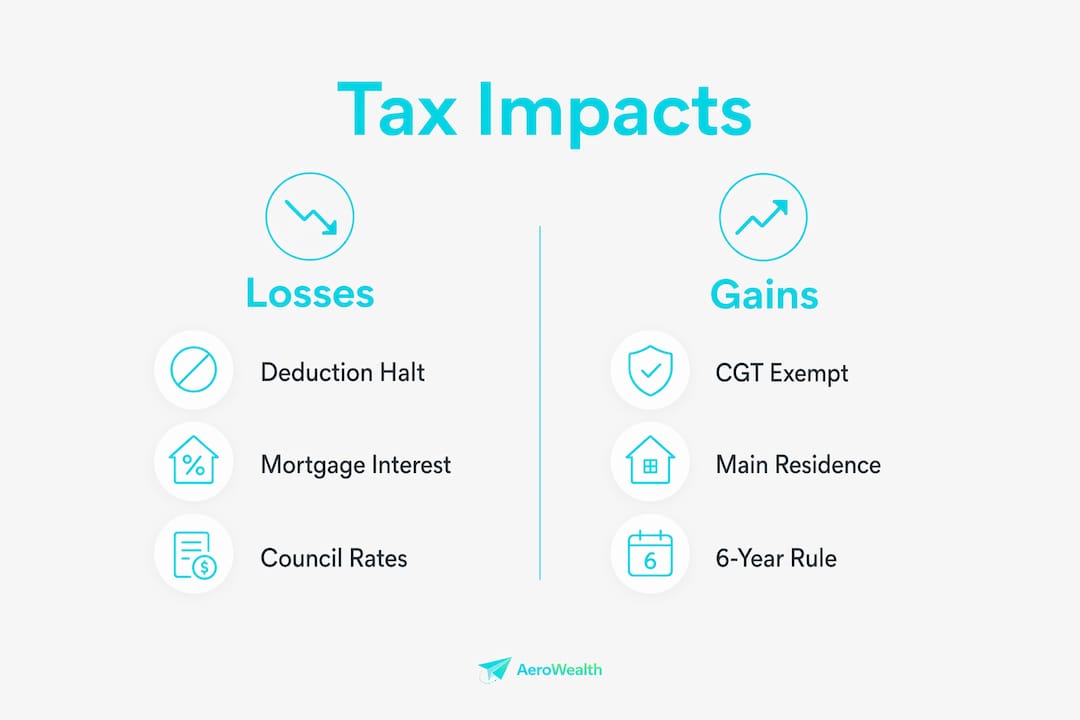
What you gain for CGT: The period you live in the property as your main residence is exempt from CGT. When you eventually sell, the capital gain is apportioned between the rental period (taxable) and the residence period (exempt). Short stints of living there don't erase the CGT accrued during rental years — the ATO calculates the exemption proportionally based on days.
The 6-year rule has a critical catch. Many property owners assume the 6-year CGT exemption rule applies to their investment property. It doesn't, unless the property was first your main residence before you rented it out. If you bought the property as an investment from day one, the 6-year rule cannot be applied retroactively. It only resets when you move back in and re-establish residence.
One PPOR at a time, with a 6-month buffer. You can only designate one property as your main residence at any given time. The ATO allows a 6-month overlap if you're transitioning between two homes, but both properties cannot be your PPOR indefinitely.
Keep meticulous records from the acquisition date and the move-in date. The ATO's proportional CGT calculation depends on exact day counts, and gaps in documentation can cost you.
Pro Tip: Before making any move, run the numbers on what you'll actually pay in CGT at sale versus what you'll save in loan interest. Aerowealth's CGT and tax impact modeling lets you compare these scenarios side by side, so you're not guessing at a six-figure decision.
What changes with your mortgage when you move in
Your lender needs to know. Failing to notify them of an occupancy change breaches your credit agreement and can trigger compliance action. This isn't a technicality — lenders price investment loans differently because the risk profile is different, and they're entitled to know when that changes.
- Investment loans convert to owner-occupied loans, which typically carry lower interest rates. That rate reduction is a genuine financial benefit, but it comes with a trade-off: the interest is no longer tax-deductible.
- Lenders require documentation to process the conversion. Expect to provide a formal letter, updated identification showing your new address, and possibly updated income verification if your financial position has changed.
- Loan terms may be renegotiated. Some lenders treat the conversion as an opportunity to reassess your loan structure. This can work in your favor if you want to refinance to a better rate, or it can surface issues if your borrowing capacity has changed.
- Timing the switch reduces disruption. Converting the loan at the same time you move in, rather than months later, keeps your records clean and avoids any period where the loan purpose doesn't match your actual use.
If you're considering refinancing at the same time, compare the total cost of switching lenders against the rate benefit. Break fees on fixed-rate investment loans can be substantial.
Tenant rights and ending leases the right way

You can't move into a tenanted property without following the correct legal process. Tenants have rights, and bypassing them exposes you to tribunal claims, financial penalties, and delays that could push your move-in date back by months.
Moving in yourself is a recognized ground for ending a tenancy in most Australian states, but the procedure must be followed precisely.
- Check whether the lease is fixed-term or periodic. Fixed-term leases generally cannot be terminated early for owner-occupation without the tenant's agreement or a tribunal order. Periodic leases are more flexible but still require proper notice.
- Serve written notice that meets your state's requirements. In NSW, landlords must give notice in writing and the period varies by tenancy type. Queensland requires a notice period of about two months for periodic tenancies. Victoria, South Australia, and Western Australia each have their own rules — check your state's tenancy authority before issuing any notice.
- Do not pressure tenants to leave early. Illegal eviction or harassment can result in compensation orders against you. If a tenant disputes the notice, the matter goes to a tenancy tribunal, which adds time and cost.
- Confirm the property is vacant before you move in. Moving into an occupied property, even after notice has been served, creates serious legal exposure.
The legal requirement for proper notice is non-negotiable. Budget the notice period into your timeline from the start.
Practical planning for a smooth move into your investment property
The mechanics of moving in are straightforward. The financial and logistical timing is where most people create unnecessary problems for themselves.
- Build the notice period into your timeline first. If your state requires proper written notice periods that vary by state and tenancy type, that's your minimum lead time before you can occupy. Work backward from your target move-in date.
- Arrange insurance before you move in. Landlord insurance doesn't cover owner-occupied properties. You'll need to switch to home and contents insurance, and there's typically a gap period during the transition that leaves you exposed. Arrange the new policy to start from the date the tenant vacates.
- Reassess your property valuation. If you're refinancing at the same time, a current valuation will determine your loan-to-value ratio and the rates available to you. Owner-occupied properties sometimes attract different valuations than investment properties, depending on the market.
- Model the loss of deductions against your new loan rate. The financial trade-off between tax deductions and lower interest isn't always obvious. A property that was generating a $8,000 annual tax benefit through negative gearing might save you $5,000 in interest after converting to an owner-occupied rate — a net loss of $3,000 annually before you factor in CGT.
- Update government benefit declarations if applicable. If you receive any means-tested government payments, your living arrangements affect your eligibility. More on this below.
How Aerowealth helps you model this decision
Moving into your investment property is a financial decision with a 10–20 year tail. The immediate effects — losing deductions, changing loan rates — are visible. The long-term effects on your retirement wealth and CGT liability at sale are harder to see without proper modeling.

Aerowealth is built specifically for this kind of scenario. You can model your current situation (property as investment, with deductions and rental income) against the alternative (property as PPOR, with lower loan rates and CGT exemption building from move-in date), and see the projected net worth difference at your target retirement age.
The platform's side-by-side scenario comparison is particularly useful here. You're not choosing between two obvious options — you're weighing a complex set of variables: rental yield, loan interest rate differential, CGT liability at various sale dates, and the opportunity cost of capital tied up in a property you're living in rather than renting. Stress-testing those assumptions with different sale dates or interest rate movements gives you a much clearer picture than a spreadsheet.
Pro Tip: Use Aerowealth's investment property modeling tools to run the scenario before you serve notice on your tenant. Once you've committed to the timeline, the financial decisions follow quickly — having the numbers ready means you're not making them under pressure.
For Australians planning for early retirement, the bridge years modeling in Aerowealth's Pro plan is especially relevant. If moving into the property is part of a broader plan to reduce expenses before reaching your superannuation preservation age, that interaction needs to be modeled explicitly.

Aerowealth's free plan lets you build your first scenario today. The Pro plan unlocks side-by-side comparisons, CGT modeling, and the AI assistant that explains every projection under Australian tax rules. See how your numbers look before you make the call.
How moving in affects government benefits and allowances
This is the subtopic most guides skip, and it matters more than people expect.
Centrelink and means-tested payments: If you receive Age Pension, JobSeeker, or other Centrelink payments, your principal place of residence is generally exempt from the assets test. Moving into your investment property could reduce your assessable assets under the assets test, which might increase your payment rate. However, you'd also lose the rental income that was previously assessed as income, which has its own effect on income-tested payments. The net impact depends on your specific circumstances and must be reported to Services Australia promptly.
First Home Owner Grant (FHOG) and stamp duty concessions: If you received a FHOG or a stamp duty concession when you originally purchased the property as your first home, there are usually residency conditions attached. Moving in now might actually satisfy those conditions if you haven't already, but if you received the grant and rented the property immediately without meeting the residency requirement, you may have already breached the grant conditions. Check with your state revenue office.
Land tax: Most Australian states exempt your principal place of residence from land tax. Moving in and registering the property as your PPOR can eliminate or reduce your land tax liability, which is a meaningful annual saving in states like NSW and Victoria where land tax thresholds are relatively low.
Report any change in living arrangements to the relevant government agencies within the required timeframe. Centrelink requires notification within 14 days of a change in circumstances.
Key Takeaways
Living in your investment property is legally permitted in Australia, but it triggers immediate changes to your tax deductions, CGT status, loan classification, and tenancy obligations that must be managed in the correct sequence.
| Point | Details |
|---|---|
| CGT exemption is proportional | Only the period you live in the property as your PPOR is CGT-exempt; rental years remain taxable at sale. |
| 6-year rule doesn't apply to pure investments | The 6-year CGT exemption only works if the property was your main residence before you rented it out. |
| Notify lender and ATO promptly | Failing to notify your lender of an occupancy change breaches your credit agreement and creates compliance risk. |
| Tenant notice periods are mandatory | State laws require 60–90 days' written notice in most cases; fixed-term leases add further restrictions. |
| Model the trade-off before committing | Losing rental deductions may outweigh the interest rate saving; run the numbers in a tool like Aerowealth first. |
FAQ
Can I live in my investment property in Australia?
Yes. There's no legal barrier to living in a residential investment property you own. You must notify the ATO, inform your lender, and end any existing tenancy lawfully before moving in.
What happens to CGT if I move into my investment property?
The period you live in the property as your principal place of residence becomes CGT-exempt. The years it was rented remain taxable, and the gain is apportioned proportionally based on days of each use when you sell.
Can I move back into my investment property to avoid CGT?
Partially. Moving in does start building a CGT exemption from that date, but it doesn't erase the CGT liability from the rental period. Short periods of residence won't significantly reduce a large accrued gain.
How long do I need to live there to qualify as my main residence?
The ATO sets no minimum time period, but the property must genuinely be your main residence, supported by evidence such as your electoral roll address, mail delivery, and connected utilities. The exemption is proportional to the time you actually lived there.
Does the 6-year CGT rule apply to investment properties?
Only if the property was your main residence before you rented it out. Properties purchased as investments from the start are not eligible for the 6-year rule until you move in and establish residence first.