
Successful budgeting in retirement comes down to three moves: estimate your realistic annual living costs, map every income source you can count on (Age Pension, super drawdown, investments, part-time work), and convert your desired annual spend into a target nest egg or withdrawal plan. Do those three things with real numbers, and you have a working retirement budget. Skip any one of them, and you're guessing.
Start here before anything else:
- Track one month of actual spending using bank statements or a spending diary to get a real baseline, not an estimate.
- Check the ASFA Retirement Standard benchmarks: a comfortable lifestyle currently costs an amount estimated by ASFA for a single retiree and a couple respectively.
- Run the MoneySmart retirement planner to model how long your savings will last under different assumptions.
- Check your Age Pension entitlements via Services Australia — around 62% of Australians aged 65 or older receive some form of government income support.
- Model scenarios using a tool like Aerowealth to stress-test your plan before you commit to a withdrawal rate.
The ASFA figures are the standard benchmark in Australia, but they assume you own your home outright and retire at 67. If you rent, retire early, or have health costs above average, your number will be higher. The sections below show you exactly how to adjust.
Table of Contents
- How to estimate your retirement living costs step by step
- What "modest" and "comfortable" actually mean in the ASFA benchmarks
- Income sources in retirement: how to estimate what you'll receive
- Build your retirement budget: worksheet and sample Australian budgets
- How to convert your desired annual budget into a super balance target
- Timing, sequencing, and risks that can reshape your retirement budget
- Government concessions that can meaningfully reduce your retirement costs
- Where to get help and what to do next: your practical checklist
- Key Takeaways
- The retirement budget most people build is already out of date
- Aerowealth makes the worksheet work for you
- Useful Australian sources and calculators
- FAQ
How to estimate your retirement living costs step by step
The most reliable retirement budget starts with what you actually spend, not what you think you spend. Most people underestimate discretionary costs by 20–30% when they estimate from memory. A structured approach fixes that.

Step 1: Gather your baseline data
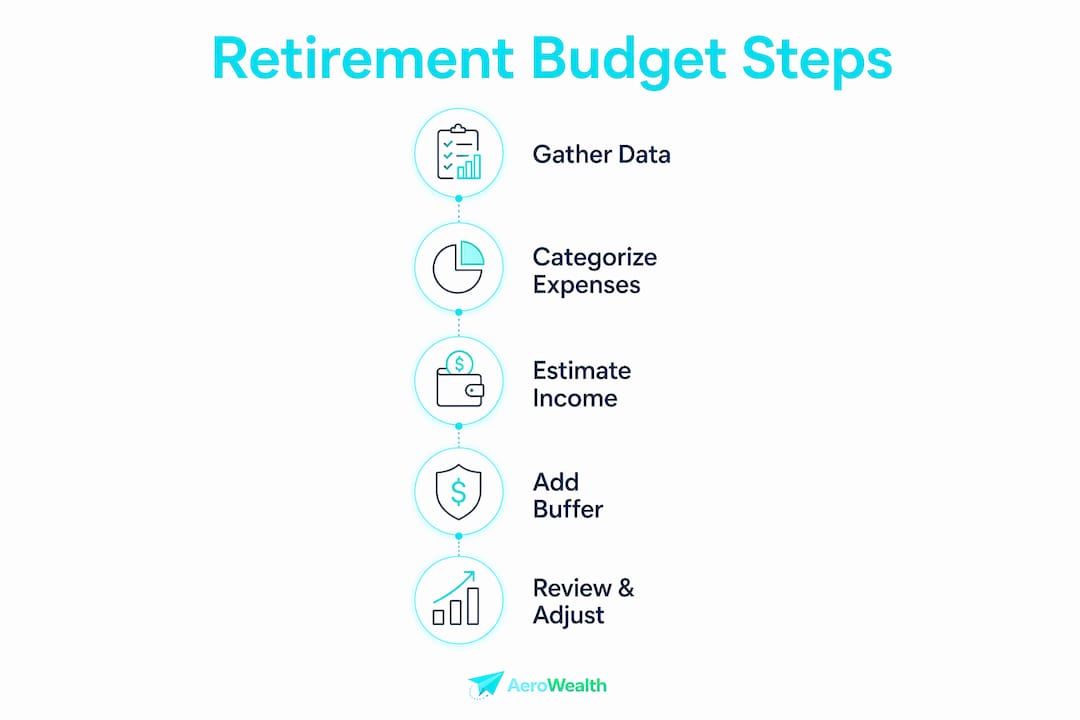
Pull 12 months of bank and credit card statements. Look for every recurring payment, every annual bill, and every irregular purchase. This is your raw material. Also collect your most recent super statement, insurance renewal notices, rates notices, and any investment income statements.

Step 2: Categorize every expense
Split costs into three buckets:
- Fixed costs: Rent or mortgage (if still paying), council rates, strata fees, utilities, insurance premiums, phone, internet, health insurance.
- Variable essential costs: Groceries, fuel, medications, GP visits, specialist appointments, home maintenance.
- Discretionary costs: Dining out, travel, hobbies, gifts, subscriptions, clothing, entertainment.
Don't forget irregular costs that don't appear monthly: car registration, home repairs, dental work, and holiday flights. These are the ones that blow budgets.
Step 3: Adjust for retirement-specific changes
Your spending in retirement won't mirror your working life. Commuting costs drop. Work clothing disappears. But travel, hobbies, and health costs often rise, especially in the first decade. Retiree spending typically peaks in early active years for travel and lifestyle, then shifts toward health-related costs later. Plan for three distinct phases:
- Active years (roughly ages 65–75): Higher discretionary spending on travel, dining, and hobbies.
- Middle years (roughly ages 75–85): Spending stabilizes; travel reduces; health costs begin rising.
- Later years (85+): Health, mobility, and potential aged-care costs dominate.
Step 4: Add a contingency buffer
Build in at least 10–15% above your estimated total for unexpected costs. Aged-care accommodation and fees, dental work, and home modifications for mobility are the three most common budget shocks retirees face.
Pro Tip: Keep a 30-day spending diary — not just bank statements. Write down every purchase, including cash. Practitioners consistently find this reveals "spending leaks": small regular purchases (daily coffee, streaming services, impulse buys) that aggregate into thousands of dollars annually and materially change long-range projections.
What "modest" and "comfortable" actually mean in the ASFA benchmarks
The ASFA Retirement Standard is the closest thing Australia has to an official retirement spending benchmark. It publishes quarterly figures for two lifestyle levels across two household types, and it's the number most financial planners, super funds, and government agencies reference when discussing retirement adequacy.
Comfortable assumes a retiree can afford private health insurance, a reasonable car, regular domestic and occasional overseas travel, good food, and leisure activities. Modest covers the basics with a little more than the Age Pension provides, but leaves limited room for extras.
ASFA annual benchmarks (current figures)
| Lifestyle | Single (annual) | Couple (annual) |
|---|---|---|
| Comfortable | $55,923 | $78,566 |
| Modest | $32,897 | $47,387 |
ASFA lump-sum targets at retirement (age 67)
| Lifestyle | Single | Couple |
|---|---|---|
| Comfortable | $630,000 | $730,000 |
| Modest | $100,000 | $100,000 |
The modest lump-sum figure is low because ASFA assumes the Age Pension covers most of a modest lifestyle. The comfortable figure assumes a much larger super balance funding the gap above the Age Pension.
Key assumptions behind the numbers
ASFA's lump-sum methodology uses a 2.75% AWE deflator and an assumed 6% investment return. It models super being drawn down to zero by age 92, with the Age Pension topping up income as the balance falls. Critically, all figures assume home ownership. A retiree who rents needs meaningfully more — the additional annual rent cost (which varies widely by city and suburb) must be added directly to the ASFA figure to get a realistic target.
If you're younger than 67 at retirement, the lump-sum target rises because your money needs to last longer. If you're older, it falls. ASFA doesn't publish figures for every retirement age, so use the MoneySmart retirement planner to interpolate for your specific situation.
Super Consumers Australia takes a different view, arguing that three spending tiers (low, medium, high) better reflect actual retiree choices than ASFA's binary split. That's worth keeping in mind if your lifestyle sits somewhere between modest and comfortable, or well above comfortable.
Income sources in retirement: how to estimate what you'll receive
Your retirement income comes from several buckets, and the mix matters as much as the total. Some income is predictable and guaranteed; some fluctuates with markets or your choices. Map each one separately.
The five primary income sources for Australian retirees:
- Age Pension: A government payment means-tested on income and assets. Check your entitlement early via Services Australia — the full single rate and couple rate change quarterly, and partial pensions are common for people with moderate super balances.
- Account-based pension (super drawdown): Flexible withdrawals from your super fund, with a government-mandated minimum drawdown percentage that rises with age. Tax-free for most retirees over 60.
- Investment income: Dividends from shares, interest from term deposits, and rental income from property. Taxable at your marginal rate outside super, so the net figure is what matters for budgeting.
- Part-time work or consulting: Many retirees work part-time in early retirement. Factor this in as temporary income, not permanent, and model what your budget looks like without it.
- Lump-sum assets: Cash savings, term deposits, or proceeds from downsizing. These can supplement income but deplete over time, so they need to be modeled carefully.
For a deeper look at how these income streams interact and sequence over time, the retirement income strategies guide covers drawdown sequencing and tax timing in detail.
Documents to pull right now
- Latest super fund statement (balance, investment option, insurance)
- ATO income tax return (last two years)
- Investment account statements (shares, managed funds, term deposits)
- Rental income statements if applicable
- Any defined benefit pension entitlement letters
Pro Tip: The Age Pension means test has two components: an income test and an assets test. The one that produces the lower pension applies. Run both tests using the Services Australia online estimator before assuming you'll receive a full or partial pension. Many people with moderate super balances qualify for a partial pension that meaningfully reduces their required drawdown.
A quick note on tax: super drawdowns for retirees over 60 are generally tax-free. Investment income outside super is not. This difference can be worth tens of thousands of dollars over a long retirement, which is why the sequencing of which assets you draw from first genuinely matters. For more on retirement income streams and their tax treatment, that's a topic worth reading before you set your withdrawal strategy.
Build your retirement budget: worksheet and sample Australian budgets
A retirement budget has one job: tell you whether your income covers your planned spending, and by how much. The worksheet below gives you the structure; the sample budgets give you a reality check.
Retirement budget worksheet (fill in your own figures)
| Category | Annual amount (AUD) |
|---|---|
| Age Pension (estimated) | $ |
| Super drawdown (planned) | $ |
| Investment income (net) | $ |
| Part-time work (if applicable) | $ |
| Other income | $ |
| Total income | $ |
| Housing (rent, rates, strata, maintenance) | $ |
| Utilities (electricity, gas, water, internet, phone) | $ |
| Groceries and household | $ |
| Health (insurance, GP, specialists, medications) | $ |
| Transport (car costs, registration, fuel, public transport) | $ |
| Insurance (home, contents, car, life) | $ |
| Leisure and travel | $ |
| Gifts and family support | $ |
| Irregular costs (dental, home repairs, appliances) | $ |
| Contingency buffer (10–15% of total expenses) | $ |
| Total expenses | $ |
| Annual surplus / shortfall | $ |
Three sample Australian budgets
The figures below are illustrative, structured around ASFA comfortable benchmarks and adjusted for housing type. They assume retirement at 67 with no mortgage.
| Budget type | Annual income | Annual expenses | Annual surplus |
|---|---|---|---|
| Homeowner single (comfortable) | $55,923 | $52,000 | ~$3,900 |
| Homeowner couple (comfortable) | $78,566 | $74,000 | ~$4,500 |
| Renter single (comfortable + rent) | $75,000 | $72,000 | ~$3,000 |
The renter single budget assumes approximately $19,000 per year in rent (a conservative figure for a modest one-bedroom in a regional or outer-suburban area). In Sydney or Melbourne, that figure could easily be $26,000–$32,000, which pushes the required income significantly higher.
Converting an annual budget to a nest egg target: If you need $55,923 per year and expect $20,000 from the Age Pension, your super needs to fund $35,923 annually. At a 4% withdrawal rate, that implies a balance of roughly $898,000. At 3.5%, it's closer to $1,026,000. The ASFA lump-sum figure of $630,000 for a comfortable single assumes the Age Pension contribution rises as the super balance falls, which is a dynamic that a flat withdrawal-rate calculation does not fully capture.
Build in a buffer for inflation. At 3% annual inflation, $55,923 today becomes roughly $75,000 in 10 years. Your withdrawal plan needs to account for that, either through indexed drawdowns or by holding growth assets long enough to keep pace.
How to convert your desired annual budget into a super balance target
The math here is simpler than most people expect, but the assumptions underneath it are where things get complicated.
The core conversion: Divide your required annual income from super by your chosen withdrawal rate. If you need $40,000 per year from super, a 4% withdrawal rate implies a — balance. A 3.5% rate implies —. A 4.5% rate implies $889,000.
The ASFA lump-sum methodology doesn't use a flat withdrawal rate. It models a declining balance drawing down to zero at age 92, with the Age Pension filling the gap as super depletes. That's why ASFA's comfortable single lump sum ($630,000) looks lower than a simple 4% rule would suggest: the Age Pension is doing meaningful work in the later years of the model.
Withdrawal rate comparison
| Withdrawal rate | Required balance for $40,000/year from super |
|---|---|
| 4.5% (optimistic) | $889,000 |
What changes the required balance most
Small shifts in assumptions produce large changes in the required balance:
- Investment return: ASFA assumes 6% per year. If your portfolio earns 4.5%, you need a larger balance or a lower withdrawal rate.
- Inflation: At 3% annually, your purchasing power halves in roughly 24 years. A 25-year retirement is not unusual.
- Life expectancy: ASFA models to age 92. If you live to 95 or 100, a balance that looked adequate at 67 may not be.
- Age Pension means test: A larger super balance reduces your Age Pension entitlement. As your balance falls in later years, your pension entitlement rises — this is the "taper" that makes ASFA's lump-sum figures work.
Pro Tip: Don't anchor to a single withdrawal rate. Model three scenarios: conservative (3.5%), base (4%), and optimistic (4.5%). The gap between conservative and optimistic tells you your planning range. If the conservative scenario still works, you're in good shape. If only the optimistic scenario works, you need either a larger balance or a lower spending target. Tools like Aerowealth run these scenario comparisons side by side so you can see the impact without building a spreadsheet from scratch.
Timing, sequencing, and risks that can reshape your retirement budget
The biggest threat to a retirement budget isn't a bad year. It's a bad year at the wrong time, combined with a spending pattern that doesn't adapt.
The central risk: Sequence-of-returns risk. A market downturn in years one through five of retirement, when your balance is at its peak and you're drawing from it, does far more damage than the same downturn in year fifteen. You sell units at low prices to fund living costs, and those units never recover for you.
Stress-test scenarios every retiree should model
- Early-retirement travel surge: You spend $25,000 more than planned in years one through three. How much does that reduce your balance at age 75?
- Mid-retirement market shock: A 25% portfolio drop in year five. At a 4% withdrawal rate, your effective withdrawal rate jumps to over 5% on the new lower balance.
- Late-life health-cost spike: Aged-care accommodation bonds (RADs) can run into hundreds of thousands of dollars. A residential aged-care entry at age 85 could require a lump sum that depletes remaining super.
- Rental increase (renters only): A 15% rent increase adds roughly $2,850 per year to a $19,000 rent bill. Over five years, that's a material budget shift.
- Downsizing windfall: Selling a family home and moving to a smaller property can inject $200,000–$500,000 into your super via the downsizer contribution scheme (for those aged 55 and over), materially extending your runway.
A simple stress-test example
Assume a comfortable single retiree with a $630,000 balance, drawing $35,923 per year from super (the gap above the Age Pension). In year three, markets fall 25%, reducing the balance to roughly $400,000 after drawdowns. At the same withdrawal rate, the effective rate is now over 9%. Without adjusting spending or drawdown, the balance depletes by age 82, not 92.
The practical response: reduce discretionary spending by 15–20% in the recovery years, draw from a cash buffer rather than selling growth assets, and reassess the plan at the two-year mark.
Practical sequencing tactics:
- Hold 1–2 years of living expenses in cash or short-term deposits as a buffer against having to sell growth assets in a downturn.
- Consider a bridge strategy if retiring before your super preservation age (currently 60): use non-super savings or investments to fund the gap years.
- Review your withdrawal rate and balance every two to three years, not just annually, especially after a significant market move.
Pro Tip: Stress-test your plan against at least three scenarios before you retire, not after. The time to discover that a 20% market drop breaks your budget is while you still have options: work an extra year, reduce planned spending, or adjust your asset allocation. Aerowealth's scenario comparison feature lets you run these tests side by side without rebuilding your numbers each time.
Government concessions that can meaningfully reduce your retirement costs
Concessions are one of the most underused tools in retirement financial management. Checking eligibility early, before you retire, can change your required savings target.
The Pensioner Concession Card (PCC) is available to Age Pension recipients and provides discounts on prescription medications under the Pharmaceutical Benefits Scheme (PBS), bulk-billed GP visits, reduced council rates in most states, discounted public transport, and reduced energy bills through state-based concession schemes. The Commonwealth Seniors Health Card (CSHC) is available to self-funded retirees of Age Pension age who don't qualify for the pension itself, and it provides PBS concessions and some state-based benefits.
Key concessions and their financial effect
| Concession | Who qualifies | Typical annual saving |
|---|---|---|
| Pensioner Concession Card | Age Pension recipients | Varies by state; PBS savings significant |
| Commonwealth Seniors Health Card | Self-funded retirees at Age Pension age | PBS concessions; state energy discounts |
| PBS concession rate | PCC or CSHC holders | Reduced co-payment per prescription |
| State energy concessions | Varies by state; generally pension card holders | $200–$500+ per year depending on state |
| State transport concessions | Varies by state | Free or heavily discounted public transport |
| Council rates concessions | Varies by council and state | $100–$400+ per year |
The PBS concession rate alone can save hundreds of dollars annually for retirees on regular medications. A retiree taking three common medications monthly at the concession co-payment rate versus the full rate saves meaningfully over a year, and more over a decade.
How to check eligibility: Services Australia's website covers Age Pension and PCC eligibility in detail. For state-based concessions, each state government runs its own concession register. In Victoria, the Concessions Victoria portal covers most state concessions in one place. In NSW, Service NSW handles most state concession applications.
Pro Tip: Apply for the Commonwealth Seniors Health Card even if you think you're over the income threshold. The threshold is higher than most self-funded retirees expect, and the card provides PBS concessions that compound in value over a long retirement. Check the current income limits on the Services Australia website before assuming you don't qualify.
A brief note on aged care: residential aged-care costs, including accommodation payments and daily fees, are means-tested and can be substantial. Factor a contingency for potential aged-care costs into your long-range plan, and seek advice from an aged-care specialist before making accommodation decisions. This is a complex area where the rules change regularly.
Where to get help and what to do next: your practical checklist
The next three actions to take today: track your actual spending for one month, benchmark it against ASFA, and model your income sources using a calculator.
Your action checklist
This week:
- Pull 12 months of bank and credit card statements.
- List every income source you expect in retirement (super, Age Pension estimate, investments, rental income, part-time work).
- Run the MoneySmart budget planner to categorize current spending.
This month:
- Keep a 30-day spending diary to catch what bank statements miss.
- Run the MoneySmart retirement planner with your actual super balance and expected retirement age.
- Check your Age Pension entitlement estimate via the Services Australia online estimator.
- Compare your estimated annual spend to the ASFA benchmarks for your household type.
- Model at least two scenarios (conservative and base case) using Aerowealth or a comparable tool.
Before you retire (or now, if already retired):
- Gather: super statements, last two tax returns, investment income statements, property valuations, insurance policies, and any defined benefit entitlement letters.
- Book a session with a licensed financial adviser who specializes in Australian retirement planning. Ask about their fee structure (fee-for-service vs commission), their experience with super drawdown strategies, and whether they hold an Australian Financial Services Licence (AFSL).
- Set a review cadence: at minimum annually, and immediately after any major life event (health change, property sale, market shock, change in household).
For a broader retirement preparation checklist, that guide covers the full sequence of steps from five years out to retirement day.
When to seek professional advice
A financial planner adds the most value when your situation involves complexity: a defined benefit pension, significant investment property, a business sale, early retirement before preservation age, or a blended household with different super balances. For straightforward situations, the free tools (MoneySmart, ASFA, Services Australia) combined with a good modelling tool can get you most of the way there.
Questions to ask a planner before engaging them: Are you a fiduciary? How are you paid? Do you specialize in retirement income planning? Can you model Age Pension means-test interactions? What software do you use for projections?
Key Takeaways
Effective budgeting in retirement requires tracking real spending, benchmarking against ASFA, mapping every income source, converting your annual target into a super balance, and reviewing the plan every two to three years.
| Point | Details |
|---|---|
| Benchmark against ASFA | A comfortable single retiree needs an amount estimated by ASFA per year for singles and couples respectively., assuming home ownership. |
| Map all income sources | Combine Age Pension, super drawdown, and investment income before calculating the gap your savings must fill. |
| Convert budget to nest egg | Divide your required super income by your withdrawal rate: $40,000/year at 4% requires a — balance. |
| Stress-test before you retire | Model a conservative (3.5%) and base (4%) withdrawal scenario; check whether a 25% market drop in year five breaks your plan. |
| Use Aerowealth to model scenarios | Aerowealth runs side-by-side scenario comparisons, Age Pension means-test modelling, and stress tests without spreadsheets. |
The retirement budget most people build is already out of date
The conventional wisdom says: estimate your expenses, check ASFA, and aim for 70% of your pre-retirement income. That's not wrong, exactly. It's just not enough.
The 70% rule is a starting point, not a plan. It doesn't account for the fact that spending in early retirement often runs higher than working life, not lower, because you finally have the time to travel, eat out, and pursue hobbies you deferred for decades. It doesn't account for the three-phase spending arc that practitioners consistently observe: active years, stable middle years, and health-heavy later years. And it doesn't account for the Age Pension means test, which interacts with your super balance in ways that change your required savings target by hundreds of thousands of dollars depending on your asset mix.
The other thing most guides underweight: the renter problem. ASFA's benchmarks assume home ownership. For the growing share of Australians who will retire as renters, the comfortable lifestyle figure is not $55,923. It's $55,923 plus whatever rent costs in their city, which in most capital cities adds $20,000–$35,000 per year to the target. That's a fundamentally different retirement savings problem, and it deserves to be treated as one.
The practical takeaway: build your budget from your actual spending, not from a rule of thumb. Use ASFA as a sanity check, not a starting point. And model the plan with real numbers, including the Age Pension interaction, before you decide you're ready to retire.
Aerowealth makes the worksheet work for you
Retirement budgeting involves a lot of moving parts: super balances, Age Pension means tests, investment returns, inflation, tax on investment income, and the timing of when you draw from which account. Doing that manually in a spreadsheet is possible, but one wrong formula or one missed assumption can send your projections off by years.
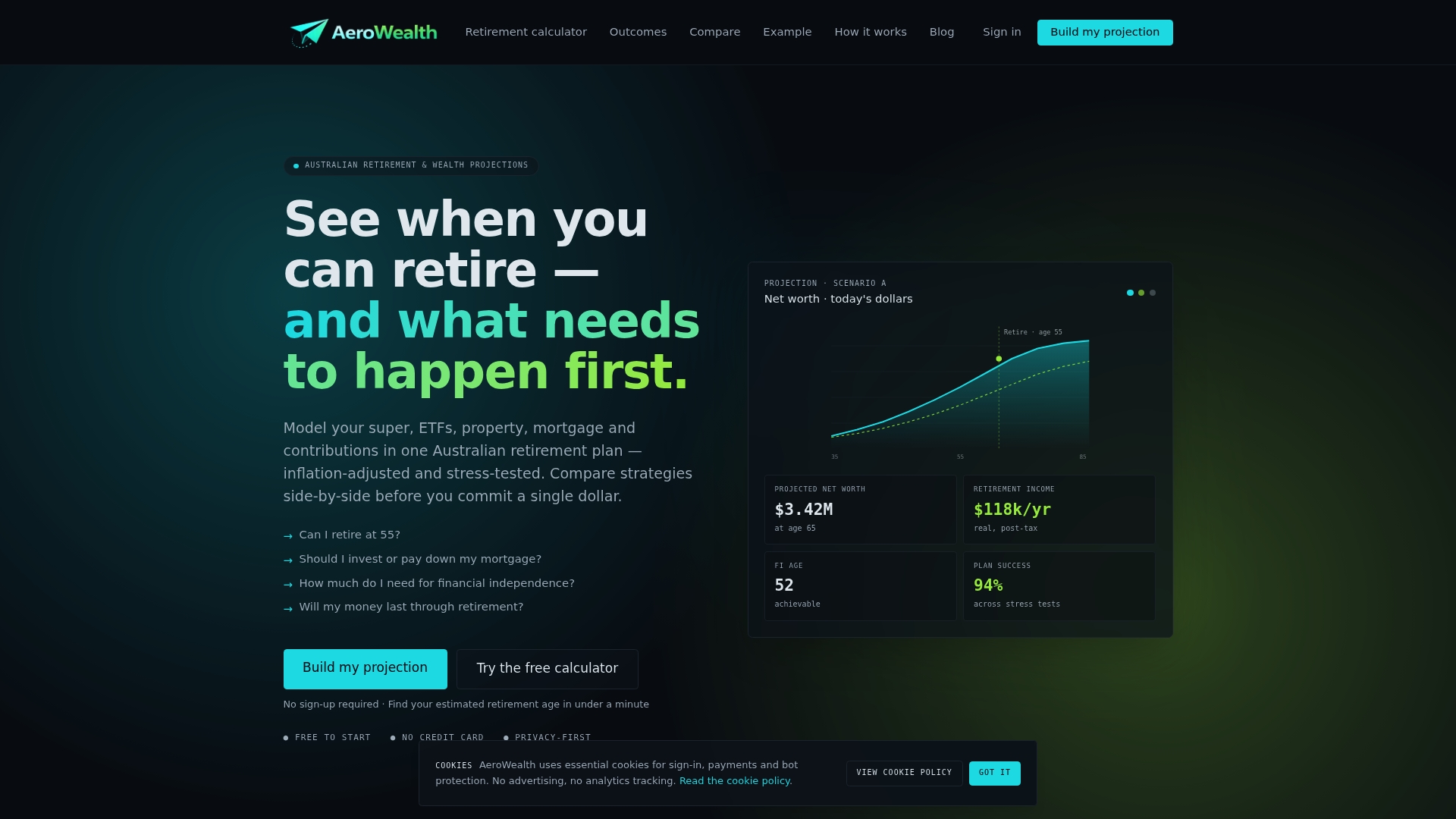
Aerowealth was built specifically for Australians working through exactly this problem. The platform lets you model your superannuation drawdown, investment property, ETFs, and mortgage offset strategies in one plan, then run side-by-side scenario comparisons to see how different decisions change your retirement age, income, and net worth. The Age Pension means test is built into the modelling, so you don't have to estimate that interaction manually. Bridge years (the gap between early retirement and your super preservation age) are modelled directly, which is a feature most spreadsheets can't handle cleanly.
The free plan gives you enough to run a base-case retirement projection and see where your numbers land against your target. The Pro plan adds expanded scenario capacity, advanced mortgage features, and a higher AI assistant quota for questions about how Australian rules apply to your specific situation. Aerowealth reports planning success rates of up to 94% for users who engage with the full scenario modelling features.
Start with a free plan at aerowealth.net and run your first scenario today. If you want to compare the free and Pro features before committing, the pricing page lays out exactly what each plan includes.
This article provides general information only and is not financial advice. For guidance specific to your situation, consult a licensed Australian financial adviser.
Useful Australian sources and calculators
| Resource | Best for | Link |
|---|---|---|
| ASFA Retirement Standard | Benchmark annual budgets and lump-sum targets for modest and comfortable lifestyles | superannuation.asn.au |
| MoneySmart retirement planner | Modelling how long savings last under different return and spending assumptions | moneysmart.gov.au |
| MoneySmart budget planner | Building and categorizing a current or projected retirement budget | moneysmart.gov.au/budgeting |
| Services Australia | Age Pension eligibility, payment rates, and online estimator | servicesaustralia.gov.au |
| Super Consumers Australia | Alternative three-tier spending model and consumer-focused super guidance | superguide.com.au |
| Aerowealth | Scenario modelling, super drawdown projections, Age Pension means-test integration, stress testing | aerowealth.net |
| Aerowealth pricing | Comparing free vs Pro plan features for retirement modelling | aerowealth.net/pricing |
FAQ
What is a realistic annual budget for retirement in Australia?
The ASFA Retirement Standard puts a comfortable lifestyle at $55,923 per year for a single retiree and $78,566 for a couple, assuming home ownership. Renters need to add their annual rent cost on top of those figures.
How much super do you need to retire comfortably in Australia?
ASFA estime qu'une personne seule a besoin d'environ 630 000 $ en super à 67 ans pour un mode de vie confortable, et un couple d'environ 730 000 $. Ces chiffres supposent que l'Allocation de retraite complète le revenu à mesure que le solde du super diminue au fil du temps.
What is the number one mistake retirees make with their budget?
Underestimating spending in early retirement is the most common error. Many retirees spend more in their active years (travel, dining, hobbies) than they planned, which depletes savings faster and leaves less buffer for health costs later.
What percentage of Australians retire with — in super?
Publicly available data doesn't give a precise percentage for — balances specifically, but the majority of Australians retire with balances well below the ASFA comfortable lump-sum targets. Around 62% of Australians aged 65 or older receive some government income support, which reflects how common it is to retire with a balance that requires Age Pension supplementation.
How often should you review your retirement budget?
Review your retirement budget at minimum once a year, and immediately after any major life event: a significant market move, a health change, a property sale, or a change in household composition. Running a scenario comparison every two to three years using a tool like Aerowealth helps you catch drift before it becomes a problem.