
MySuper is Australia's default superannuation product, designed for workers who don't actively choose where their employer contributions go. It's a privately managed, low-cost investment product offered by authorized super funds, not a government scheme. The Australian Prudential Regulation Authority (APRA) sets and enforces the standards every MySuper product must meet, covering fees, insurance, and investment transparency. Here's what that means for your retirement savings:
- Simple structure: One investment option per fund, with a clear fee schedule and no unnecessary add-ons
- Default enrollment: If you start a job and don't nominate a fund, your employer contributions flow into a MySuper product automatically
- Built-in insurance: Most MySuper products include default life and total and permanent disability (TPD) cover
- Investment approach: Typically a balanced or lifecycle strategy suited to most Australians across different life stages
- Regulated protections: APRA monitors performance, fees, and compliance continuously
Table of Contents
- How legislation shaped MySuper's regulatory framework
- How MySuper products actually work inside super funds
- How APRA and the ATO track MySuper product performance
- How to compare and choose among MySuper products
- Using retirement planning tools alongside your MySuper account
- Key Takeaways
How legislation shaped MySuper's regulatory framework
The Superannuation Legislation Amendment (MySuper Core Provisions) Act 2012 is the law that created MySuper. It passed in 2012, took effect on January 1, 2014, and by July 1, 2017, every default member account had to sit inside a MySuper product. That phased rollout gave funds time to restructure, but the end goal was firm: no more default accounts hiding in products loaded with fees members never asked for.
APRA's role goes well beyond rubber-stamping applications. The regulator authorizes each fund before it can offer a MySuper product, then monitors ongoing compliance across net returns, fee levels, and member protections. Funds that fail performance benchmarks face consequences, including potential loss of authorization.
The financial impact of that oversight has been real. MySuper's introduction is estimated to reduce total superannuation fees paid by members by around $550 million per year initially, increasing to approximately $1.7 billion per year as the reforms became fully implemented. For individual members, that translates directly to more money compounding toward retirement.
Key regulatory requirements every MySuper product must satisfy:
- A single, transparent fee structure with no hidden charges
- Standardized insurance arrangements that members can opt out of
- Annual performance reporting against APRA benchmarks
- Prohibition on exit fees when members switch funds
- Trustee obligations focused on net returns, not just gross performance
How MySuper products actually work inside super funds
Super funds offer MySuper as their default option. If you join a fund and say nothing about where you want your money invested, it goes into MySuper. You can stay there indefinitely; there's no obligation to move to a more complex product.
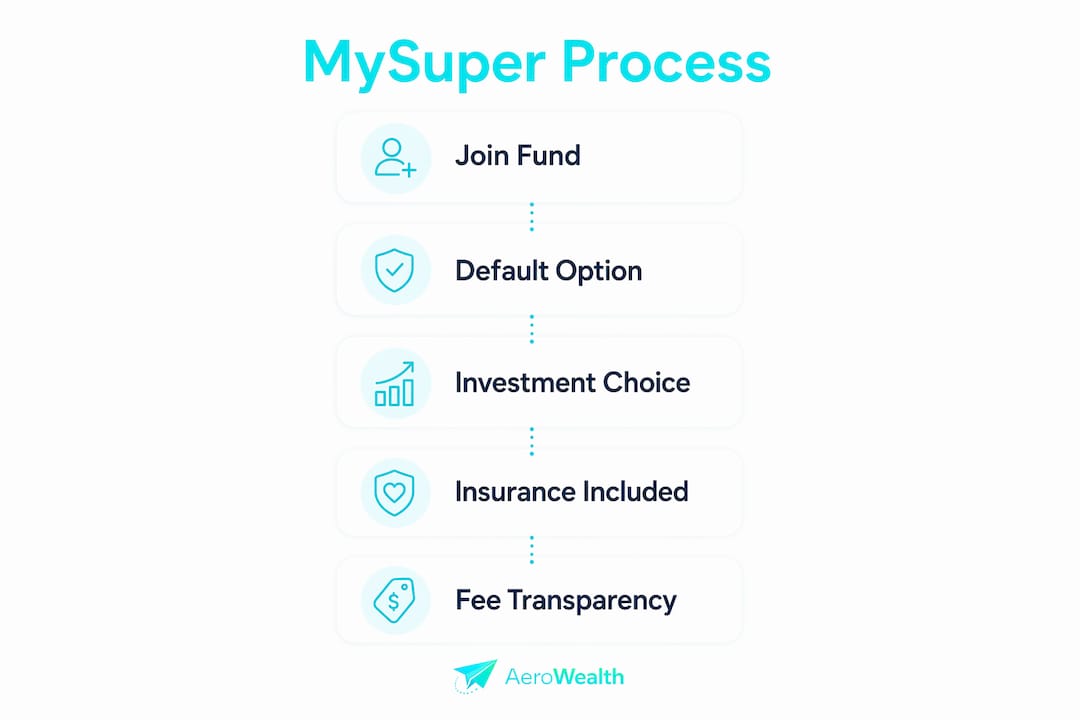
Most MySuper products use one of two investment approaches. A balanced strategy holds a mix of growth assets like shares and property alongside defensive assets like bonds and cash, targeting moderate risk across all ages. A lifecycle strategy does something different: it automatically shifts your allocation toward lower-risk assets as you get closer to retirement, so a 30-year-old and a 60-year-old in the same fund hold meaningfully different portfolios without either of them doing anything.

Insurance is included by default in most MySuper products, typically covering death, TPD, and sometimes income protection. That coverage activates automatically, which is genuinely useful for younger workers who might not think to arrange it themselves. The catch is that premiums come out of your super balance, so if you already have adequate cover elsewhere, it's worth reviewing whether you need it.
Fee structures in MySuper are standardized and disclosed clearly. You'll generally see an administration fee, an investment fee, and sometimes an indirect cost ratio. What you won't see are commissions or advice fees bundled in without your consent.
Pro Tip: Check your MySuper product's insurance terms annually. Default cover amounts are set by the fund, not by your personal circumstances, and the premiums erode your balance every year. If you're young and healthy with no dependents, the default cover may be more than you need.
How APRA and the ATO track MySuper product performance
APRA monitors MySuper product performance through metrics focused on net returns and fees, not just headline investment gains. Net returns strip out fees and costs before reporting, which gives a far more honest picture of what members actually receive. Funds that consistently underperform their benchmarks get flagged, and APRA can require remedial action.
The Australian Taxation Office runs a parallel tool for members: the YourSuper comparison tool. It displays MySuper products ranked by net returns, updated quarterly, and lets you compare up to four products side by side. If you access the personalized version through myGov, it shows your existing super accounts alongside the broader market, so you can see exactly where your fund sits.

| Feature | What it measures |
|---|---|
| Net return ranking | Annual returns after fees and taxes, updated quarterly |
| Fee comparison | Total annual fees as a percentage of balance |
| Fund size | Total assets under management |
| Insurance options | Default cover types and opt-out availability |
| Performance history | Multi-year return data for trend assessment |
Long-term net returns matter far more than any single year's result. A fund that outperforms in one year but charges high fees will often trail a lower-cost fund over a decade. The YourSuper tool's quarterly updates make it practical to check in regularly without needing a financial adviser to interpret the data.
How to compare and choose among MySuper products
The YourSuper comparison tool is the most straightforward starting point. It's free, government-run, and pulls from the same data APRA uses for regulatory oversight. Start there before looking anywhere else.
When you're comparing products, focus on these criteria:
- Net returns over 5–10 years: Short-term performance is noisy; longer periods reveal genuine consistency
- Total annual fees: Even a 0.5% fee difference compounds significantly over decades
- Insurance coverage and cost: Compare what's included and what it costs against your actual needs
- Investment strategy: Balanced vs. lifecycle, and whether the risk profile fits your age and goals
- Fund size and stability: Larger funds often have lower costs due to scale, though size alone isn't a guarantee of performance
Switching MySuper products is straightforward. You can request a transfer through your new fund or via myGov, and exit fees are banned by law. Your balance, including any insurance, transfers across. The main thing to check before switching is whether your existing insurance cover will lapse during the transition, since some funds require you to reapply if you've had a gap in membership.
Pro Tip: When comparing funds on YourSuper, look at the 7-year net return column rather than the most recent year. Markets move in cycles, and a fund that looks great over one year may simply have had a good run in a rising market. Consistency across a full cycle tells you more.
Self-Managed Super Funds (SMSFs) come up as an alternative, but they're a different proposition entirely. An SMSF requires you to act as trustee, handle compliance duties, prepare annual accounts, and arrange your own audit. That overhead is generally only worth it for balances above $200,000; below that threshold, the fixed costs of running an SMSF typically eat into returns faster than a well-run MySuper product would.
Using retirement planning tools alongside your MySuper account
Understanding your MySuper account details is one thing. Knowing how those details interact with your mortgage, investment property, and planned retirement age is another challenge entirely. That's where dedicated retirement modeling tools add real value.
Aerowealth is built specifically for Australians who want to see how their super balance, contributions, and other assets combine into a retirement outcome. The platform lets you model scenarios side by side, so you can compare, for example, what happens if you increase voluntary contributions now versus paying down your mortgage faster. You can also stress-test assumptions, running projections under different market conditions to see how resilient your plan is.
Key things you can do with a retirement planning tool like Aerowealth:
- Project your super balance at retirement under different contribution rates
- Model bridge years between early retirement and your super preservation age
- Compare the impact of switching to a lower-fee MySuper product on your final balance
- Integrate property, ETFs, and mortgage offset strategies into one retirement picture
- Use the AI assistant to explain how Australian tax rules affect your projections
Aerowealth reports planning success rates of up to 94%, which reflects how much clearer retirement decisions become when you can see the numbers rather than guess at them. For anyone preparing to retire in Australia, pairing official tools like YourSuper with a full-picture modeling platform closes the gap between knowing your super balance and actually understanding your retirement readiness. You can explore how super fits your retirement plan without needing a spreadsheet or a financial adviser to set it up.

Ready to see how your MySuper account fits into your full retirement picture? Aerowealth lets you model your super, property, and income side by side, so you can make decisions with confidence rather than guesswork. Try the free plan and see your projected retirement age in minutes.
Key Takeaways
MySuper is a regulated, low-cost default superannuation product that reduces fees by an estimated significant amount per year for Australian members while providing automatic insurance and transparent investment options.
| Point | Details |
|---|---|
| MySuper is a default product | If you don't choose a fund, employer contributions go into a MySuper product automatically. |
| APRA enforces the standards | Every MySuper product must meet fee, insurance, and performance requirements set by APRA. |
| Fee savings are substantial | MySuper reforms are estimated to reduce total member fees by around $550 million per year initially, reaching approximately $1.7 billion per year as the reforms are fully embedded. |
| Use YourSuper to compare | The ATO's YourSuper tool ranks MySuper products by net returns, updated quarterly, for free. |
| Long-term net returns matter most | Compare 7-year or 10-year net returns, not single-year results, when evaluating MySuper products. |