
A tax write off for investment property is the process of deducting eligible expenses and depreciation from your taxable income to reduce the tax you owe on rental income. Under Australian tax law, the Australian Taxation Office (ATO) permits property investors to claim a wide range of deductions, from loan interest and management fees to Division 40 and Division 43 depreciation. These deductions can significantly reduce your taxable income, and in some cases, create a rental loss that offsets your salary through negative gearing. Knowing exactly which costs qualify, and how to claim them correctly, is the difference between a good investment and a great one.
What expenses are deductible for rental properties in Australia?
Immediate deductions are available for holding costs like loan interest, council rates, landlord insurance, and property management fees, but only for periods when the property is rented or genuinely available for rent. That last condition matters more than most investors realize. If you block out weeks for personal use or leave the property vacant without actively advertising it, the ATO will disallow deductions for those periods.
The most common deductible expenses rental property investors claim include:
- Loan interest: Only the interest portion of your mortgage repayments qualifies. Principal repayments are not deductible. Annual interest costs typically range from $15,000 to $40,000 depending on your loan size.
- Property management fees: Agents typically charge 7–10% of weekly rent. That fee is fully deductible.
- Council rates and water charges: Both qualify as holding costs and are deductible in the year you pay them.
- Landlord insurance: Fully deductible. Many investors miss this one entirely.
- Body corporate fees: Ordinary body corporate fees are deductible, but the portion allocated to a capital sinking fund must be depreciated instead of claimed immediately.
- Pest control, cleaning, and gardening: Fully deductible when the property is tenanted or available for rent.
- Tax agent fees: The portion of your accountant's fee that relates to your rental property return is deductible.
Borrowing costs require special treatment. Loan establishment fees, mortgage broker fees, and lender's mortgage insurance must be amortized over five years or the loan term, whichever is shorter, if they exceed $100. If they total $100 or less, you claim the full amount immediately.
Pro Tip: Keep a dedicated folder, physical or digital, for every invoice, receipt, and statement related to your property. The ATO can audit claims up to five years back, and missing paperwork means disallowed deductions.

How does depreciation work for investment properties?
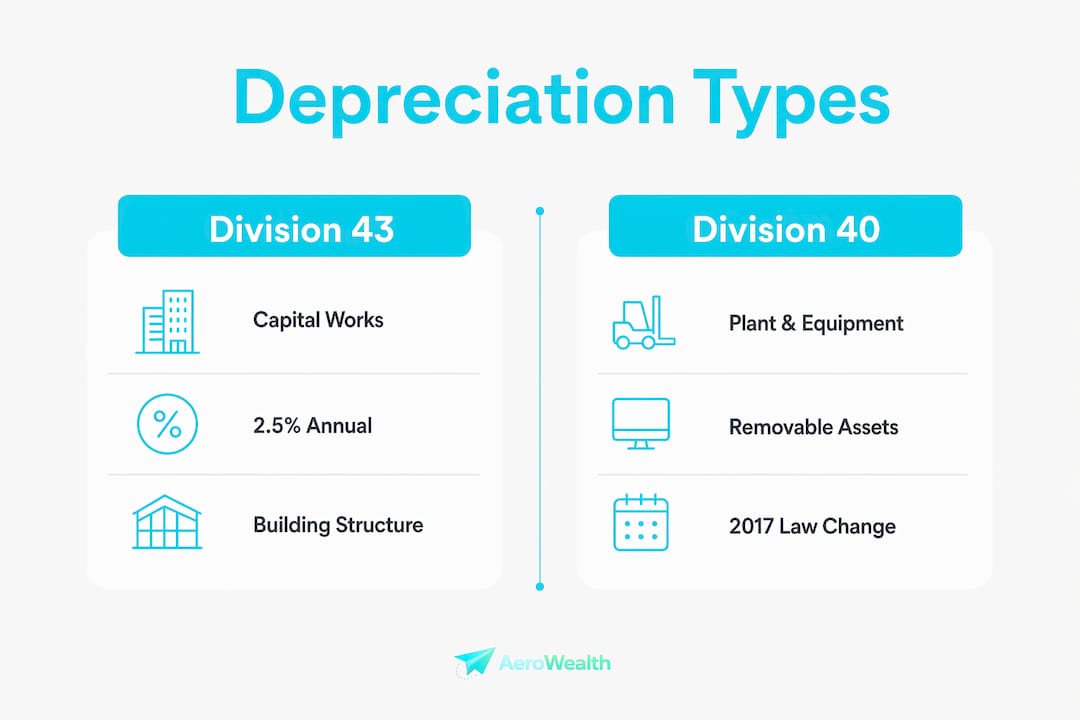
Depreciation is the most misunderstood and most underused deduction available to Australian property investors. The ATO splits it into two categories: Division 43 (capital works) and Division 40 (plant and equipment).
Division 43: Capital works depreciation
Division 43 allows a flat 2.5% annual deduction on the original construction cost of the building over 40 years, for properties built after September 16, 1987. That means a property that cost $300,000 to construct generates $7,500 in deductions every year, purely from the building structure itself. Division 43 claims are not affected by whether you bought the property new or second-hand, which makes them the more reliable deduction for established property buyers.
Division 40: Plant and equipment depreciation
Division 40 covers removable assets inside the property: ovens, dishwashers, carpet, blinds, and air conditioning units. Each asset depreciates over its effective life using either the prime cost method (equal deductions each year) or the diminishing value method (larger deductions early on).
| Feature | Division 43 | Division 40 |
|---|---|---|
| What it covers | Building structure and fixed assets | Removable plant and equipment |
| Depreciation rate | 2.5% per year flat | Varies by asset effective life |
| Eligible properties | Built after September 16, 1987 | New assets only (post-May 9, 2017 purchases) |
| Affected by 2017 law change | No | Yes, second-hand assets excluded |
The 2017 law change is critical. For properties bought after May 9, 2017, Division 40 claims apply only to assets you personally purchase and install new. Second-hand assets in an existing property are no longer deductible under Division 40. That shift made Division 43 the primary depreciation tool for most investors buying established homes.
A quantity surveyor's depreciation schedule covers both divisions and is worth every dollar. Reports typically cost $500–$770 and are fully deductible, yet they routinely identify thousands of dollars in annual deductions that investors miss when self-assessing.
Pro Tip: Commission a quantity surveyor's report the year you buy the property, not years later. Depreciation deductions are not retrospective beyond the current and prior year, so delays cost you real money.
How to claim tax deductions on your investment property
Claiming investment property tax deductions correctly requires more than just collecting receipts. Follow these steps to stay compliant and maximize your return.
-
Confirm the property is genuinely available for rent. The ATO requires properties to be listed at market rates or managed by an agent during any period you claim deductions. Advertising the property at an unrealistic rent to keep it vacant does not qualify.
-
Separate personal use periods. If you or a family member uses the property for any part of the year, you must apportion all expenses. Claim only the percentage of the year the property was rented or available for rent.
-
Categorize every expense correctly. Repairs restore the property to its original condition and are immediately deductible. Capital improvements add value or extend the property's life and must be depreciated. A new hot water system replacing a broken one is a repair. Adding a second bathroom is an improvement.
-
Amortize borrowing costs properly. Spread loan establishment fees, lender's mortgage insurance, and mortgage broker fees over five years or the loan term, whichever ends first. Do not claim the full amount in year one unless the total is $100 or less.
-
Claim pre-paid expenses correctly. You can claim a pre-paid expense in the year you pay it if the service period does not extend beyond 12 months past the payment date. This applies to landlord insurance paid annually in advance.
-
Lodge with a qualified tax agent. Tax agent fees for the rental section of your return are themselves deductible. A good accountant familiar with property tax will find deductions you would otherwise miss.
Pro Tip: Review your deductions every financial year before June 30. Prepaying landlord insurance or scheduling repairs before year-end can shift deductions into the current tax year and reduce your bill immediately.
Common mistakes when claiming investment property deductions
The ATO scrutinizes rental property claims closely, and certain errors appear repeatedly across investor tax returns.
- Claiming principal repayments as interest. Only the interest component of your loan is deductible. Investors who claim the full repayment amount face automatic disallowance and potential penalties.
- Misclassifying improvements as repairs. Fixing a leaking roof is a repair and immediately deductible. Installing a new deck is a capital improvement and must be depreciated. The ATO audits these classifications heavily, so detailed invoices describing the exact work done are non-negotiable.
- Ignoring landlord insurance and quantity surveyor fees. Many first-time investors overlook these deductions, missing out on hundreds to thousands of dollars in legitimate claims each year.
- Failing to apportion expenses for mixed use. Correct apportionment of expenses when a property has private use or is unavailable for rent is one of the most common compliance issues leading to audits.
- Claiming Division 40 depreciation on second-hand assets post-2017. Investors who buy established properties and attempt to depreciate existing carpets or appliances under Division 40 are breaching the 2017 rule change. Division 43 remains available, but Division 40 does not apply to inherited second-hand assets.
Negative gearing allows rental losses to offset other income, reducing overall taxable income. This benefit is most powerful for investors on higher marginal tax rates, where every dollar of deduction saves more at tax time. Maximizing legitimate deductions is the foundation of any effective negative gearing strategy.
Key Takeaways
The most effective approach to writing off investment property expenses is to claim every eligible deduction, apply the correct depreciation method under Division 40 or Division 43, and keep records that satisfy ATO scrutiny.
| Point | Details |
|---|---|
| Claim all holding costs | Loan interest, council rates, insurance, and management fees are immediately deductible when the property is rented. |
| Use Division 43 for established properties | Capital works depreciation at 2.5% per year applies regardless of whether you bought the property new or second-hand. |
| Commission a depreciation schedule | A quantity surveyor's report costs $500–$770 and is fully deductible, often returning thousands in annual deductions. |
| Separate repairs from improvements | Repairs are immediately deductible; capital improvements must be depreciated over time. |
| Apportion expenses for mixed use | Claim only the percentage of costs that corresponds to the period the property was rented or available for rent. |
What I've learned about maximizing property tax write-offs
At Aerowealth, we work with Australian investors across a wide range of property portfolios, and the pattern is consistent. Investors who treat tax deductions as an afterthought leave real money on the table every single year.
The biggest missed opportunity is almost always the quantity surveyor's report. Investors assume they can self-assess depreciation or that their accountant will handle it. Most accountants are not quantity surveyors. They cannot legally estimate construction costs or asset values. A qualified quantity surveyor produces a schedule that covers both Division 43 and Division 40 assets, lasts the life of the property, and costs less than one week's rent on most properties.
The second pattern we see is poor record-keeping in the early years of ownership. Investors lose invoices, forget to document repairs, and then face an audit with no supporting evidence. The fix is simple. Set up a dedicated folder the day you settle on the property and treat every receipt as a tax document.
The third lesson is staying current with ATO rulings. The 2017 Division 40 change caught many investors off guard. Legislative updates happen, and the investors who read the Aerowealth blog or work with proactive advisors adapt before they file, not after.
Tax deductions do not change the fundamentals of a property investment. But they do change the cash flow, and cash flow determines how long you can hold the asset. Getting the deductions right is not a bonus. It is part of the investment strategy.
— Aerowealth Team
How Aerowealth helps you see the full picture
Understanding your tax deductions is one piece of the puzzle. Seeing how those deductions interact with your mortgage, superannuation, and retirement timeline is where real planning begins.

Aerowealth is built specifically for Australian investors who want to model exactly that. The platform lets you run side-by-side retirement scenarios that incorporate property income, depreciation deductions, and loan structures, so you can see how your investment property affects your retirement age and net worth before you make decisions. Aerowealth's planning tools achieve success rates of up to 94%, giving you confidence that your numbers reflect reality. Visit the Aerowealth pricing page to find the plan that fits your portfolio.
FAQ
What is a tax write off for an investment property?
A tax write off for an investment property is a deductible expense or depreciation claim that reduces your taxable rental income. The ATO allows deductions for costs like loan interest, management fees, repairs, and depreciation under Division 40 and Division 43.
Can I claim depreciation on a second-hand investment property?
Division 43 capital works depreciation applies to second-hand properties built after September 16, 1987, at 2.5% per year. Division 40 plant and equipment depreciation is restricted to new assets you personally purchase and install for properties bought after May 9, 2017.
What records do I need to claim investment property deductions?
The ATO requires invoices, receipts, bank statements, and a depreciation schedule for all claimed deductions. You must also show evidence that the property was genuinely available for rent during the period you are claiming.
Are property management fees tax deductible in Australia?
Property management fees are fully deductible as a rental expense. Agents typically charge 7–10% of weekly rent, and that entire amount qualifies as a deductible expense rental property investors can claim each financial year.
How does negative gearing relate to investment property deductions?
Negative gearing occurs when your deductible expenses exceed your rental income, creating a loss. That loss offsets your other income, such as your salary, reducing your overall tax bill. The benefit is greatest for investors on higher marginal tax rates.